 Tiny Timeline
Weaning your baby: when and how to start solid foods
A calm, evidence-based UK guide to starting your baby on solid foods — when to begin, the signs they are ready, what to offer first, and how to wean safely.
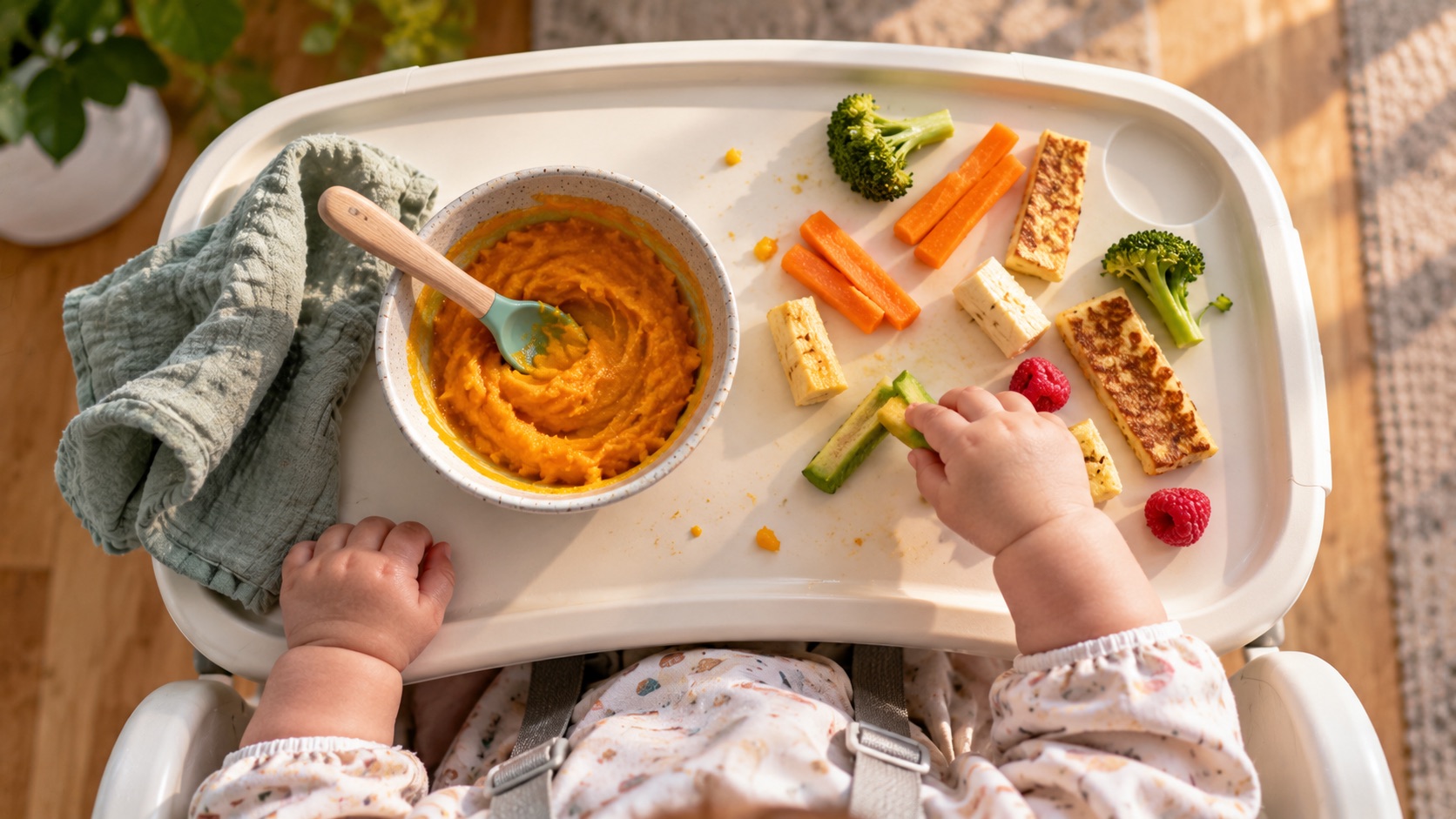
What is weaning?
Weaning means slowly introducing your baby to solid foods alongside their usual breast milk or formula. The NHS also calls this complementary feeding, because at first solid food adds to milk rather than replacing it.[1] The NHS Start for Life service describes it as starting "when your baby is around 6 months old".[2]
In the early weeks, the aim is not to fill your baby up. It is to help them get used to new tastes, new textures and the skill of moving food around their mouth. Milk stays their main source of energy and nutrients for some time yet. Over the following months, solid food gradually becomes a bigger part of their diet.
When should you start weaning your baby?
Start introducing solid foods when your baby is around 6 months old. The NHS says weaning "should start when your baby is around 6 months old".[1] This is echoed by the UK government's expert nutrition committee, SACN (the Scientific Advisory Committee on Nutrition), which advises that "solid foods should not be introduced until around 6 months to benefit the child's overall health".[6]
Every baby is different, so "around 6 months" is a guide, not a fixed date on the calendar. What matters is that your baby shows they are ready (see the signs below) and that you do not start too early.
Why around 6 months?
Until about 6 months, milk gives your baby everything they need. In the NHS's words, "breast milk or first infant formula provide the energy and nutrients your baby needs until they're around 6 months old".[1] Waiting also gives your baby's body time to develop so they "can cope fully with solid foods".[1]
Internationally, the World Health Organization (WHO) gives similar advice: babies should "breastfeed exclusively … for the first 6 months of life", after which "safe complementary (solid) foods are introduced from six months".[9]
Why not before 4 months?
Solid foods should never be started before 4 months (about 17 weeks). UK allergy specialists at BSACI advise introducing solids "from approximately 6 months old (not before 4 months)".[7] The charity Anaphylaxis UK gives the same floor: "from around six months of age (but not before four months)".[8]
Before about 4 months, a baby's swallowing and digestion are not ready for solid food, and starting too soon can mean they take less of the milk they still need. If you are thinking about starting between 4 and 6 months for any reason, talk to your health visitor first.
How do you know your baby is ready?
The NHS describes three clear signs that, together, show a baby is ready. Most babies do not show all three until around 6 months.[1] Your baby is likely ready when they can:
- Sit up and hold their head steady — "stay in a sitting position and hold their head steady".[1]
- Coordinate eyes, hands and mouth — "look at the food, pick it up and put it in their mouth by themselves".[1]
- Swallow food — "swallow food (rather than spit it back out)".[1]
Signs that are often mistaken for readiness
Some very normal baby behaviours are easy to read as "my baby wants food", but on their own they are not signs of readiness. The NHS lists three common ones:[1]
- chewing their fists
- waking up in the night more than usual
- wanting extra milk feeds
As the NHS puts it, "these are all normal behaviours for babies and not necessarily a sign that they're hungry or ready to start solid food".[1] A growth spurt, for example, can cause extra milk feeds without meaning your baby needs solids.
What are the best first foods?
Simple, single foods are a good place to start. The NHS suggests beginning with single vegetables and fruits — "mashed or soft, cooked sticks of parsnip, broccoli, potato, yam, sweet potato, carrot, apple or pear".[1] Offering plenty of vegetables early, not just sweeter fruits, helps your baby get used to a range of flavours.
Include iron-rich foods. From around 6 months a baby's own iron stores begin to run low, so iron from food becomes important. The NHS advises you "include food that contains iron, such as meat, fish, fortified breakfast cereals, dark green vegetables, beans and lentils".[1] SACN agrees that "a wide range of solid foods, including foods containing iron, should be introduced from around 6 months of age".[6]
Aim for variety. A wide mix of tastes and textures helps your baby learn to enjoy different foods. SACN says these foods "should have different textures and flavours".[6]
Moving on through textures
Your baby does not need to stay on smooth purées for long. The NHS suggests you "move your baby on from puréed or blended foods to mashed, lumpy or finger foods as soon as they can manage them".[1] Lumps and soft finger foods give your baby practice at chewing and moving food around their mouth, which also helps with speech later on.
Spoon-feeding or baby-led weaning — which is better?
There are two common styles of weaning, and UK guidance does not tell you to pick one. Spoon-feeding (the purée or "traditional" method) means you offer smooth or mashed food on a spoon. Baby-led weaning (BLW) means you offer soft finger foods and let your baby feed themselves from the start.
Neither approach is officially recommended over the other, and many families combine them — for example, some spoon-fed purée and some soft finger foods at the same meal. Whichever you choose, the same rules apply: start around 6 months, include iron-rich foods, offer variety, move on through textures, and follow the safety steps below.[1]
| Aspect | Spoon-feeding (purées) | Baby-led weaning (BLW) |
|---|---|---|
| How food is offered | You offer smooth or mashed food on a spoon | Baby picks up soft finger foods and feeds themselves |
| Usual starting texture | Smooth or blended, moving on to lumps | Soft finger foods from the start |
| Learning to self-feed | Comes a little later, as you add finger foods | Practised from the very beginning |
| Mess | Usually less | Usually more |
| Seeing how much is eaten | Easier to judge amounts | Harder to judge; more may be dropped early on |
| Choking safety | Supervise at all times; gagging can still happen | Supervise at all times; offer soft, safe shapes |
| Can you combine the two? | Yes — mixing both is fine and common, to suit your baby and your family | |
Keeping mealtimes safe
Two simple habits prevent most problems. First, always stay with your baby while they eat. The NHS is clear: "always stay with your baby when they're eating in case they start to choke".[1] Never leave a baby alone with food, even for a moment.
Second, sit your baby upright. The NHS says your baby "needs to be sitting safely in an upright position (so they can swallow properly)".[1] Do not feed a baby who is lying back, slumped, or in a moving car seat or bouncer.
Gagging and choking are not the same
Gagging is common and normal while babies learn to eat. It is the body's way of pushing food forward if it goes too far back. Gagging is noisy. The NHS says "gagging is loud", and your baby's skin "may also look red when they're gagging".[4] A gagging baby is usually sorting the food out themselves, so try to stay calm and let them.
Choking is different, and it is silent. The NHS warns that "choking is quiet".[4] A choking baby cannot cry, cough or make much noise, and their skin, lips, gums or fingernails may start to look blue.[4] This is an emergency.
If your baby is choking, act at once
Remember: serious choking is usually silent. A choking baby cannot cry, cough or breathe. The NHS says to "shout for help", get your baby out of the high chair, and give firm back blows "between the shoulder blades".[4] If the choking continues, call 999. Because seconds matter, it is well worth learning infant first aid before you start weaning.
Preparing foods to prevent choking
Small, round, hard or sticky foods are the main risks. Prepare them safely:
- Cut small round foods up. The NHS says "cut small, round foods, like grapes and cherry tomatoes, into quarters (4 small pieces)".[1]
- Remove hard bits. "Remove hard pips and stones from fruits, and bones from meat or fish".[1]
- Soften hard foods. "Avoid hard foods like whole nuts, or raw carrot or apple".[1] Cook or grate hard fruit and vegetables so they are soft.
- No whole nuts under 5. "Whole nuts should not be given to children under 5 years old, as they can choke on them".[3] You can still give nuts crushed, ground, or as a smooth nut butter spread onto food — but "do not give nut butter on its own as your child could choke on it".[3]
- Watch sticky textures. "Raw jelly cubes can be a choking hazard for babies and young children".[3]
Introducing allergens safely
Foods that commonly cause allergies can, and should, be introduced during weaning — there is no need to leave them out. From around 6 months, offer them one at a time so you can spot any reaction. The NHS advises you "introduce the foods that can trigger allergic reactions one at a time so that you can spot any reaction".[5]
Introduce each new allergen in a small amount, ideally earlier in the day, and wait a couple of days before the next. If your baby is fine with it, keep it in their diet: the NHS says that "once introduced and if tolerated, these foods should become part of your baby's usual diet to minimise the risk of allergy".[5] Anaphylaxis UK suggests offering them "regularly (ideally at least a couple of times a week)".[8]
Do not delay peanut and egg. This is one of the biggest changes in modern advice. The NHS warns that "delaying the introduction of peanut and hen's eggs beyond 6 to 12 months may increase the risk of developing an allergy to these foods".[5] SACN reaches the same conclusion, that "the deliberate exclusion of peanuts or hen's egg beyond 6 to 12 months of age may increase the risk of allergy".[6] BSACI adds that introducing these foods "within the first year of life appears to be safe".[7] Serve peanut as smooth peanut butter or finely ground (never whole), and egg well cooked unless it carries the British Lion mark.[5]
The common allergen foods. The NHS lists the foods to introduce one at a time and watch:[5]
- eggs
- peanuts and other nuts (finely ground, or as nut butter)
- cows' milk (in cooking or on food; not as a main drink under 1)
- foods containing gluten — wheat, barley and rye
- beans, lentils and peas
- seeds, especially sesame (finely ground)
- soya
- shellfish (not raw or lightly cooked)
- fish
- celery
- mustard
- sulphur dioxide (sometimes found in dried fruit and fruit juice)
Higher-risk babies: get advice first
Some babies are more likely to develop a food allergy. The NHS says that "if your baby already has an allergy, such as a diagnosed food allergy or eczema, or if you have a family history of food allergies, eczema, asthma or hay fever … talk to your GP or health visitor first".[5] BSACI similarly recommends that parents of "infants with pre-existing food allergy and/or severe eczema speak to a healthcare professional for advice on allergen introduction".[7] Getting advice rarely means avoiding allergens — usually it means introducing them in a planned, safe way.
Spotting a reaction
Reactions "usually happen quickly, within a few minutes", though they can take up to two hours to appear — and, for cows' milk, sometimes days.[5] Mild signs the NHS lists include "swollen lips or face", red or itchy watery eyes, a red itchy rash, wheezing or coughing, worsening eczema, being sick, tummy pain, or diarrhoea.[5] If you notice mild signs, stop that food and speak to your GP or health visitor.
When to call 999
A severe allergic reaction, called anaphylaxis, is a medical emergency. The NHS says it "can cause breathing problems, a swollen throat or tongue, or a raised, itchy rash" and "needs urgent treatment".[5] Call 999 straight away if your baby has any swelling of the lips, mouth, throat or tongue, or any difficulty breathing. Do not wait to see if it passes.
Foods to avoid
A few foods are not safe or not suitable for babies:
- Honey — not until age 1. "Do not give your child honey until they're over 1 year old." Honey can occasionally contain bacteria that "produce toxins in a baby's intestines, leading to infant botulism, which is a very serious illness".[3]
- Salt. "Babies should not eat much salt, as it's not good for their kidneys." Do not add salt to food or cooking water, and avoid stock cubes and gravy, which are "often high in salt".[3]
- Sugar. "Your baby does not need sugar." Skipping sugary snacks and drinks (including fruit juice) helps "prevent tooth decay".[3]
- Saturated fat. "Do not give your child too many foods that are high in saturated fat, such as crisps, biscuits and cakes".[3]
- Some cheeses. Pasteurised full-fat cheese is fine from 6 months, but avoid "mould-ripened soft cheeses, such as brie or camembert", ripened goats' cheese and soft blue-veined cheese.[3]
- Raw or lightly cooked eggs without the British Lion mark. These "should be cooked until both the white and yolk are solid".[3]
- Rice drinks. "Children under 5 years old should not have rice drinks as a substitute for breast milk or infant formula", as they may contain too much arsenic.[3]
When to get advice or urgent help
Speak to a health professional if…
Weaning is usually straightforward, but ask your health visitor or GP for advice in these situations:
- Your baby was born prematurely. The NHS says: "if your baby was born prematurely, ask your health visitor or GP for advice on when to start introducing solid foods".[1] The right time may not be worked out from their birth date alone.
- Your baby has a medical condition, a diagnosed food allergy, or severe eczema. Get tailored advice before you introduce allergens.[5][7]
- Your baby is around 6 to 7 months and shows no interest in solids, or cannot manage to move on from milk. Your health visitor can help.
And remember: call 999 for any severe allergic reaction — swelling of the lips, mouth, throat or tongue, or difficulty breathing.[5]
Frequently asked questions
Can I start weaning at 4 or 5 months?
The advice is to wait until around 6 months, and never to start before 4 months.[7][8] If you think your baby may be ready between 4 and 6 months, talk to your health visitor. Signs like chewing fists or waking at night are not, on their own, signs of readiness.[1]
Do I have to choose between purées and baby-led weaning?
No. UK guidance does not favour one method, and you can combine them. The important things are starting around 6 months, offering iron-rich foods and variety, and moving on through textures safely.[1]
How do I give peanut and egg safely?
Introduce them from around 6 months, one at a time, and do not delay them.[5][6] Give peanut as smooth peanut butter or finely ground (never whole nuts under 5), and egg well cooked unless it carries the British Lion mark.[3][5] If tolerated, keep them in the diet regularly.[5][8]
My baby gagged — should I worry?
Gagging is common and usually not dangerous. It is noisy, and your baby may go red as they push the food forward.[4] Choking is different: it is silent, and the baby cannot make a noise or breathe. That is an emergency — call 999.[4]
Does my baby still need milk?
Yes. Breast milk or first infant formula stays your baby's main drink through the first year, with solids added alongside.[1][9] Cows' milk can be used in cooking from around 6 months, but should not be a main drink until 12 months.[5]
Can I give my baby the same meals as the family?
Yes, gradually — as long as you leave out salt, sugar and stock, and prepare foods safely (cutting round foods up and removing hard bits).[1][3] Sharing family food helps your baby learn to enjoy the same meals as everyone else.
Key takeaways
- Start solids at around 6 months, and never before 4 months.[1][7]
- Look for the three signs of readiness: sitting up with a steady head, hand-eye-mouth coordination, and swallowing (not spitting) food.[1]
- Offer iron-rich foods and plenty of variety, and move on through textures.[1][6]
- Stay with your baby and sit them upright. Remember: gagging is loud, choking is silent.[1][4]
- Introduce allergens one at a time from around 6 months, and do not delay peanut and egg.[5][6]
- No honey under 1, no added salt or sugar, and no whole nuts under 5.[3]
- Get advice for premature or higher-risk babies, and call 999 for a severe allergic reaction.[1][5][7]
How Tiny Timeline can help
When you are introducing new foods, especially common allergens one at a time, a quick log of what your baby tried and when makes it easy to keep track and to notice any reaction. Tiny Timeline is a baby tracker, not a medical device, and nothing here replaces advice from your GP or health visitor.
References
- NHS – Your baby's first solid foods. https://www.nhs.uk/conditions/baby/weaning-and-feeding/babys-first-solid-foods/ (Last reviewed 19 February 2026 (next review 19 February 2029))
- NHS Start for Life (Best Start in Life) – Weaning. https://www.nhs.uk/start-for-life/baby/weaning/ (Accessed 11 September 2026)
- NHS – Foods to avoid giving babies and young children. https://www.nhs.uk/conditions/baby/weaning-and-feeding/foods-to-avoid-giving-babies-and-young-children/ (Last reviewed 18 February 2026)
- NHS Start for Life (Best Start in Life) – Choking and gagging on food (safe weaning). https://www.nhs.uk/start-for-life/baby/weaning/safe-weaning/ (Accessed 11 September 2026)
- NHS – Food allergies in babies and young children. https://www.nhs.uk/baby/weaning-and-feeding/food-allergies-in-babies-and-young-children/ (Last reviewed 22 October 2024)
- Scientific Advisory Committee on Nutrition (SACN), Public Health England / GOV.UK – Feeding in the first year of life (recommendations via the GOV.UK news release; full report on assets.publishing.service.gov.uk). https://www.gov.uk/government/news/sacn-publishes-feeding-in-the-first-year-of-life-report (Published 17 July 2018)
- British Society for Allergy and Clinical Immunology (BSACI) – Early introduction of food allergens. https://www.bsaci.org/resources/allergy-management/food-allergy/allergy-prevention/early-introduction-of-food-allergens/ (Accessed 11 September 2026)
- Anaphylaxis UK – Infant Weaning Guide. https://www.anaphylaxis.org.uk/living-with-serious-allergies/infant-weaning/ (Accessed 11 September 2026)
- World Health Organization – Infant and young child feeding (fact sheet). https://www.who.int/news-room/fact-sheets/detail/infant-and-young-child-feeding (Updated 4 August 2026 (International))