 Tiny Timeline
Baby Fever: When to Worry and Call 111 or 999
A high temperature in a tiny baby is one of the most frightening moments in early parenthood. This calm, evidence-based UK guide explains what actually counts as a fever, how to check a temperature properly, and exactly when to look after your baby at home, call NHS 111 or your GP, or dial 999. The rules are different for the youngest babies, so we start there.
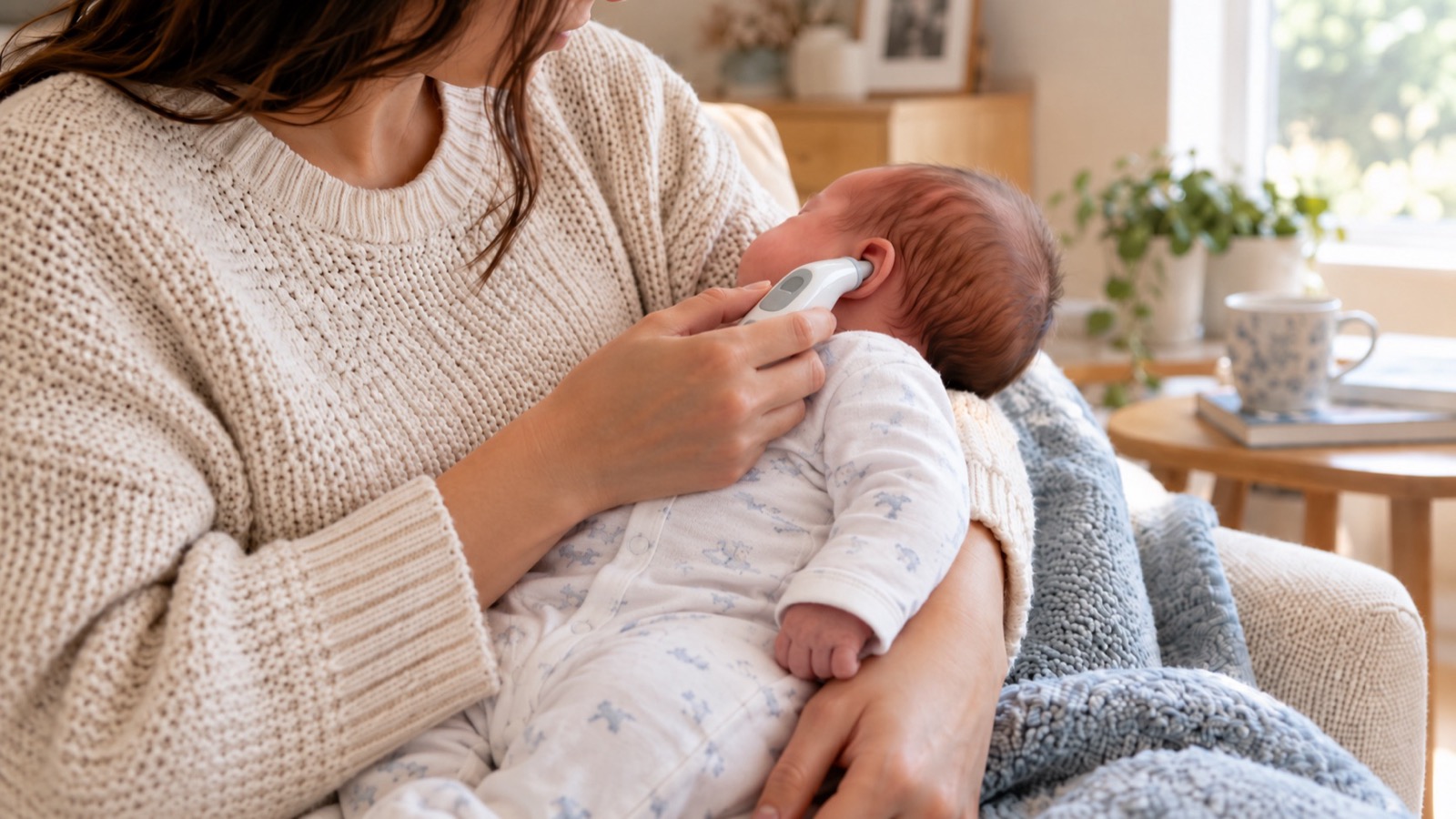
Quick answer: what is a fever, and when should I get help?
A fever is a temperature of 38C or above.[1] In a baby under 3 months, 38C or higher always needs urgent medical advice, so contact your GP urgently or call NHS 111 now.[1] Call 999 for a stiff neck, a rash that does not fade under a glass, a first fit, or breathing difficulty.[1]
When your baby feels hot and their cheeks are flushed, it is hard to think straight. Fever itself is not an illness. It is a sign that your baby's body is fighting something off, usually a common virus.[1] Most fevers in babies settle on their own. What matters is knowing the few signs that mean you should act quickly, and how urgent it is for your baby's age. This guide walks you through it, gently and in plain English.
When to get urgent help
Call 999 or go to A&E now if your baby has any of these signs. They can point to sepsis or meningitis, which are rare but need treatment fast:[1][3][4]
- A rash that does not fade when you press the side of a clear glass firmly against the skin.[1][4]
- A stiff neck, or is bothered by light.[1]
- A fit or seizure for the first time, when they cannot stop shaking.[1]
- Difficulty breathing: grunting noises, breathing very fast, or the tummy sucking in under the ribcage.[1][3]
- Skin, lips or tongue that look blue, grey, pale or blotchy. This is harder to see on brown or black skin, so also check the palms of the hands, the soles of the feet, the gums and inside the lips.[1][3]
- Very sleepy and hard to wake, floppy or unresponsive, or a weak, high-pitched or continuous cry.[1][3][4]
- Unusually cold hands and feet, or a temperature below 36C.[1][3]
- Not feeding, or not responding the way they normally do.[1][3]
Contact your GP urgently or call NHS 111 now if your baby is under 3 months with a temperature of 38C or higher, is 3 to 6 months with 39C or higher, has a fever lasting 5 days or more, will not eat or is not their usual self, or shows signs of dehydration such as fewer wet nappies, sunken eyes, or no tears when crying.[1]
You know your baby. A child with sepsis or meningitis may not have every sign listed, so if you feel something is seriously wrong, get help straight away and say plainly that you are worried.[3][4]
What is a fever, and why do babies catch them so easily?
A normal temperature in babies and children is about 36.4C, although this varies a little from child to child.[2] A high temperature, or fever, is usually a temperature of 38C or above.[1][2] Rather than a single number to dread, it helps to picture a fever as your baby's immune system turning up the heat to make life harder for germs.
Fever is a symptom, not an illness in its own right. A high temperature is very common in young children, and it is the body's natural response to fighting infections like coughs and colds.[1] The reassuring part is that it usually returns to normal within 1 to 4 days.[1] Your baby's body raises its temperature on purpose as part of that fight, which is why a fever so often comes hand in hand with a cold or an ear infection.
Small bodies also heat up and cool down faster than ours, and newborns are still learning to hold a steady temperature. That is partly why babies seem to spike a fever quickly, sometimes within an hour or two of the first snuffle. It is also why the surroundings matter so much.
Plenty of everyday things can nudge a reading upwards without any illness at all. A temperature can read higher if your baby has been wrapped up tightly in a blanket, is in a very warm room, has been very active, is wearing a lot of clothes, has been cuddling a hot water bottle, or has just had a bath.[2] So before you worry, take off a layer, move to a cooler spot, wait a few minutes, and check again.
Here is the reassuring part. A high number on the thermometer is not the same as a serious illness. The NHS advice on when to seek help is built around your baby's age and a short list of specific warning signs, not around chasing a temperature down.[1] How your baby looks and behaves tells you far more than the exact reading. The one big exception is age, which is where we go next.
Fever by age: why under 3 months is different
The single most important question is how old your baby is. A temperature that would mean home care in a toddler is treated as urgent in a newborn. Here is what the NHS advises for each stage, in line with the NICE guideline for fever in the under 5s.[1][6]
Under 3 months: always urgent
In a baby under 3 months old, a temperature of 38C or higher should always be checked urgently, even if your baby otherwise seems well.[1] Contact your GP urgently or call NHS 111 now.[1] In the youngest babies a fever is much harder to read, and it can be the only early clue to a serious infection, which is why the advice is so cautious.[3] Please do not wait to see if it passes, and do not reach for medicine to bring the number down instead of getting advice. This is the group where acting quickly matters most.
3 to 6 months: watch closely
Between 3 and 6 months, contact your GP or call NHS 111 if your baby has a temperature of 39C or higher.[1] You should also seek advice at a lower temperature if there are other signs of illness such as a rash, if your baby will not feed, is not their usual self, or if you are simply worried.[1] Trust that instinct. It is always fine to ring 111 for reassurance.
6 months and older: judge by how they seem
From around 6 months, healthy babies and toddlers usually cope with fevers better, and there is no single temperature that spells danger on its own.[1] Focus on how your child looks and behaves. Contact your GP or call 111 if a fever lasts 5 days or more, if your child does not want to eat or is not their usual self and you are worried, or if they show signs of dehydration such as nappies that are not very wet, sunken eyes, and no tears when crying.[1] Whatever your baby's age, use the 999 signs in the red box above at any time.
| Age | Temperature to act on | What to do |
|---|---|---|
| Under 3 months | 38C or higher | Contact your GP urgently or call NHS 111 now, even if your baby seems well[1] |
| 3 to 6 months | 39C or higher, or lower with other signs of illness | Contact your GP or call NHS 111[1] |
| 6 months and older | No single danger number; judge by how they look and behave | Usually home care; call 111 if unwell, not eating, dehydrated, or the fever lasts 5 days or more[1] |
| Any age | Any red-flag sign (see the urgent box above) | Call 999 or go to A&E[1][3][4] |
How to take your baby's temperature accurately
A wildly high reading from the wrong kind of thermometer can cause needless panic, so it is worth taking the temperature well. Ideally, use a digital thermometer, which gives a fast, accurate reading.[2] For children under 5, always take the temperature in the armpit.[2]
- Sit your baby comfortably on your knee.[2]
- Place the thermometer inside the top of the armpit, against the skin, and gently close the arm over it.[2]
- Hold their arm firmly against their body to keep the thermometer in place for as long as the instructions say, usually about 15 seconds. Many digital thermometers beep when they are done.[2]
- Read the number, and make a note of the time so you can see whether it is rising or settling later.
Two common thermometers are less reliable in babies. Forehead strip thermometers are held against the forehead and are not an accurate way of taking a temperature.[2] Ear, or tympanic, thermometers can give misleading readings if they are not put in the ear correctly, which is more likely to happen with babies.[2] If your only reading is high but came from one of these, take off a layer and check again in the armpit before you act.
Finally, remember the everyday things that raise a reading, such as a warm room, lots of clothes, or a recent bath.[2] If in doubt, cool the room a little, wait, and measure again.
How to help a feverish baby at home
Once you have ruled out the urgent signs and your baby is old enough to look after at home, the aim is comfort, not chasing the number down. Most feverish babies simply need fluids, rest and a watchful eye.
Keep fluids going. Offer your baby plenty of fluids, and keep up their usual breast or bottle feeds.[1] Small, frequent amounts often work best. Wet nappies are a handy sign that your baby is drinking enough, so keep half an eye on them.
Keep them comfortable, not cold. It is tempting to strip a hot baby off or wipe them down with cool water, but the NHS advises against this: do not undress your child or sponge them down to cool them.[1] Dress them in an amount of clothing that is comfortable for the room, and keep them somewhere neither too hot nor too cold.
Medicine, only if it helps them feel better. You can give either paracetamol or ibuprofen if your baby is distressed or uncomfortable, rather than simply to lower the reading.[1] Do not alternate the two unless a health professional such as a doctor or nurse tells you to.[1] Always follow the dosing on the label, and check with your pharmacist or the BNF for Children, because some medicines are not suitable for the youngest babies and doses depend on age and weight.[1][7] Never guess a dose. One important point: for a baby under 3 months, get medical advice first rather than reaching for medicine.[1]
Keep watching. Check on your child regularly, including through the night.[1] Fevers can change quickly, so re-take the temperature now and then, and review the urgent signs above if anything shifts.
Sepsis and meningitis: the signs that mean 999
Two serious infections worry parents most: sepsis and meningitis. Both are uncommon, and a fever alone is almost never either of them. But because they move fast, it is worth knowing the signs so you can act without hesitation.
The rash and the glass test. With meningitis, a rash usually starts as small red pinpricks before spreading quickly into red or purple blotches.[4] The rash does not fade if you press the side of a clear glass firmly against the skin.[4] On brown or black skin the rash can be harder to see, so check paler areas such as the palms of the hands, the soles of the feet, the roof of the mouth, the whites of the eyes, or inside the eyelids.[4] Crucially, not everyone with meningitis gets a rash, and it can be a late sign, so never wait for a rash before getting help.[4]
Other meningitis signs in a baby include a high temperature, being sick, a bulging soft spot on the top of the head, a stiff body or being floppy and unresponsive, a high-pitched unusual cry, being very sleepy and hard to wake, and very cold hands and feet.[4]
Signs that can point to sepsis include breathing very fast or with difficulty, blue, grey, pale or blotchy skin, lips or tongue, a weak, high-pitched or continuous cry, not feeding, being difficult to wake or more sleepy than usual, and not having had a wee for 12 hours.[3] On black or brown skin, colour changes may be easier to see on the palms of the hands or the soles of the feet.[3]
A baby with sepsis or meningitis might not show every sign. If you or your child are unwell and you think something is seriously wrong, get immediate medical help and trust your instincts.[3][4]
Frequently asked questions
What temperature is a fever in a baby in Celsius? A fever is a temperature of 38C or above.[1] A normal temperature in babies and children is about 36.4C, and it can vary a little between children and across the day.[2] Remember that a warm room, extra layers or a recent bath can push a reading up without any illness.[2]
When should I call 111 about my baby's fever? Contact your GP urgently or call NHS 111 if your baby is under 3 months with a temperature of 38C or higher, is 3 to 6 months with 39C or higher, has a fever lasting 5 days or more, does not want to eat or is not their usual self and you are worried, or is dehydrated with fewer wet nappies, sunken eyes or no tears.[1] Use 999 for the red-flag signs above.
Can I give paracetamol and ibuprofen together? Give either paracetamol or ibuprofen, whichever suits your baby, if they are distressed or uncomfortable.[1] Do not alternate or switch between the two unless a doctor or nurse tells you to.[1] Follow the label, check the BNF for Children if unsure, and never guess a dose, as some medicines are not suitable for the youngest babies.[1][7] For a baby under 3 months, get medical advice before giving any fever medicine.[1]
How do I take my baby's temperature without a fancy thermometer? A simple digital thermometer used in the armpit is all you need, and it is the most accurate option for children under 5.[2] Hold it in place for about 15 seconds, or until it beeps.[2] Avoid forehead strip thermometers, which are not accurate, and be aware that ear thermometers are easy to misread in babies.[2]
My baby had a fit with their fever. Is that dangerous? A febrile seizure, sometimes called a febrile convulsion or fit, can happen when a young child has a high temperature, most often between 6 months and 6 years.[5] It is frightening to watch, but it is unlikely to harm your child or cause long-term effects.[5] Call 999 if it is their first seizure, if it lasts more than 5 minutes, or if they have more than one within 24 hours, and remember a child needs to be checked in hospital after a first febrile seizure.[5]
Should I worry more if the number is very high, like 40C? A very high reading is understandably scary, but the exact number is only part of the picture. Beyond the age thresholds already covered, NHS advice is built around how your baby looks and specific warning signs, not a single danger temperature.[1] Keep offering fluids, use the age guidance above, and act on any 999 sign whatever the thermometer says.
My baby got a temperature after their jabs. Is that normal? Babies can feel a bit unwell or warm for a day or two after some vaccinations. The team who vaccinated your baby will have explained what to expect and what to do about a temperature, so follow that specific advice and the NHS vaccination information. If your baby seems unwell in other ways, or you are worried, use the same warning signs in this guide, seek advice, and trust your instincts.
Key takeaways
- A fever is 38C or above. Normal is about 36.4C, and a warm room or extra layers can raise a reading without any illness.[1][2]
- Age changes everything. Under 3 months, 38C or higher always needs urgent advice; at 3 to 6 months, act on 39C or higher; from 6 months, judge by how your baby seems.[1]
- Measure in the armpit with a digital thermometer for children under 5, holding it for about 15 seconds. Forehead strips and ear thermometers are less reliable in babies.[2]
- At home, aim for comfort. Offer plenty of fluids, do not undress or sponge your baby down, and give paracetamol or ibuprofen only if they are distressed, following the label.[1]
- Call 999 for a rash that does not fade under a glass, a stiff neck, a first fit, breathing difficulty, or blue, grey, pale or blotchy skin, checking palms, soles and gums on brown and black skin.[1][3][4]
- Trust your instincts. Sepsis and meningitis do not always show every sign, so if something feels seriously wrong, get help straight away.[3][4]
How Tiny Timeline helps when your baby has a fever
At 2am, with a hot, grizzly baby, it is hard to hold all the details in your head. Tiny Timeline is built to carry some of that load for you, so you can focus on your baby rather than on remembering numbers.
The temperature log lets you record each reading with the time it was taken. Over a few hours that turns a jumble of memories into a clear line you can actually see, which makes it easier to tell whether a fever is climbing or settling. If you do end up speaking to 111 or your GP, you can read out exactly what the temperature has been doing and when, which is far more useful than a vague sense that it has been high.
The medicine timer records when you last gave paracetamol or ibuprofen and when the next dose is due, following the timing on the label. Because the log is shared, your partner, a grandparent or a babysitter can all see the same picture, which quietly removes those anxious 3am questions like did you already give the Calpol. It is a simple way to avoid an accidental double dose when more than one person is helping.
None of this replaces medical advice, and the app will never tell you a dose or a diagnosis. Think of it as a calm, shared notebook that helps you follow the guidance on this page, and helps you tell your baby's story clearly to the people who can help.
How Tiny Timeline can help
Tiny Timeline lets you log each temperature reading with the time, so you can see at a glance whether a fever is climbing or settling, and show the pattern to your GP or 111. The medicine timer records when you last gave paracetamol or ibuprofen, so anyone caring for your baby can see it too and no one doses twice by mistake. Tiny Timeline is a baby tracker, not a medical device, and nothing here replaces advice from your GP or health visitor.
References
- NHS: High temperature (fever) in children. https://www.nhs.uk/symptoms/fever-in-children/
- NHS: How to take your baby's temperature. https://www.nhs.uk/baby/health/how-to-take-your-babys-temperature/
- NHS: Sepsis. https://www.nhs.uk/conditions/sepsis/
- NHS: Meningitis. https://www.nhs.uk/conditions/meningitis/
- NHS: Febrile seizures. https://www.nhs.uk/conditions/febrile-seizures/
- NICE: Fever in under 5s, assessment and initial management (NG143). https://www.nice.org.uk/guidance/ng143
- BNF for Children (NICE): medicines and doses. https://bnfc.nice.org.uk/