 Tiny Timeline
Baby Teething Symptoms: Real Signs and Safe Soothing
Teething gets blamed for almost every grizzly night, yet the real signs are surprisingly mild. This calm, evidence-based UK guide explains what teething actually looks like, the rough order your baby's teeth arrive in, and the safe, simple ways to soothe sore gums. Just as importantly, it draws a clear line between ordinary teething and genuine illness. A high fever, diarrhoea or a truly unwell baby is never just teething, and deserves to be checked.
Quick answer: what are the signs of teething?
Teething usually starts at around 6 months. The common signs are sore, red gums, one flushed cheek, extra dribbling, lots of chewing and being more fretful than usual.[1] Crucially, teething does not cause a high fever, diarrhoea or serious illness, so a genuinely unwell baby should be checked, not put down to teething.[1][4]
That first tooth is a lovely milestone, but the weeks around it can be miserable for everyone. Your baby is grizzly, soaking through bibs and chewing their fists, and you are left wondering what is teething and what is something more. This calm, NHS-based guide walks you through the real signs, the safe ways to help, and the clear line between teething and illness.
When it might not be teething: see your GP
Teething gets blamed for almost everything, but it only causes mild symptoms.[1] If your baby seems genuinely unwell, please do not put it down to teething. Trust your instincts and get them checked.
Contact your GP or call NHS 111 if your baby:[1][4]
- Has a temperature of 38C or above. This is a fever, and teething does not cause a fever.[1][4] It is urgent in a baby under 3 months at 38C or higher, and in a baby 3 to 6 months at 39C or higher.[4]
- Has diarrhoea or is being sick, will not feed, or is not their usual self.[1]
- Has any symptom that is worrying you. You know your baby best.[1]
Call 999 or go to A&E now if your baby:[4]
- Has a rash that does not fade when you press the side of a clear glass firmly against the skin.[4]
- Has a stiff neck, or is bothered by light.[4]
- Has a fit or seizure for the first time.[4]
- Has difficulty breathing, is breathing very fast, or you notice grunting or the tummy sucking in under the ribs.[4]
- Has blue, grey, pale or blotchy skin, lips or tongue. This is harder to see on brown and black skin, so also check the palms, soles, gums and inside the lips.[4]
- Is very sleepy and hard to wake.[4]
None of these are teething. They can be signs of a real illness that needs treating quickly, so act on them whatever else is going on in your baby's mouth.[4]
What teething really looks like
Teething is simply a new tooth pushing its way up through the gum. It can ache for a few days before the tooth appears, then settle once it breaks through. Every baby is different. Some sail through with barely a grumble, while others find it genuinely uncomfortable for a while.
According to the NHS, the usual signs that your baby is teething are:[1]
- their gum is sore and red where the tooth is coming through
- their temperature is slightly raised, but stays below 38C
- they have one flushed cheek
- they have a rash on their face
- they are rubbing their ear
- they are dribbling more than usual
- they are gnawing and chewing on things a lot
- they are more fretful than usual
- they are not sleeping very well
Notice the common thread: these are all mild, and they come and go as each tooth moves. The extra dribble is normal too, and it is why the chin, bib and everything within reach ends up soggy. A little rash on the chin from the wetness is common, and a soft barrier cream can protect the skin.
Here is the part that matters most. Teething only nudges the temperature up a touch, and it stays under 38C.[1] A reading of 38C or more is a fever, and a fever is not caused by teething.[1][4] The same goes for a runny nappy: some people think teething causes diarrhoea, but there is no evidence for this.[1] Teething also does not cause vomiting, a bad cough, or a baby who is floppy and hard to rouse. If any of that appears, something else is going on and deserves looking at in its own right.
This is not about worry, it is about protecting your baby. When a genuine illness is waved away as "just teething", the thing that needs treating can be missed. So enjoy the mild signs for what they are, and keep the warning signs above at the front of your mind.[1]
When do babies start teething? The order teeth come through
Most babies get their first tooth at around 6 months.[1] After that, teeth tend to arrive in a fairly predictable order, usually in pairs, with the bottom front teeth often leading the way. The timings below are a guide from the NHS, not a deadline, so try not to measure your baby against them too closely.
| Teeth | Roughly when they appear |
|---|---|
| Central incisors (front teeth) | Usually first, at around 6 months[1] |
| Lateral incisors (either side of the front teeth) | Around 8 months[1] |
| First molars (back teeth) | Around 12 months[1] |
| Canines (pointed teeth between the lateral incisors and first molars) | Around 18 months[1] |
| Second molars | Around 24 months[1] |
By around two and a half, most children have their full set of 20 baby teeth. The big back molars can be more uncomfortable than the little front ones, so do not be surprised if the first birthday brings fresh grizzling.
What about babies who do not follow the script? Timing varies enormously, and that is almost always normal. A few babies are born with a tooth already showing. Others reach their first birthday with a gummy grin and no teeth at all. Both can be perfectly healthy, and late teeth on their own rarely signal anything wrong.
If your baby has no teeth by around 12 to 18 months and you are anxious, there is no harm in mentioning it. Your health visitor or dentist can offer reassurance. The order can be jumbled too, and a tooth arriving out of sequence is not a problem.
One gentle myth to retire: an unsettled patch does not always mean a tooth is on the way. Because babies teethe on and off for two years or more, it is tempting to blame every unsettled night on the next tooth. Sometimes it is teething, and sometimes it is a growth spurt or the start of a cold. A rough note of what you see helps you tell the difference over time.
How to soothe a teething baby safely
The simplest, cheapest options are also the safest, and the ones the NHS recommends first.[2] The goal is comfort: helping your baby feel a bit better while the tooth does its thing, not curing anything.
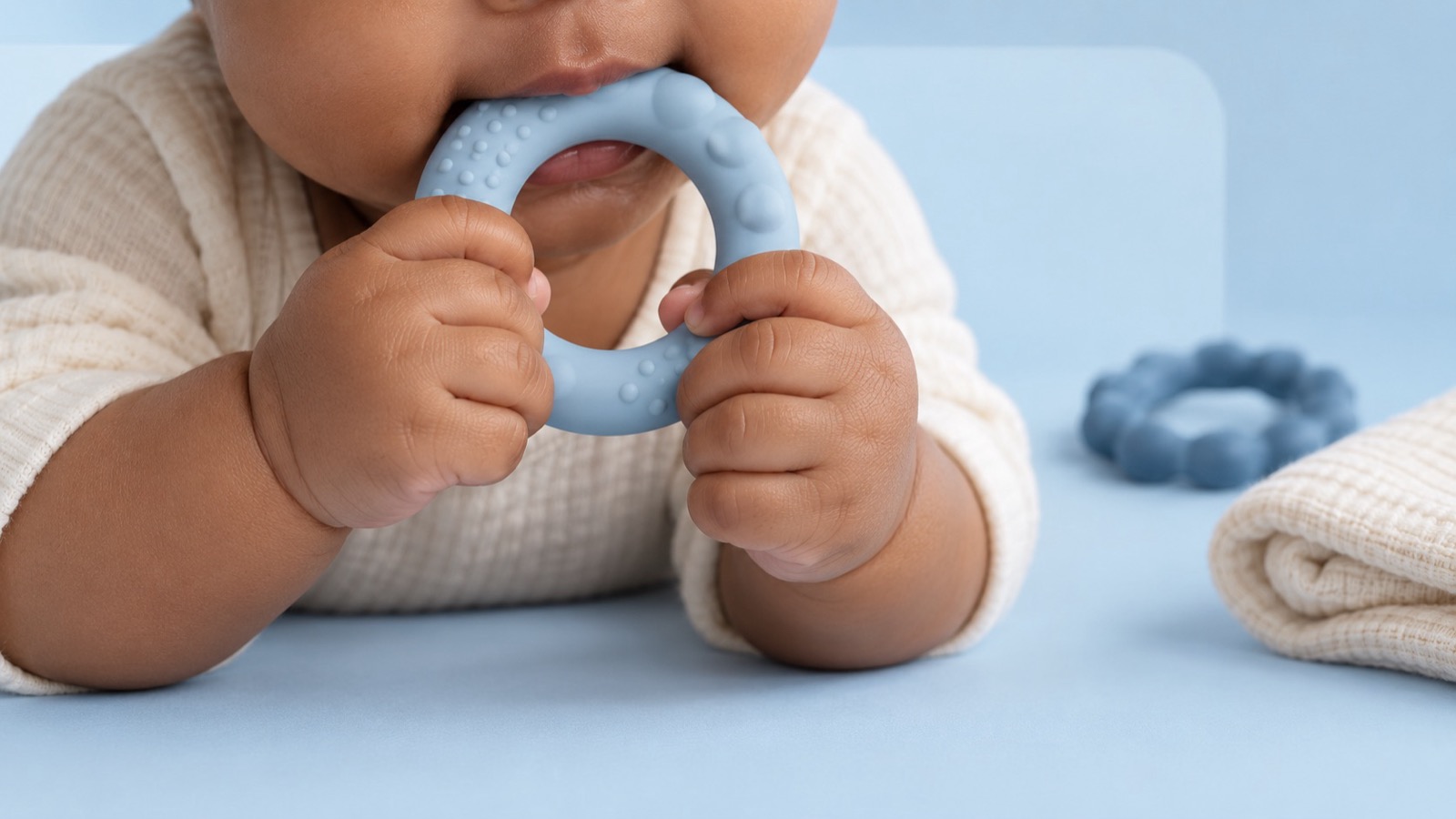
Something to chew. A teething ring gives your baby something to chew safely, which may ease the discomfort and distract them.[2] You can cool it in the fridge first to soothe the gums a little more.[2] Two safety points. Never put a teething ring in the freezer, because a frozen ring can damage the gums.[2] And never tie it, or anything else, around your baby's neck, as it is a choking hazard.[2]
A clean, cool flannel. If you do not have a teething ring to hand, a clean flannel or muslin, cooled in the fridge, gives your baby something soft and cold to gnaw on. Keep it cool rather than frozen, and stay with your baby while they chew.
Gentle gum rubbing. Gently rubbing your baby's gums with a clean finger may also help.[2] Many babies find the steady pressure comforting, and it is something you can do anywhere, at any hour, with nothing but clean hands.
Comfort and distraction. Never underestimate a cuddle. Comforting or playing with your baby can distract them from any pain in their gums.[2] Extra closeness, a favourite song, or a walk in the pram can all break the cycle of grizzling.
Something cool to chew if they are weaning. If your baby is 6 months or older and has started solids, you can offer healthy things to chew on, such as raw fruit and vegetables.[2] Soft fruit like melon, or a chilled (not frozen) piece of cucumber, can feel wonderful on sore gums. Always stay with your baby while they eat, and offer pieces big enough to hold but not small enough to choke on. It is best to avoid rusks and other sugary foods, which can cause tooth decay even when your child has only a few teeth.[2]
Gentler feeds. Sore gums can make feeding fussy for a while. Some babies pull off the breast or bottle, feed in shorter bursts, or want to comfort-feed more often. This usually passes as the tooth settles. Offer calm, unhurried feeds, and try not to worry about a temporary dip, as long as your baby is having plenty of wet nappies and is otherwise well.
Simple pain relief, if they really need it. If your baby is in real discomfort and the options above are not enough, a sugar-free painkilling medicine can help. Paracetamol can be given for teething symptoms from 2 months of age, and ibuprofen from 3 months.[2] Choose a sugar-free version, always follow the instructions with the medicine, and never guess a dose.[2] If you are unsure, or your baby is very young, speak to your pharmacist or GP.[2] Medicine is a backup for a genuinely uncomfortable baby, not a routine part of teething.
Teething products to avoid, and why
A whole industry has grown up around teething, and some of it is at best useless and at worst dangerous. Here is what to leave on the shelf.
Unlicensed teething gels. There is a lack of evidence that teething gels are effective.[2] In the UK, gels containing the local anaesthetic lidocaine are now sold only in pharmacies.[7] A safety review found a lack of evidence of benefit over simple non-medicine options.[7] Try the gentle methods above first, and treat a gel as a last resort, ideally after talking to your pharmacist.[7] Steer clear of unlicensed gels sold online or abroad, which are not regulated and may not be safe.
Amber teething necklaces. These are widely sold, but they are not safe. Amber teething jewellery, including necklaces, bracelets and anklets, can choke or strangle a child under 3.[8] The advice is clear: never use them, and never put any cord, string or chain around a baby's neck.[8] Safety regulators have received reports of death and serious injury, including strangulation and choking, caused by teething jewellery such as amber necklaces.[9] There is no good evidence they relieve pain, so the risk is not worth taking.
Homeopathic teething granules and tablets. These are best avoided too. Homeopathic products marketed for babies and children have been found to contain belladonna, also known as deadly nightshade.[10] One made without careful manufacturing controls can end up far stronger than its label claims, which puts children at risk.[10] There is no reliable evidence they work. With a genuine safety concern and no proven benefit, stick with the NHS-approved comfort methods above.
Teething or illness? How to tell the difference
When your baby is unsettled, this table can help you sort mild teething from something that needs a professional eye. When in doubt, always use the warning signs in the urgent box near the top of this guide.
| Sign | Likely teething | Get medical advice (not teething) |
|---|---|---|
| Temperature | Slightly warm, but under 38C[1] | 38C or above, which is a fever[1][4] |
| Gums and mouth | Red, sore gums where a tooth is pushing through[1] | Sore mouth with a rash, blisters or refusing all fluids |
| Mood | Grizzly and fretful, but can be soothed[1] | Inconsolable, floppy, or very drowsy and hard to wake[4] |
| Nappies and tummy | No change; teething does not cause diarrhoea[1] | Diarrhoea, vomiting, or far fewer wet nappies[1][4] |
| Feeding | Fusses briefly at the breast or bottle from sore gums | Refusing feeds, or feeding much less over a whole day[4] |
| Overall pattern | Comes and goes as each tooth moves[1] | Steadily getting worse, or simply not their usual self[1] |
Caring for your baby's first tooth
The moment a tooth appears, it needs looking after. Baby teeth may not be permanent, but they hold space for the adult teeth and help your child eat and speak, so decay is worth preventing from day one.
Start brushing straight away. You can start brushing your baby's teeth as soon as they start to come through.[3] Use a baby toothbrush with a tiny smear of fluoride toothpaste for babies and toddlers up to 3 years old.[3] Move to a pea-sized amount for children aged 3 to 6.[3] Choose a family or children's toothpaste that contains at least 1,000 parts per million (ppm) of fluoride, which is what helps protect against decay.[6]
Twice a day, every day. Brush at least twice a day, once last thing before bed and once at another time that suits your routine.[3] Use gentle small circles over all the surfaces, and encourage your child to spit the toothpaste out afterwards.[3] There is no need to rinse with water, as that washes away the fluoride.[3] Keep helping your child brush until you are sure they can do a good job themselves, usually until at least 7.[3]
See a dentist early. Take your child to the dentist when their first milk teeth appear, or before they are 12 months old.[5] Early visits mostly help your baby get familiar with the surroundings, so check-ups feel normal rather than frightening later.[5] NHS dental care for children is free, so there is no cost to registering early.[5] Cutting down on sugary foods and drinks, especially in bottles and at bedtime, protects new teeth as much as brushing does.[2]
Frequently asked questions
Does teething cause a high temperature or fever? No. Teething can make a baby's temperature slightly raised, but it stays below 38C.[1] A temperature of 38C or more is a fever, and a fever is not caused by teething.[1][4] If your baby has a fever, treat it as a possible illness. Contact your GP or call NHS 111 if your baby is under 3 months with a temperature of 38C or higher.[4] Also call if they are 3 to 6 months with 39C or higher.[4]
Can teething cause diarrhoea or a bad nappy? There is no evidence that teething causes diarrhoea, even though many people believe it does.[1] If your baby has diarrhoea, is being sick, or has far fewer wet nappies, do not put it down to teething. Get advice from your GP or NHS 111, and keep offering fluids.[1][4]
How long does teething pain last? It varies. The discomfort tends to flare for a few days around each tooth, easing once it breaks through the gum. Because babies teethe on and off from around 6 months to about two and a half years, you will see several short spells rather than one long one.[1] A baby who seems unwell for days on end points away from teething and towards something worth checking.
What is the best way to soothe teething at night? Reach for the calm, low-tech options. A cool teething ring or clean cool flannel to chew, a gentle gum rub with a clean finger, and plenty of comfort all help.[2] If your baby is genuinely uncomfortable, sugar-free paracetamol (from 2 months) or ibuprofen (from 3 months) can help, following the label.[2] Keep the room calm and dim so it does not become playtime.
Are amber teething necklaces safe? No. Amber teething jewellery can choke or strangle a child under 3, and the clear advice is never to use it or to put any cord around a baby's neck.[8] There is no good evidence it eases pain, so the risk is not worth taking. Safe options give your baby something to chew that cannot wrap around the neck.[2][8]
Can I use teething gel or Calpol for teething? There is a lack of evidence that teething gels work, and lidocaine gels are now pharmacy-only and best treated as a last resort after gentler methods.[2][7] Simple sugar-free paracetamol from 2 months, or ibuprofen from 3 months, is a reasonable option for a baby in real discomfort.[2] Just follow the label and never guess a dose. Your pharmacist can help you choose and use it safely.[2]
My baby is 12 months old with no teeth. Is that a problem? Usually not. Teeth arrive on their own timetable, and some healthy babies have no teeth at their first birthday.[1] Late teeth alone rarely mean anything is wrong. For reassurance, mention it to your health visitor or dentist.[5]
Key takeaways
- Teething is mild. Expect sore red gums, dribbling, chewing, a flushed cheek and a bit of fretfulness, and a temperature that is only slightly raised and stays under 38C.[1]
- A fever is not teething. A temperature of 38C or more, diarrhoea, vomiting or a genuinely unwell baby all need to be assessed as possible illness, not blamed on teeth.[1][4]
- Soothe simply. A teething ring cooled in the fridge (never the freezer), a clean cool flannel, gentle gum rubbing, and plenty of comfort are the safe, recommended first steps.[2]
- Medicine is a backup. Sugar-free paracetamol from 2 months or ibuprofen from 3 months can help a very uncomfortable baby, following the label; ask a pharmacist if unsure.[2]
- Avoid the risky extras. Skip amber teething necklaces (a choking and strangulation risk), homeopathic teething granules, and unlicensed teething gels.[8][9][10][2][7]
- Care for that first tooth. Brush twice a day with a smear of fluoride toothpaste as soon as teeth appear, and see an NHS dentist by your baby's first birthday.[3][5][6]
How Tiny Timeline helps during teething
Teething plays out over many months, and it is hard to hold all of it in your head when you are tired. Tiny Timeline is built to be a calm, shared notebook, so you can spot patterns and, just as importantly, spot when something is not teething at all.
Logging the little things turns a blur of unsettled days into something you can see. Note a grizzly evening, extra dribble, a refused feed, or a cool teether that helped. Over a couple of weeks, a clear teething pattern often stands out, which is reassuring. Just as useful, if the picture shifts to a real temperature, a run of loose nappies or a baby who is simply not themselves, that stands out too. It is your cue to check the warning signs and seek advice, rather than assume teeth.
If you do reach for pain relief, the medicine timer records when you last gave paracetamol or ibuprofen. It also shows when the next dose is due, following the timing on the label. Because the log is shared, your partner or a grandparent sees the same information, so nobody doses twice by mistake. The temperature log lets you note any readings with the time, which is far more useful to a GP or NHS 111 than a vague memory.
None of this replaces medical advice, and the app will never tell you a dose or a diagnosis. Think of it as a quiet way to follow the guidance on this page and to tell your baby's story clearly to the people who can help.
How Tiny Timeline can help
Tiny Timeline lets you jot down the small things, sore gums, extra dribble, a cool teether that helped, so a clear teething pattern emerges and a real illness stands out instead of hiding behind the teeth. The medicine timer records when you last gave paracetamol or ibuprofen, so anyone caring for your baby can see it too and no one doses twice by mistake. Tiny Timeline is a baby tracker, not a medical device, and nothing here replaces advice from your GP or health visitor.
References
- NHS: Baby teething symptoms. https://www.nhs.uk/baby/babys-development/teething/baby-teething-symptoms/
- NHS: Tips for helping your teething baby. https://www.nhs.uk/baby/babys-development/teething/tips-for-helping-your-teething-baby/
- NHS: Looking after your baby's teeth. https://www.nhs.uk/baby/babys-development/teething/looking-after-your-babys-teeth/
- NHS: High temperature (fever) in children. https://www.nhs.uk/symptoms/fever-in-children/
- NHS: Take care of children's teeth. https://www.nhs.uk/live-well/healthy-teeth-and-gums/taking-care-of-childrens-teeth/
- NHS Best Start in Life: How to take care of your baby or toddler's teeth. https://www.nhs.uk/best-start-in-life/how-to-take-care-of-your-baby-or-toddlers-teeth/
- GOV.UK (MHRA): Teething gels for babies and children to be sold in pharmacies only. https://www.gov.uk/government/news/teething-gels-for-babies-and-children-to-be-sold-in-pharmacies-only
- HSE (Ireland): Amber teething jewellery for babies. https://www2.hse.ie/babies-children/child-safety/choking-strangulation-suffocation/amber-teething-jewellery/
- US FDA: Safely soothing teething pain in infants and children. https://www.fda.gov/consumers/consumer-updates/safely-soothing-teething-pain-infants-and-children
- US FDA: Some homeopathic products may put you at risk. https://www.fda.gov/drugs/understanding-over-counter-medicines/some-homeopathic-products-may-put-you-risk