 Tiny Timeline
Safe Sleep for Your Newborn: Reducing the Risk of SIDS
Few worries weigh on new parents like the fear of cot death. The reassuring truth is that safer sleep is mostly simple, and a handful of everyday choices genuinely lower the risk. This calm, UK guide, based on the Lullaby Trust and the NHS, explains exactly how to settle your newborn safely: on their back, in a clear cot, in your room, at the right temperature. We also give you the honest facts on swaddling and bed-sharing, so you can decide with confidence.
Quick answer: how do I put my newborn to sleep safely?
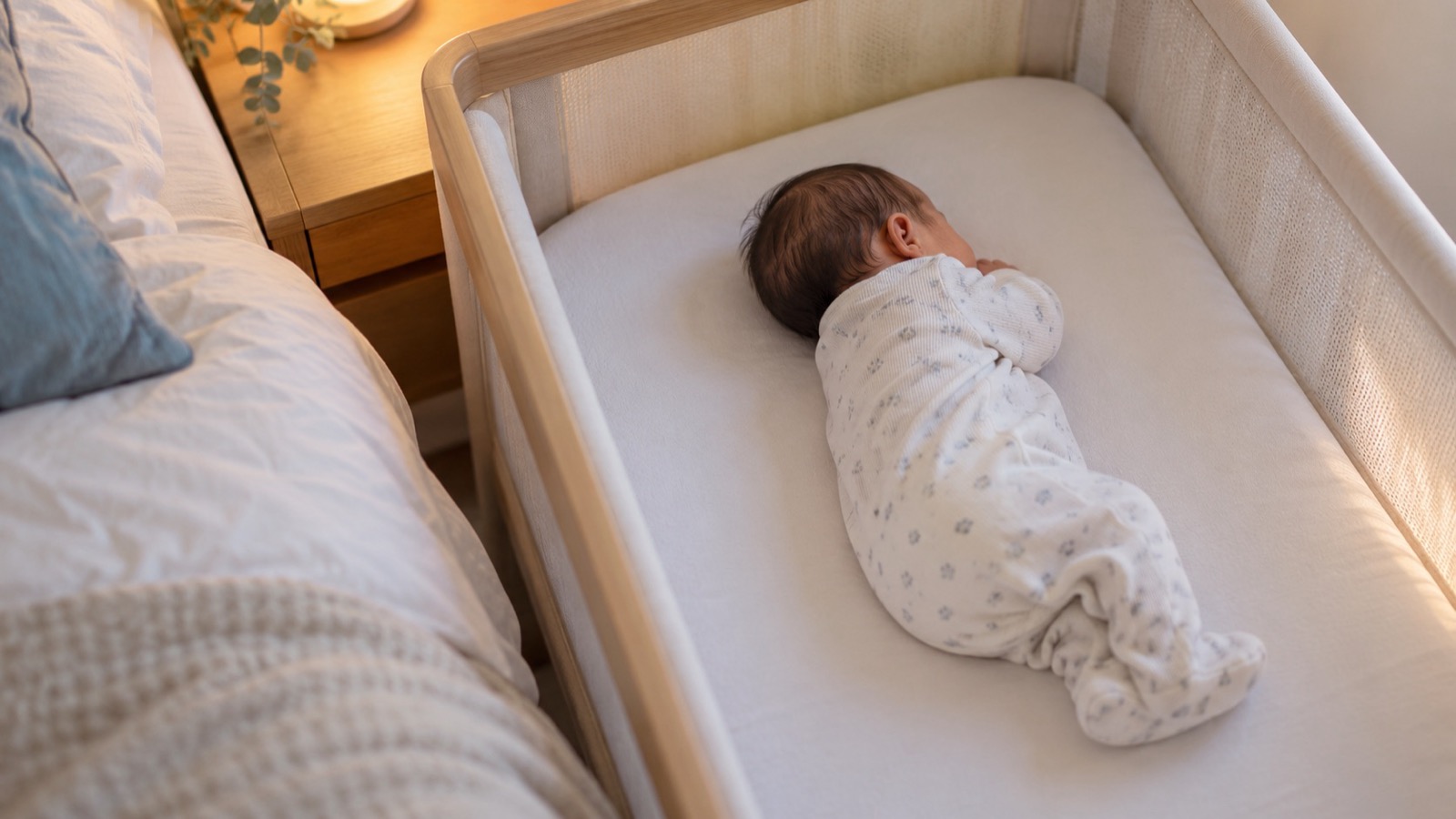
For every sleep, day and night, lie your baby on their back.[1][3] Put them in their own clear cot or Moses basket, in the same room as you for at least the first 6 months.[1][2][4] Use a firm, flat mattress with no pillows, duvets, cot bumpers, soft toys, pods or nests.[1][2] Keep the room at 16C to 20C, never let your baby get too hot, and keep their world smoke-free.[1][2][5] Never sleep on a sofa or armchair with your baby.[1][6] Following this advice for every sleep lowers the risk of sudden infant death syndrome (SIDS), often called cot death.[1][2]
Few things feel as high-stakes as laying a tiny, sleeping baby down and walking away. If your mind races at every snuffle, you are not alone, and you are already doing the most important thing by reading this. Safer sleep is not about fear. It is about a few clear habits that stack the odds in your baby's favour.[1][2] This guide walks you through each one in plain English, so you can settle your newborn with confidence, even at 2am.
When to get urgent help
Call 999 and start CPR straight away if your baby is unresponsive and not breathing normally.[11] When you call 999 for an ambulance, the call handler will give you basic life-saving instructions, including how to do CPR.[11] If you are on your own, give CPR for about 1 minute first, then call 999 and carry on until help arrives.[11]
Call 999 if your baby's skin, lips or tongue suddenly turn blue, grey or pale.[12] On brown and black skin this can be harder to see.[12] So also check the lips, gums, palms of the hands, soles of the feet, and inside the eyelids.[12]
Learning baby first aid and CPR before you ever need it is time well spent. Ask your midwife or health visitor, or book a recognised course near you.
What is SIDS, and why does safer sleep work?
Sudden infant death syndrome (SIDS) is the sudden and unexplained death of an apparently healthy baby aged up to 12 months old.[1] You may know it as cot death. It is rare, but it does still happen.[1] It is more likely in the first 6 months of life, which is exactly why these early weeks deserve such care.[1]
Here is the honest part. It is not known what causes SIDS.[1] Because no one can fully explain it, no one can promise any baby is completely safe. What we can do is clear and hopeful. There are simple, proven steps that lower the risk, and following them for every sleep is the single most powerful thing you can do.[1][2]
The cornerstone is sleeping position. Since parents were first advised to put babies down on their back, far fewer babies have died. Sleeping a baby on their front or side greatly increases the risk of SIDS, so back sleeping is the base that everything else builds on.[3] A clear sleep space matters too, because loose bedding and soft objects can cover a small face and get in the way of easy breathing.[1][2]
Two gentle habits also seem to protect babies. Sleeping in the same room as you lowers the risk compared with your baby sleeping alone.[4] Any amount of breastfeeding reduces the risk of SIDS as well.[2] On the other side of the scales, getting too hot and being around cigarette smoke both push the risk up.[2][5]
This UK advice lines up closely with guidance abroad, which is reassuring. In the United States, the American Academy of Pediatrics also recommends back sleeping for the whole first year, a firm flat sleep surface, and room-sharing without bed-sharing.[13]
If you have already had some frightening nights, or you did not know all of this with an older child, please be kind to yourself. SIDS is rare, its cause is unknown, and none of this is about blame.[1] Think of the steps below as small, caring choices you get to make afresh at every single sleep.
Safer sleep, step by step
Here are the essentials for every sleep, day and night. None of them are complicated, and together they make up the safest possible start.
1. Always on the back. Put your baby on their back for every sleep, day or night, as this is the safest way for them to sleep.[3] Back sleeping is much safer than the front or side.[3] Side sleeping is not safe, because babies can easily roll onto their tummy from there.
2. Feet to foot, firm and flat. Lay your baby in the "feet to foot" position, with their feet right at the bottom of the cot, so they cannot wriggle down under the blankets.[7] The safest mattresses are firm, flat and protected by a waterproof cover.[7] If you use a blanket, tuck it in firmly and no higher than your baby's shoulders, and keep it lightweight.[7]
3. A clear cot is a safe cot. Keep the sleep space clear of anything that could cover your baby's face or make them too hot.[2] That means no pillows or duvets, no cot bumpers, no soft toys or comforters, and no bulky or weighted bedding.[2] It also means no pods, nests, rolled-up towels, or wedges and straps that hold your baby in one position.[2]
4. Their own space, in your room. The safest place for your baby to sleep is in their own clear, flat, firm, separate sleep space, such as a cot or Moses basket, in the same room as you.[2] Keep them with you for sleep, day and night, for at least the first 6 months.[1][4]
5. Not too hot. Try to keep the room where your baby sleeps between 16C and 20C.[2][5] The risk of SIDS is higher in babies who get too hot.[5] A room thermometer takes out the guesswork.[5] To check your baby, feel their chest or the back of their neck, not their hands and feet, which are usually cooler and that is completely normal.[5] If they feel hot or sweaty, simply remove a layer of bedding.[5]
6. A smoke-free world. The risk of SIDS is much higher if you or your partner smoke during pregnancy or after your baby is born.[2] Do not smoke around your baby, and keep their rooms, car and home smoke-free.[1] If you smoke, quitting is one of the most protective things you can do, and your midwife can help.
7. Breastfeeding, if you can. Any amount of breastfeeding reduces the risk of SIDS, so every feed counts.[2] Breast milk also protects your baby from infections.[1] If breastfeeding is not for you, the other steps here still do the heavy lifting.
8. A dummy, if you choose. It is possible that using a dummy at the start of sleep also lowers the risk of SIDS.[1][9] A dummy is optional, so there is no need to start if you would rather not.
| Safer sleep step | What to do |
|---|---|
| Position | On the back for every sleep, feet to foot in the cot[3][7] |
| Surface | Firm, flat, waterproof mattress; clear of pillows, duvets, bumpers, pods and nests[2][7] |
| Place | Own cot or Moses basket, in your room, for at least 6 months[1][4] |
| Temperature | Room at 16C to 20C; check the chest or back of the neck[5] |
| Smoke | Smoke-free in pregnancy and after birth[1][2] |
| Never | Never sleep with your baby on a sofa or armchair[1][6] |
How safer sleep changes as your baby grows
The core rules stay the same all the way to your baby's first birthday. A few things shift as your baby gets stronger, so here is what to expect stage by stage.
Newborn to 6 months
This is the stage where safer sleep matters most, because SIDS is more likely in the first 6 months.[1] Follow every step above for naps and night sleep alike. Keep your baby in their own cot or Moses basket in your room, day and night.[1][4] Newborns often sleep in short bursts and wake to feed, and that is normal and expected. Safer sleep does not depend on your baby sleeping through, only on where and how they sleep.
6 to 12 months
After 6 months, many families move their baby into their own room. Back sleeping, a clear cot and a 16C to 20C room still apply for the whole first year.[2][3][5] Around this age babies grow more mobile, and sleep can become broken again as they practise new skills. The safer sleep rules do not change just because your baby is bigger or more active.
When your baby starts to roll
Rolling is a normal, healthy milestone, and it changes how you handle sleep. Once your baby can move from their back to their front and back again by themselves, they can find their own sleeping position.[3] Keep placing them down on their back to start.[3] The first few times they roll onto their tummy, you might gently turn them back.[3] You do not need to get up all night to check on them.[3] Give them plenty of tummy time while they are awake and supervised, as this builds the strength that keeps them safe.[3]
Swaddling your baby safely
A snug swaddle can help some babies settle, and it can be done safely if you follow a few rules. The safest sleeping position for a baby is on their back, whether they are swaddled or not, so always lay a swaddled baby down on their back.[8]
Keep the swaddle looser around the hips so the legs can still move freely, because a swaddle that is too tight can cause hip problems.[8] Use lightweight material, such as a thin muslin or a thin cot sheet, and check your baby's temperature so they do not get too hot.[8] Do not swaddle above the shoulders, which lowers the chance of loose material covering your baby's face.[8]
There is a clear moment to stop. Once your baby shows signs of rolling, stop swaddling them with their arms wrapped inside the material.[8] A swaddled baby who rolls onto their tummy may not be able to roll back, so timing this well really matters.
Bed-sharing, sofas and armchairs: the honest facts
Many parents end up sharing sleep with their baby at some point, sometimes on purpose and sometimes by accident during a long night of feeds. Because it is so common, it helps to know the facts rather than the myths. The safest place for your baby is still their own separate cot or Moses basket, next to your bed.[2][4]
Never on a sofa or armchair. This is the one hard line. Never fall asleep on a sofa or armchair with your baby, as it significantly increases their risk of SIDS.[6] If you feel you might drop off while feeding or cuddling at night, it is far safer to feed in your bed than to risk the sofa.[1]
Some situations make bed-sharing very dangerous. Never share a bed with your baby if any of these apply:[1][6]
- You or anyone in the bed has recently drunk any alcohol.[6]
- You or anyone in the bed smokes, or the baby was exposed to smoking in pregnancy.[1][6]
- You or anyone in the bed has taken drugs, or any medication that makes you feel sleepy.[1][6]
- Your baby was born prematurely, before 37 weeks, or weighed under 2.5kg at birth.[6]
In any of these situations, always put your baby in their own separate sleep space, such as a cot or Moses basket next to your bed.[6]
If you do choose to bed-share and none of those higher-risk factors apply, make it as safe as you can. Keep pillows and adult bedding away from your baby, along with anything that could cover their head or make them overheat.[6] Keep your baby on their back, and check they cannot get trapped in the bed frame or headboard, fall out, or become wedged between the mattress and the wall.[6]
Safer sleep on the hard nights
Real life is messy, and safer sleep has to survive exhaustion. Here are calm answers to the moments that catch parents out.
"I keep dozing off feeding on the sofa." This is one of the riskiest places to fall asleep with a baby.[6] If you are so tired that you might drop off, feed in your bed instead, with pillows and duvet pushed well away, rather than on the sofa or in a chair.[1][6]
"My baby will only sleep on me." This is incredibly common in the early weeks. Hold and cuddle your baby as much as you like while you are awake. For sleep, aim to settle them on their back in their own clear cot, and share the load with another caregiver so someone is always alert.
"My baby seems unwell." An unwell baby needs extra care, not extra bedding. Keep to the same safer sleep steps, avoid overheating, and trust your instincts. If you are worried your baby is ill, contact your GP or call NHS 111, and use the 999 advice above for any emergency sign.[11][12]
Frequently asked questions
When can my baby sleep on their front or tummy? Always put your baby down on their back until they can roll both ways on their own.[3] Once your baby can move from back to front and front to back by themselves, they can find their own sleeping position.[3] You should still lay them down on their back to start each sleep.[3] Plenty of supervised tummy time while they are awake builds the strength they need.[3]
Is it safe to swaddle my baby? Yes, swaddling can be safe if you do it carefully. Always place a swaddled baby on their back.[8] Keep the wrap looser around the hips, because one that is too tight can cause hip problems.[8] Use lightweight material, do not swaddle above the shoulders, and check your baby does not get too hot.[8] Stop swaddling as soon as your baby shows signs of rolling.[8]
Can I bed-share with my baby safely? The safest place for your baby is their own cot or Moses basket in your room.[2][4] Never bed-share if you or anyone in the bed has drunk alcohol, smokes or smoked in pregnancy, or has taken drugs or medication that makes you sleepy.[6] Never bed-share if your baby was born before 37 weeks or weighed under 2.5kg.[6] Never sleep with your baby on a sofa or armchair, as this significantly raises the risk.[1][6]
What temperature should my baby's room be? Aim to keep the room where your baby sleeps between 16C and 20C.[1][5] The risk of SIDS is higher in babies who get too hot.[5] A room thermometer helps you check.[5] Feel your baby's chest or the back of their neck, not their hands and feet, which are usually cooler.[5] If they feel hot or sweaty, take off a layer of bedding.[5]
Does a dummy really lower the risk of SIDS? Possibly. Research suggests that using a dummy when you put your baby down to sleep could lower the risk of SIDS.[1][9] If you breastfeed, wait until feeding is well established, usually around 4 weeks, before you start.[9] Offer it for every sleep rather than now and then, do not force it, and do not put anything sweet on it.[9] If it falls out while your baby sleeps, there is no need to put it back in.[9]
Can my baby sleep in a car seat, bouncer or sleep nest? These are not safe for everyday sleep. The Lullaby Trust advises against letting babies sleep in anything that keeps them seated or at an incline, as this can restrict their breathing.[10] Pods and nests are not recommended either, as they are soft with raised, cushioned sides.[10] If your baby falls asleep in a car seat, swing or bouncer, move them onto their back in their own cot or Moses basket when you can.[10]
Key takeaways
- Back is best, every single time. Sleep your baby on their back for every nap and every night, as the front and side are far riskier.[3]
- Clear, firm, flat, and in your room. Use a firm, flat mattress in a clear cot or Moses basket, with no pillows, duvets, bumpers, pods or nests, kept in your room for at least 6 months.[1][2][4]
- Keep it cool and smoke-free. Aim for a room of 16C to 20C, never let your baby overheat, and keep pregnancy and your baby's world smoke-free.[1][2][5]
- Know the bed-sharing facts. Never sleep with your baby on a sofa or armchair, and never bed-share if anyone has had alcohol, smokes, has taken sleepy-making drugs or medication, or if your baby was premature or low birth weight.[1][6]
- Swaddle safely and stop at rolling; a dummy is optional. Swaddle on the back with loose hips, and stop once your baby can roll; a dummy at sleep time may lower the risk.[8][9]
- Call 999 if your baby is unresponsive, not breathing, or turns blue, grey or pale, checking the lips, gums, palms and soles on brown and black skin, and start CPR.[11][12]
How Tiny Timeline helps you keep sleep safe and consistent
Safer sleep is really a set of small habits repeated many times a day, often by more than one tired person. That is exactly where a shared record helps. Tiny Timeline is built to carry a little of that mental load, so you can focus on your baby rather than on remembering every detail.
The sleep log lets you note each nap and night sleep, including where your baby slept. Over a few days that turns a blur of broken nights into a clear picture you can actually see. It is a simple way to keep every sleep happening in the cot or Moses basket, in the same room, the way safer sleep advice suggests.
Because the log is shared, family sync keeps everyone on the same page. Your partner, a grandparent or a night-time helper can all see the same routine, so the same safe habits follow your baby from one pair of hands to the next. It quietly answers those 3am questions like where did she last go down, without a flurry of messages.
None of this replaces the advice from the Lullaby Trust, the NHS, your midwife or your health visitor, and the app will never diagnose your baby. Think of it as a calm, shared notebook that helps everyone caring for your baby follow the same safer sleep steps, every single sleep.
How Tiny Timeline can help
Tiny Timeline lets you log each nap and night sleep, including where your baby slept, so safer sleep stays consistent from one caregiver to the next. Family sync means your partner, a grandparent or a night helper all see the same routine, so your baby goes down on their back, in their own cot, in your room, every single time. It never replaces NHS or Lullaby Trust advice, and it never diagnoses. Tiny Timeline is a baby tracker, not a medical device, and nothing here replaces advice from your GP or health visitor.
References
- NHS: Sudden infant death syndrome (SIDS). https://www.nhs.uk/baby/caring-for-a-newborn/sudden-infant-death-syndrome-sids/
- The Lullaby Trust: Safer sleep overview. https://www.lullabytrust.org.uk/baby-safety/safer-sleep-information/safer-sleep-overview/
- The Lullaby Trust: Sleeping position. https://www.lullabytrust.org.uk/baby-safety/safer-sleep-information/sleeping-position/
- The Lullaby Trust: Room sharing. https://www.lullabytrust.org.uk/baby-safety/safer-sleep-information/room-sharing/
- The Lullaby Trust: Room temperature. https://www.lullabytrust.org.uk/baby-safety/safer-sleep-information/room-temperature/
- The Lullaby Trust: Co-sleeping. https://www.lullabytrust.org.uk/baby-safety/safer-sleep-information/co-sleeping/
- The Lullaby Trust: Mattresses and bedding. https://www.lullabytrust.org.uk/baby-safety/baby-product-information/mattresses-and-bedding/
- The Lullaby Trust: Swaddling. https://www.lullabytrust.org.uk/baby-safety/baby-product-information/swaddling/
- The Lullaby Trust: Dummies. https://www.lullabytrust.org.uk/baby-safety/baby-product-information/dummies/
- The Lullaby Trust: Baby sleeping products. https://www.lullabytrust.org.uk/baby-safety/baby-product-information/baby-sleeping-products/
- NHS: How to resuscitate a child. https://www.nhs.uk/baby/first-aid-and-safety/first-aid/how-to-resuscitate-a-child/
- NHS: Blue or grey skin or lips (cyanosis). https://www.nhs.uk/symptoms/blue-skin-or-lips-cyanosis/
- American Academy of Pediatrics (HealthyChildren.org): How to keep your sleeping baby safe (US guidance). https://www.healthychildren.org/English/ages-stages/baby/sleep/Pages/Preventing-SIDS.aspx