 Tiny Timeline
Baby Milestones: When Do Babies Roll, Sit & Crawl?
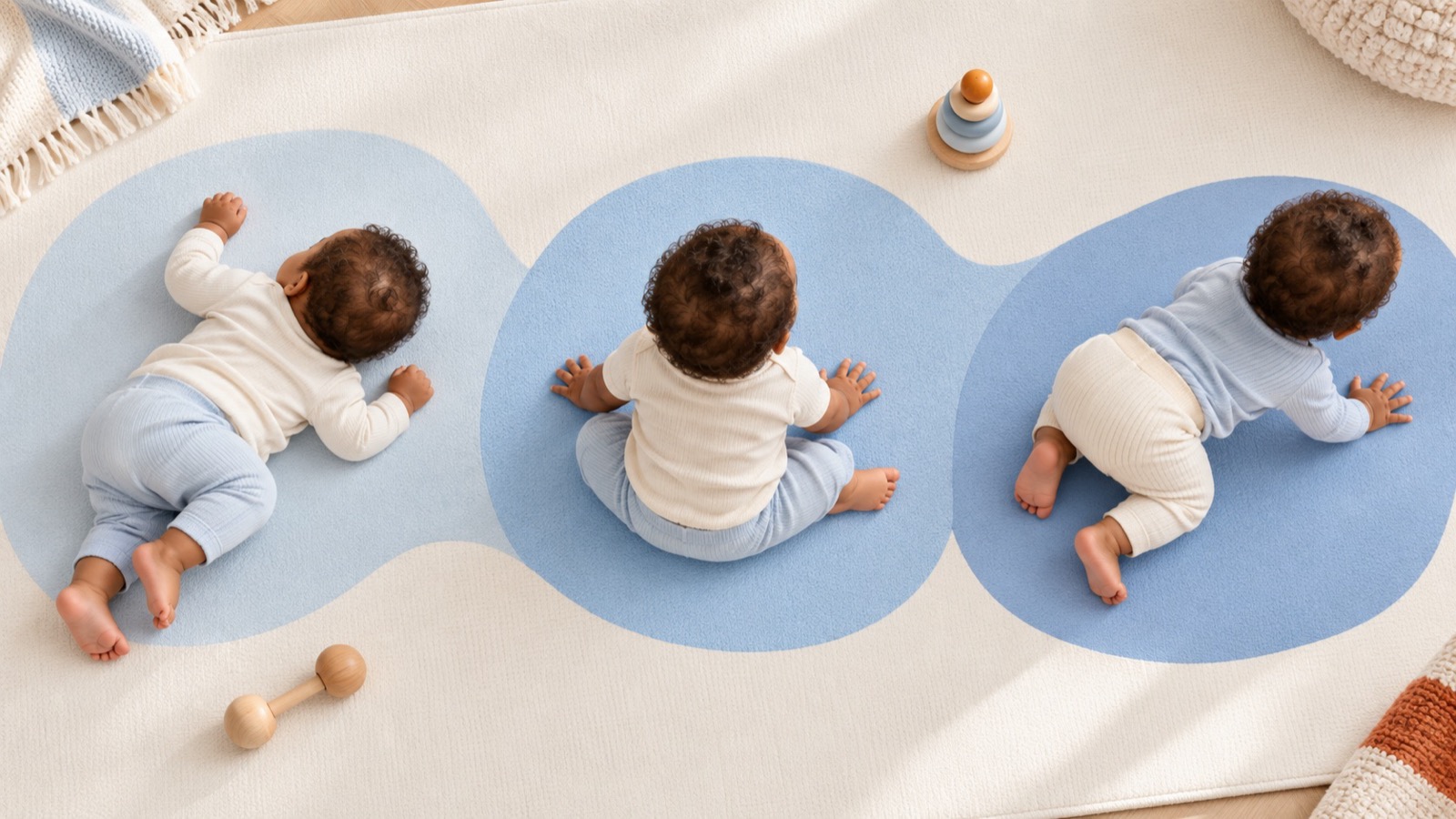
Watching other babies roll, sit and crawl "first" can make any parent anxious. Take a breath. Milestones arrive in wide, healthy windows, not on a fixed date. This evidence-based guide walks through the usual ranges for rolling, sitting and crawling, explains why so much variation is normal, and sets out the clearer signs worth a quick word with your health visitor.
Is my baby behind on rolling, sitting and crawling?
Probably not. Babies reach these milestones across wide, healthy windows, not on a fixed date. As a rough guide, many roll around 4 to 6 months,[6] sit without support between about 4 and 9 months,[5] and crawl between about 5 and 13 months.[5] Some skip crawling entirely.[5] Steady progress matters more than the exact age.
So if your baby is a little later than the baby next door, that alone is usually not a worry. It is always fine to check, though. Speak to your health visitor if you are worried your baby is not moving at all,[2] or has lost a skill they could do before.[8] That is what your health visitor and GP are there for.[10]
How babies learn to move, in order
Babies build movement roughly from the head downwards. First they gain steady head control, then strength through the shoulders, trunk and hips, and finally the legs. This top-to-bottom order is why sitting comes before standing, and standing before walking.
Think of it as one skill stacking on the next. A baby needs a strong, steady neck before they can push up in tummy time. They need a strong trunk before they can sit. They need to sit securely before their hands are free to reach, and later to crawl. Each stage quietly lays the groundwork for the one after it.
This is why the sequence usually matters more than the exact age. Two healthy babies can reach the same milestone months apart and both be completely typical. The World Health Organization (WHO) studied healthy babies across several countries. It found wide "windows of achievement" for each skill, and states plainly that these windows "represent normal variation in ages of milestone achievement among healthy children".[4][5]
Tummy time is where it starts
Most of this early strength is built through play on the floor, and tummy time is the star of the show. The NHS says tummy time "is important for your baby's development as it helps to build the muscles your baby needs for sitting and crawling".[3] It strengthens "the back, neck and shoulders" too.[2]
You can start from day one. The NHS suggests you "can start doing tummy time from birth by lying your baby on your chest", as long as you are wide awake.[2] Little and often works best. If your baby dislikes it at first, that is, as the NHS puts it, "very normal for lots of babies".[2] Build up slowly, a minute or two at a time.
From here the familiar milestones follow: rolling, sitting, crawling or shuffling, pulling up, cruising, and eventually those first wobbly steps. Let us look at the normal range for each.
Rolling, sitting and crawling: the normal age ranges
The ages below are guides, not targets. They come from large studies of healthy babies, so they show a broad normal range rather than a single "right" age. Your baby may be early with one skill and later with another. That mixture is entirely normal.[5]
| Skill | Typical window | What you might see |
|---|---|---|
| Steady head control | around 3 to 4 months | Holds their head steady when held; lifts head and chest in tummy time[9] |
| Rolling over | often around 4 to 6 months | Rolls tummy to back first, then back to tummy. Most roll tummy to back by about 6 months[6] |
| Sitting without support | about 4 to 9 months | Sits steadily without hands, then gets into sitting alone. Most sit without support by about 9 months[5][7] |
| Crawling | about 5 to 13 months | On hands and knees, or bottom-shuffling, commando-crawling, or skipping crawling entirely[5][9] |
| Pulling up and cruising | around 6 to 12 months | Pulls up on furniture, then sidesteps along it holding on. Most pull to stand by about 12 months[5][8] |
| Walking alone | about 8 to 18 months | First independent steps, often wobbly and wide-legged[5] |
The windows for sitting, crawling, standing and walking come from the WHO Motor Development Study of healthy babies across several countries. The "most babies by" markers come from the US Centers for Disease Control and Prevention (CDC) 2022 milestone checklists. Both describe ranges, not deadlines.[4][5][6][7][8]
When do babies roll over? Usually around 4 to 6 months
Rolling is usually the first big move. Babies tend to roll from tummy to back first, because it takes a little less strength. Rolling from back to tummy often comes a few weeks later. The US CDC lists "rolls from tummy to back" as something most babies do by 6 months.[6] Some roll earlier, some later, and both can be perfectly fine.
When do babies sit up? About 4 to 9 months
Sitting usually starts propped and wobbly, then becomes steady and hands-free. In the WHO study, healthy babies sat without support anywhere from about 4 to 9 months.[5] Early on, a baby often "leans on hands to support" themselves while sitting.[6] By around 9 months, most babies can sit without support, and even get into a sitting position by themselves.[7]
When do babies crawl? About 5 to 13 months, and not every baby does
Crawling has the widest range and the most variety. In the WHO study, hands-and-knees crawling appeared anywhere from about 5 to 13 months.[5] Plenty of babies never crawl in the classic way at all. Some bottom-shuffle, which the NHS notes "can delay walking" a little.[9] Others "commando crawl on their elbows with their legs on the floor" first.[9]
Some babies skip crawling entirely and go straight to pulling up and walking. This is more common than many parents realise. In the WHO study, about 1 in 20 babies (4.3%) never crawled on hands and knees, yet went on to walk normally.[5] Crawling is simply not a box every baby has to tick.
What comes next: pulling up, cruising and first steps
After sitting and shuffling about, babies pull up on furniture, then "cruise" sideways while holding on. The CDC lists pulling up to stand and walking while holding furniture among the things most babies do by about 12 months.[8] Independent walking then has a famously wide range. In the WHO study, healthy babies walked alone anywhere from about 8 to 18 months.[5] So a first birthday with no steps yet is still well within normal.
How to help your baby get moving
You cannot rush a milestone, and you do not need to. Babies are driven to move the moment their bodies are ready. What you can do is give them plenty of safe chances to practise. Here is what genuinely helps.
- Make floor time the default. A firm, safe patch of floor is the best "equipment" there is. Lay your baby on their back so they can "kick their legs", and "put some toys nearby for them to reach out to".[3] Reaching, kicking and rolling all build the strength for what comes next.
- Do tummy time every day, little and often. Tummy time builds the neck, shoulder and trunk muscles behind rolling, sitting and crawling.[3] Start with a minute or two, a few times a day, and build up. Lying your baby on your chest can make it feel friendlier at first.[2]
- Give them a reason to move. Place a favourite toy just out of reach during tummy time or sitting. Get down on the floor and play face to face. Your face and your voice are the best motivation your baby has.
- Go easy on baby seats, walkers and bouncers. These have their place, but time strapped in is time not spent practising. The NHS advises that babies should "not spend too much time" in "baby walkers or bouncers" or "baby carriers and seats", and if you do use them, for "no more than 20 minutes at a time".[3]
- Follow your baby, not the calendar. Let them set the pace, and cheer the small wins, like a new roll or a steadier sit. Comparing with other babies rarely helps, and the range of normal really is wide.[5]
Born early? Use your baby's corrected age
If your baby arrived prematurely, judge their development from your due date, not their birth date. The premature baby charity Bliss explains that a "premature baby's development should always be assessed by their due date and not the date they were actually born", which is called their "corrected age".[11] So a baby born two months early may reach each milestone around two months later than the calendar suggests, and still be right on track. This usually matters most for roughly the first two years. If in doubt, your health visitor can help you work it out.[11]
When to talk to your health visitor or GP
Most babies who are "a bit late" are simply working to their own timetable. But some signs are worth checking, not to frighten you, but because early help is easy to arrange and often reassuring. You know your baby best. Trust your instincts, and remember you can raise a worry at any time.[1]
Check in with your health visitor or GP if your baby:
- is not lifting their head in tummy time by around 4 months, or shows no sign of trying to roll by around 6 months[9]
- is not sitting with support by around 6 months,[9] or is not sitting on their own by around 8 months[10]
- is not taking any weight on their legs,[9] or not moving around at all, by around 12 months[2]
- is not walking by around 18 months[10]
- seems very floppy, or very stiff, or has weak arms or legs[10]
- consistently uses one side of the body far more than the other, or only ever reaches with one hand[10]
- loses a skill they could do before, such as sitting or rolling[8]
None of these means something is definitely wrong. The NHS lists signs like these among reasons to "speak to your health visitor or a GP if you have any concerns about your child's health or development".[10] And if your baby is "not showing any signs of moving by 12 months", the NHS advises asking your health visitor for advice.[2]
These are all signs in how your baby moves and holds themselves, so they show up the same whatever your baby's skin tone. Trust what you see in how your baby moves.
It also helps to know when the routine checks happen. The NHS offers development reviews at set points: a new baby review at 10 to 14 days, a physical examination at 6 to 8 weeks, a review at 9 to 12 months, and another at 2 to two-and-a-half years.[1] These exist "to support you and your baby, and make sure their development is on track".[1] Between them, "you can contact a health visitor or GP, or go to your local baby clinic" whenever something is on your mind.[1]
Frequently asked questions
Is it normal for my baby not to crawl? Yes, and it is more common than people think. Some babies bottom-shuffle or commando-crawl instead, and some skip crawling and go straight to pulling up and walking.[9] In the WHO study, about 1 in 20 healthy babies never crawled on hands and knees.[5] As long as your baby is finding ways to move and explore, crawling itself is optional. If your baby is not moving around at all by around 10 to 12 months, have a chat with your health visitor.[2][9]
When should a baby sit up unsupported? There is a wide window. In the WHO study, healthy babies sat without support between about 4 and 9 months.[5] By around 9 months, most babies can sit without support and get into a sitting position by themselves.[7] If your baby is not sitting with support by around 6 months, or not sitting alone by around 8 months, mention it to your health visitor.[9][10]
My baby is 6 months and not rolling. Should I worry? Not on its own. Rolling has a broad range, and some babies pour their energy into other skills first. Keep offering daily tummy time and floor play, which build the muscles for rolling.[3] If your baby shows no sign of trying to roll by 6 months, and you have been encouraging it, the NHS suggests contacting your health visitor for reassurance.[9]
Does skipping crawling cause problems later? There is no good evidence that a baby who skips crawling is worse off. Crawling is one of several ways babies get moving, and it is not a milestone every child reaches.[5] What matters is that your baby keeps making progress and reaches walking within the normal range. If you are unsure, your health visitor can check.[1]
When do babies start walking? Later than many parents expect, and across a big range. In the WHO study, healthy babies walked alone between about 8 and 18 months.[5] So no steps by the first birthday is still normal. It is worth a word with your health visitor or GP if your baby is not walking by around 18 months.[10]
Do baby walkers help my baby learn to walk? No, and they are best used sparingly. Babies learn to walk through floor play, pulling up and cruising, not by being placed in a walker. The NHS advises against too much time in "baby walkers or bouncers", and "no more than 20 minutes at a time" if you use them.[3] Floor time is far more useful.
Can tummy time really speed things up? It genuinely helps. Tummy time builds "the muscles your baby needs for sitting and crawling".[3] You can start from birth on your chest, and build up little and often.[2] It will not force a milestone before your baby is ready, but it gives them the strength, and the chance, to practise.
Tracking milestones with Tiny Timeline
When you are tired and a little anxious, it is hard to hold the whole picture in your head. Was that first proper roll last week, or the week before? Tiny Timeline quietly keeps the record, so you do not have to rely on memory.
You can log milestones as they happen, first head lift, first roll, first steady sit, first crawl or shuffle, each with a date and a photo. Over time this builds a clear picture of your baby's own pace, rather than a comparison with anyone else's baby. Seeing steady progress, laid out in your baby's own timeline, is often the reassurance parents are really looking for.
Those notes are genuinely useful at health visitor and GP reviews. Instead of trying to recall a blurry few months, you can show exactly when each skill appeared. That helps the conversation, whether everything is on track or you would like something looked at.
And because the family view is shared, both parents, grandparents and other carers see the same milestones as they happen. Everyone gets to share the "she did it!" moments, even when they were at work. Tiny Timeline is a keepsake and a memory aid, not a medical tool. For any worry about your baby's development, your health visitor or GP is always the right first call.
Key takeaways
- Milestones are windows, not deadlines. Healthy babies reach rolling, sitting and crawling across wide age ranges, which the WHO calls "normal variation".[5]
- The order matters more than the exact age. Babies build strength from the head down, so sitting comes before standing, and standing before walking.[5]
- Rough guide: rolling often 4 to 6 months, sitting about 4 to 9 months, crawling about 5 to 13 months, walking about 8 to 18 months.[5][6][7]
- Crawling is optional. Around 1 in 20 babies never crawl on hands and knees, and bottom-shuffling is a normal variation.[5][9]
- Tummy time and floor play help most. They build the muscles for sitting and crawling, and you can start from birth.[2][3]
- Born early? Use corrected age, judged from your due date, for roughly the first two years.[11]
- Check in if in doubt. Speak to your health visitor or GP about not sitting by 8 months, not walking by 18 months, a very floppy or stiff baby, strong one-sided movement, or any lost skill.[8][10]
How Tiny Timeline can help
Log rolling, sitting, crawling and those first steps in Tiny Timeline, each with a date and a photo, and watch your baby's own timeline take shape. It is a lovely keepsake, and a clear record to share with your health visitor at review time. Tiny Timeline is a baby tracker, not a medical device, and nothing here replaces advice from your GP or health visitor.
References
- NHS - Your baby's health and development reviews. https://www.nhs.uk/baby/babys-development/height-weight-and-reviews/baby-reviews/
- NHS Best Start in Life - Baby moves. https://www.nhs.uk/best-start-in-life/baby/baby-moves/
- NHS - How to keep your baby or toddler active. https://www.nhs.uk/baby/babys-development/play-and-learning/keep-baby-or-toddler-active/
- WHO - Windows of achievement for six gross motor milestones (Motor Development Study). https://cdn.who.int/media/docs/default-source/child-growth/child-growth-standards/indicators/motor-development-milestones/mm_windows_graph.pdf
- WHO Motor Development Study: windows of achievement for six gross motor milestones (Acta Paediatrica Suppl 2006;450:86-95). https://www.rti.org/publication/motor-development-study-windows-achievement-six-gross-motor-development-milestones
- CDC - Important Milestones: Your Baby By Six Months (2022). https://www.cdc.gov/ncbddd/actearly/milestones/milestones-6mo.html
- CDC - Important Milestones: Your Baby By Nine Months (2022). https://www.cdc.gov/ncbddd/actearly/milestones/milestones-9mo.html
- CDC - Important Milestones: Your Baby By One Year (2022). https://www.cdc.gov/ncbddd/actearly/milestones/milestones-1yr.html
- Oxford Health NHS Foundation Trust - Gross motor skills (babies and toddlers). https://oxfordhealth.nhs.uk/cit/resources/gross-motor-skills-babies-and-toddlers/
- NHS - Cerebral palsy: Symptoms. https://www.nhs.uk/conditions/cerebral-palsy/symptoms/
- Bliss - Early developmental milestones (corrected age). https://www.bliss.org.uk/parents/about-your-baby/early-developmental-milestones