 Tiny Timeline
Baby Poo Colour Chart: What's Normal and Warning Signs
Few things make a new parent look twice like the contents of a nappy. The good news is that baby poo comes in a wide range of normal colours and textures, and most of what you see is nothing to worry about. This calm, UK guide follows the newborn poo journey, from sticky black meconium to soft yellow, and covers what to expect from breast and formula milk. It also flags the warning colours, like pale, white or bloody poo, that always need a doctor. We start with those, so you know when to act.
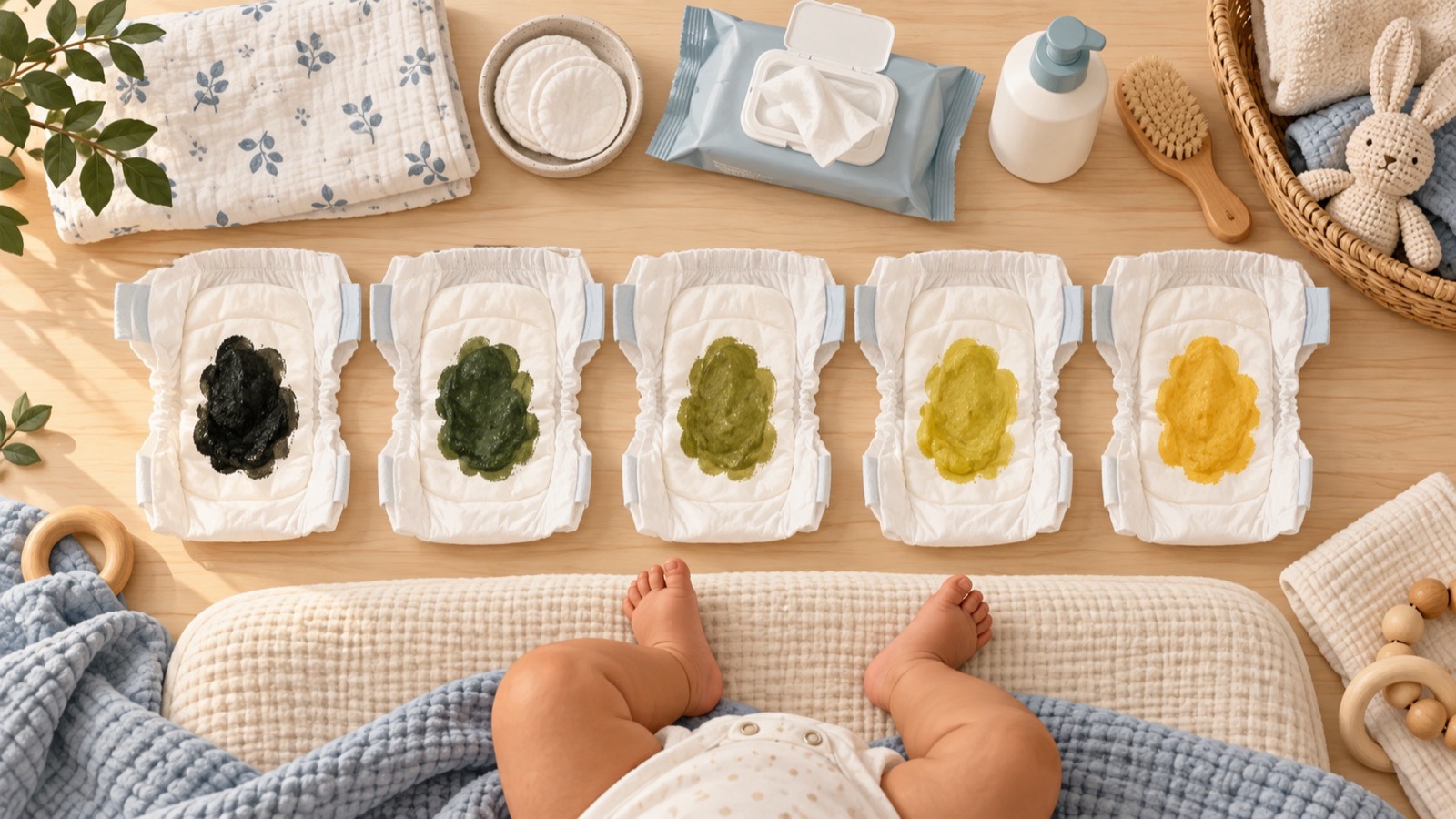
Quick answer: what does normal baby poo look like?
Your baby's first poo is sticky, greenish-black meconium.[1][2] Within a few days it turns yellow or mustard.[1][2] Breastfed poo is soft, yellow and seedy;[2][10] formula poo is firmer, browner and smellier.[1][2] Almost any yellow, green or brown is normal.[1][9] Pale, white or bloody poo always needs a doctor,[2][8][9] and a very unwell baby needs 999.[6]
Nappies tell you a surprising amount about how your baby is doing. Colour, texture and frequency all shift in the early weeks, as a brand-new gut wakes up to milk. Almost all of it is normal. A few signs are worth acting on quickly, so this guide keeps those at the top, then covers everything that is ordinary.
When baby's poo needs a doctor
Ask for an urgent GP or health visitor appointment, or call NHS 111 now, if:[2][8]
- your baby's poo is very pale, white or chalky, or their wee is dark. Pale poo can be a sign of a liver problem, so get it checked promptly and keep the nappy to show them.[2][8][9]
- there is blood in your baby's poo.[2][5][9]
- your baby's poo turns black once the meconium days have passed, after about the first 2 to 3 days.[1][11]
- your baby has diarrhoea that is not settling, or signs of dehydration such as fewer wet nappies, drowsiness, or a sunken soft spot on the head.[6][7]
- your baby is under 8 weeks old and has not pooed for 2 to 3 days, or a younger breastfed baby has not pooed for 24 to 48 hours.[3][4]
- you are simply worried about a baby under 12 months, for any reason.[6]
Call 999 or go to A&E if your baby:[6]
- is too drowsy to wake, or is not responding as usual.[6]
- has blue, grey or blotchy skin, lips or tongue. On brown or black skin this may be easier to see on the palms of the hands or soles of the feet.[6]
- has severe difficulty breathing, or is taking lots of quick, short breaths.[6]
- passes poo that looks like redcurrant jelly and seems very unsettled or unwell. This is uncommon, but needs to be seen straight away.[11]
You know your baby. If something looks wrong to you, trust that feeling and ask for advice, even if it is not on this list.[9]
What is normal baby poo, and why does it change so much?
Baby poo is not one thing. It is a moving picture that changes with your baby's age, their milk and even the time of day. Knowing the usual pattern makes it much easier to spot the rare thing that is out of place.
Your baby's very first poo is called meconium. It is a sticky, greenish-black substance that usually appears in the first 1 to 2 days.[1][2] It is made of what your baby swallowed in the womb, so it looks nothing like later poo, and it can be tarry and hard to wipe off. That is all normal.[3]
Once your baby starts feeding, their gut clears the meconium out. By around day 3 the poo begins to change, becoming a looser, greenish colour, and by about day 4 or 5 it is usually soft and yellow.[3][9] The reason it turns yellow is that breast milk in particular is a natural laxative, so it moves through the gut quickly and comes out soft and often.[3] This shift from black, through green, to yellow is one of the clearest signs that feeding is going well.
From there, the normal range is wide. Poo can be yellow, green, tan or brown, runny or more formed, seedy or smooth, and still be perfectly healthy.[9] What matters is the overall pattern, and whether your baby is feeding well, having plenty of wet nappies and generally content, rather than any single nappy.
The first week of newborn poo: meconium to mustard yellow
The first seven days follow a fairly reliable rhythm. Seeing it laid out can be reassuring when you are staring at yet another surprising nappy at 3am.
Days 1 to 2. Expect meconium: dark, greenish-black and sticky.[1][2] You might see only a couple of wet nappies and one or more dirty ones, which is normal as your milk comes in.[10]
Days 3 to 4. The poo starts to change, moving from that dark colour towards green and a browner or greener mix, and becoming looser.[3][9] Wet nappies increase, and you should see at least a couple of dirty nappies a day.[10]
Days 5 to 7. By now the meconium is usually gone and the poo is soft and yellow.[9] A well-fed baby of about a week old often has at least 6 wet nappies and 2 or more yellow poos a day, each poo at least the size of a two-pound coin.[10] Breastfed poo at this stage is classically yellow and grainy, a bit like runny French mustard.[10]
If your baby's poo is still black or very dark by around day 4 or 5, mention it to your midwife. It can simply mean feeding needs a little support.[3]
Breastfed, formula-fed and mixed: what is normal for each
Milk changes poo more than almost anything else, so it helps to know what is typical for how your baby is fed. None of these is better or worse. They are just different.
Breastfed babies
Breastfed poo tends to be soft or runny, yellow or mustard coloured, and often seedy or grainy in texture.[2][10] It usually does not smell strong.[1][2] Because breast milk is a natural laxative, young breastfed babies often poo a lot.[3] In the early weeks your baby may poo at almost every feed.[1] Between about day 4 and 6 weeks, a baby who is breastfeeding well should pass at least 2 yellow poos a day.[3]
Then something surprising often happens. After about 6 weeks, many breastfed babies poo far less often, sometimes going several days without a poo.[1][3] In a thriving older baby whose poo is still soft, this is usually normal, not constipation.[3] More on that next, because timing matters.
Formula-fed babies
Formula poo is usually firmer and more formed than breastfed poo, darker brown or tan in colour, and more strongly smelling.[1][2] Formula-fed babies may poo up to about 5 times a day at first, and this often settles to around once a day after a few months.[1] Some formulas can also turn the poo a dark green colour, which on its own is not a problem.[9]
Mixed feeding
If you combine breast and formula, your baby's poo often sits between the two, usually a little firmer than fully breastfed poo.[1][2] As always, it is the overall pattern that matters, not one surprising nappy.
How often should a baby poo?
There is no single right number; it changes with age and milk. Here is the usual range.
| Age and feeding | Typical pooing pattern |
|---|---|
| First week (any feeding) | 2 or more poos a day, moving from meconium to yellow[2][10] |
| Breastfed, day 4 to 6 weeks | At least 2 yellow poos a day if feeding well[3] |
| Breastfed, 6 weeks and older | Often less often, sometimes several days between soft poos[1][3] |
| Formula-fed, early weeks | Up to about 5 a day, settling towards once a day over the months[1] |
The tricky part is telling normal infrequency from constipation. They are not the same thing. Constipation is about the poo being hard, dry or pellet-like and difficult to pass, not simply about how many days have gone by.[5] An older breastfed baby who goes 4 or 5 days and then passes a large, soft poo is usually fine.[3]
Age is the key to when a gap is worth a call. In the early weeks poo should be frequent, so a gap means more. If your breastfed baby has not pooed in the past 24 to 48 hours in those first weeks, speak to your midwife or health visitor, as it can mean they are not getting enough milk.[3] If your baby is under 8 weeks old and has not done a poo for 2 to 3 days, talk to your midwife, health visitor or GP.[4] After that stage, in a happy, growing baby, longer gaps with soft poo are usually nothing to worry about.
Baby poo colour chart: what each colour means
Use this as a quick reference. Most rows are firmly normal; the last few are the ones to act on. When in doubt, ask your health visitor or GP.
| Colour or type | What it usually means | What to do |
|---|---|---|
| Greenish-black and sticky (meconium) | The normal first poo, days 1 to 2 | Nothing needed, this is expected[1][2] |
| Green and changing, around day 3 to 4 | Normal transition from meconium to milk poo | Nothing needed[3][9] |
| Yellow or mustard, soft and seedy | Typical, healthy breastfed poo | Nothing needed, this is normal[2][10] |
| Firm, darker brown or tan, stronger smell | Typical, healthy formula poo | Nothing needed[1][2] |
| Green | Often normal, and some formulas make poo green | Usually fine; speak to your GP or health visitor if it is green and watery and your baby is unsettled or off feeds[9] |
| Very pale, white or chalky | Possible liver or bile problem | Get checked promptly by a GP, health visitor or NHS 111; keep the nappy[2][8][9] |
| Blood in the poo (red streaks or specks) | Often a small tear or a milk issue, but always needs checking | Speak to your GP or health visitor[2][5][9] |
| Black, after the meconium days | Can be old, digested blood from higher in the gut | Speak to a GP or NHS 111; get urgent help if your baby is unwell[1][11] |
| Watery and much more frequent (diarrhoea) | Usually a tummy bug | Watch for dehydration; call 111 if worried, especially under 12 months[6][7] |
| Hard, dry or pellet-like | Constipation | See your GP, and get help early[5] |
When is baby poo a problem? The warning colours explained
These are the sections to read closely. Each one is uncommon, and most have a simple explanation, but each is worth acting on rather than waiting to see.
Pale, white or chalky poo
This is the single most important colour to know. Healthy baby poo has colour, from yellow through green to brown. Poo that is very pale, white, chalky or putty coloured can be a sign that bile is not reaching the gut, which points to a problem with the liver or bile ducts.[9] The NHS lists pale poo, often alongside dark wee, as a reason to get urgent advice.[2][8]
Most babies never show this, and the odd slightly paler nappy is usually nothing. But persistently pale, white or chalky poo should always be checked, and quickly.[9] These conditions are rare, yet far easier to treat when found early, so please do not wait. Keep the dirty nappy to show your GP, health visitor or the clinician on NHS 111.[8]
Blood in the poo
Seeing blood in a nappy is frightening, but it often has a harmless cause. A common one is a tiny tear around the bottom from a large, hard poo, which leaves a streak of bright red blood.[5] In breastfed babies, a little swallowed blood from a mother's cracked nipple can also show up in the poo.[11] Whatever the cause, blood in your baby's poo should always be checked, so speak to your GP or health visitor.[2][9] If there is a large amount of blood, or your baby also seems unwell, treat that as urgent and get help straight away.[11]
Black poo after the meconium days
Black poo is expected in the first day or two, as meconium.[1] Once your baby has moved on to yellow milk poo, black is no longer part of the normal picture. Black or tar-like poo later on can be a sign of old, digested blood from higher up in the gut, though in breastfed babies swallowed blood from a cracked nipple is a common and harmless cause.[11] Either way it needs a professional to look at it, so speak to your GP or NHS 111, and get urgent help if your baby also seems unwell.[11]
Constipation
Constipation is about how the poo looks and feels to pass, not just how often it comes. Signs include pooing fewer than 3 times a week, poo that is large and hard or looks like rabbit droppings or little pellets, and straining or pain when going.[5] A constipated baby may be less hungry than usual, have a firm tummy, or have unusually smelly wind and poo.[3][4] A large, hard poo can cause a small tear and a streak of bright red blood.[5]
Constipation is less common in fully breastfed babies and can appear around changes such as starting formula or weaning. If you think your baby is constipated, see your GP, and do it early, because the longer it goes on the harder it is to settle.[5]
Diarrhoea and dehydration
Diarrhoea means poo that is more watery and much more frequent than usual. It is often caused by a tummy bug and usually stops within 5 to 7 days, while any vomiting usually settles in 1 or 2 days.[6] The main risk with diarrhoea in a baby is dehydration, because small bodies lose fluid quickly.
Watch for signs of dehydration: fewer wet nappies than usual, a sunken soft spot on the top of the head, sunken eyes, few or no tears when crying, and being drowsy or irritable.[7] Keep offering milk, and feed more often if you can. Call NHS 111 if you are worried about a baby under 12 months, if your baby stops breast or bottle feeding while ill, or if signs of dehydration appear.[6][7] Call 999 or go to A&E if your baby is too drowsy to wake, is not responding as usual, has blue, grey or blotchy skin, lips or tongue, or has severe difficulty breathing.[6]
Frequently asked questions
Is green baby poo normal? Usually, yes. Green poo is common during the change from meconium, and some formulas turn poo green.[3][9] In a happy, feeding baby it is generally nothing to worry about. Speak to your GP or health visitor if the poo is green and watery and your baby is also unsettled or going off their feeds.[9]
Is it normal for a breastfed baby not to poo for several days? After about 6 weeks, often yes. Many breastfed babies start pooing much less often, sometimes going several days between poos, and this can be completely normal if the poo is still soft when it arrives and your baby is well.[1][3] It is different in the early weeks, when poo should be frequent. If a young baby under 8 weeks has not pooed for 2 to 3 days, check in with your midwife, health visitor or GP.[4]
What does it mean if my baby's poo is pale or white? Very pale, white or chalky poo can be a sign of a problem with the liver or bile system, so it should always be checked promptly.[9] It is often noticed alongside dark wee, which the NHS treats as a reason for urgent advice.[2][8] Keep the nappy and contact your GP, health visitor or NHS 111. These problems are rare, but early treatment makes a real difference.[8]
Is a little blood in my baby's poo an emergency? Not usually, but it always needs checking. A small streak of bright red blood is often caused by a tiny tear from a hard poo, and in breastfed babies can be swallowed blood from a cracked nipple.[5][11] Speak to your GP or health visitor about any blood in the poo.[2][9] Treat it as urgent if there is a large amount of blood, if the poo looks like redcurrant jelly, or if your baby also seems unwell.[11]
What does baby poo look like when a baby is constipated? Constipated poo is dry, hard, lumpy or pellet-like, and can look like little rabbit droppings.[3][5] Your baby may strain or seem in pain, poo fewer than 3 times a week, be less hungry, or have a firm tummy.[4][5] If you think your baby is constipated, see your GP, and do it sooner rather than later.[5]
When should I worry about my baby's poo? Trust the pattern, and trust your instincts. Get advice for very pale, white or chalky poo, blood in the poo, black poo after the meconium days, diarrhoea with signs of dehydration, or a young baby who is not pooing when they should be.[2][5][6][7][11] And if you are worried about a baby under 12 months for any reason, that alone is a good enough reason to call NHS 111.[6]
Key takeaways
- Meconium comes first. The first poo is sticky and greenish-black, in the first day or two, then changes through green to yellow by about day 4 or 5.[1][2][3]
- Milk shapes the poo. Breastfed poo is soft, yellow and seedy; formula poo is firmer, darker and smellier. Both are normal.[1][2][10]
- Frequency varies hugely. Young babies often poo several times a day; after 6 weeks, breastfed babies may go days between soft poos and still be fine.[1][3]
- Pale, white or chalky poo is the big one. It can signal a liver problem and always needs checking promptly.[2][8][9]
- Blood and post-meconium black poo need a doctor. Often harmless, but always worth a professional look.[2][5][11]
- Watch for dehydration with diarrhoea. Fewer wet nappies, drowsiness or a sunken soft spot mean it is time to call 111, or 999 if your baby is very unwell.[6][7]
How Tiny Timeline helps you keep track
When you are tired, the details of nappies are almost impossible to hold in your head. Was that the second yellow poo today or the third? When did the colour last change? Tiny Timeline is a calm, shared notebook that quietly keeps those answers for you.
You can log each nappy as it happens, wet or dirty, and add a quick note about the colour or texture, such as pale, green or seedy. Over a few days that builds a picture of your baby's normal pattern, which makes any real change easy to spot. If the poo suddenly turns very pale, or you see blood, you will have the dates and details ready to share.
Because the log is shared, both parents, a grandparent or a childminder see the same record, which ends the endless did she poo today? messages. When you speak to your health visitor or GP, you can show them exactly what changed and when. None of this replaces medical advice, and the app never gives a diagnosis. It simply helps you follow the guidance on this page and tell your baby's story clearly.
How Tiny Timeline can help
Tiny Timeline lets you log every wet and dirty nappy with the time, and add a quick note about poo colour and texture. When something changes, like very pale poo or a spot of blood, you can show your health visitor or GP exactly what happened and when, instead of trying to remember it all on no sleep. Tiny Timeline is a baby tracker, not a medical device, and nothing here replaces advice from your GP or health visitor.
References
- NHS — Changing a nappy (Best Start in Life). https://www.nhs.uk/best-start-in-life/baby/baby-basics/caring-for-your-baby/changing-a-nappy/
- NHS — How to change your baby's nappy. https://www.nhs.uk/conditions/baby/caring-for-a-newborn/how-to-change-your-babys-nappy/
- NHS — Breastfeeding and constipation (Best Start in Life). https://www.nhs.uk/best-start-in-life/baby/feeding-your-baby/breastfeeding/breastfeeding-challenges/constipation/
- NHS — Bottle feeding and constipation (Best Start in Life). https://www.nhs.uk/best-start-in-life/baby/feeding-your-baby/bottle-feeding/bottle-feeding-challenges/constipation-and-bottle-feeding/
- NHS — Constipation in children. https://www.nhs.uk/baby/health/constipation-in-children/
- NHS — Diarrhoea and vomiting. https://www.nhs.uk/conditions/diarrhoea-and-vomiting/
- NHS — Dehydration. https://www.nhs.uk/conditions/dehydration/
- NHS — Jaundice in babies (newborn jaundice). https://www.nhs.uk/conditions/jaundice-newborn/
- Kent Community Health NHS Foundation Trust — A guide to your baby's poo and wee. https://family.kentcht.nhs.uk/baby/you-and-your-baby-birth-to-1-year/a-guide-to-your-babys-poo-and-wee/
- Just One Norfolk (East of England Community Health & Care NHS Trust) — What's in the nappy. https://www.justonenorfolk.nhs.uk/healthy-lifestyles/infant-feeding/breastfeeding/whats-in-the-nappy/
- NHS Greater Glasgow and Clyde — PR bleeding: advice for referrers. https://www.clinicalguidelines.scot.nhs.uk/rhc-for-health-professionals/guidelines/primary-care-referral-guidelines/medical-paediatric-pre-referral-guidance/pr-bleeding-advice-for-referrers/