 Tiny Timeline
Best first foods for weaning: what to offer at 6 months
Those first spoonfuls are a big moment, and it helps to know what to actually put on the tray. This is a calm, evidence-based UK guide to the best first foods for weaning at around six months, from single vegetables and soft fruit to the iron-rich foods your baby now needs, with milk still their main drink through it all.
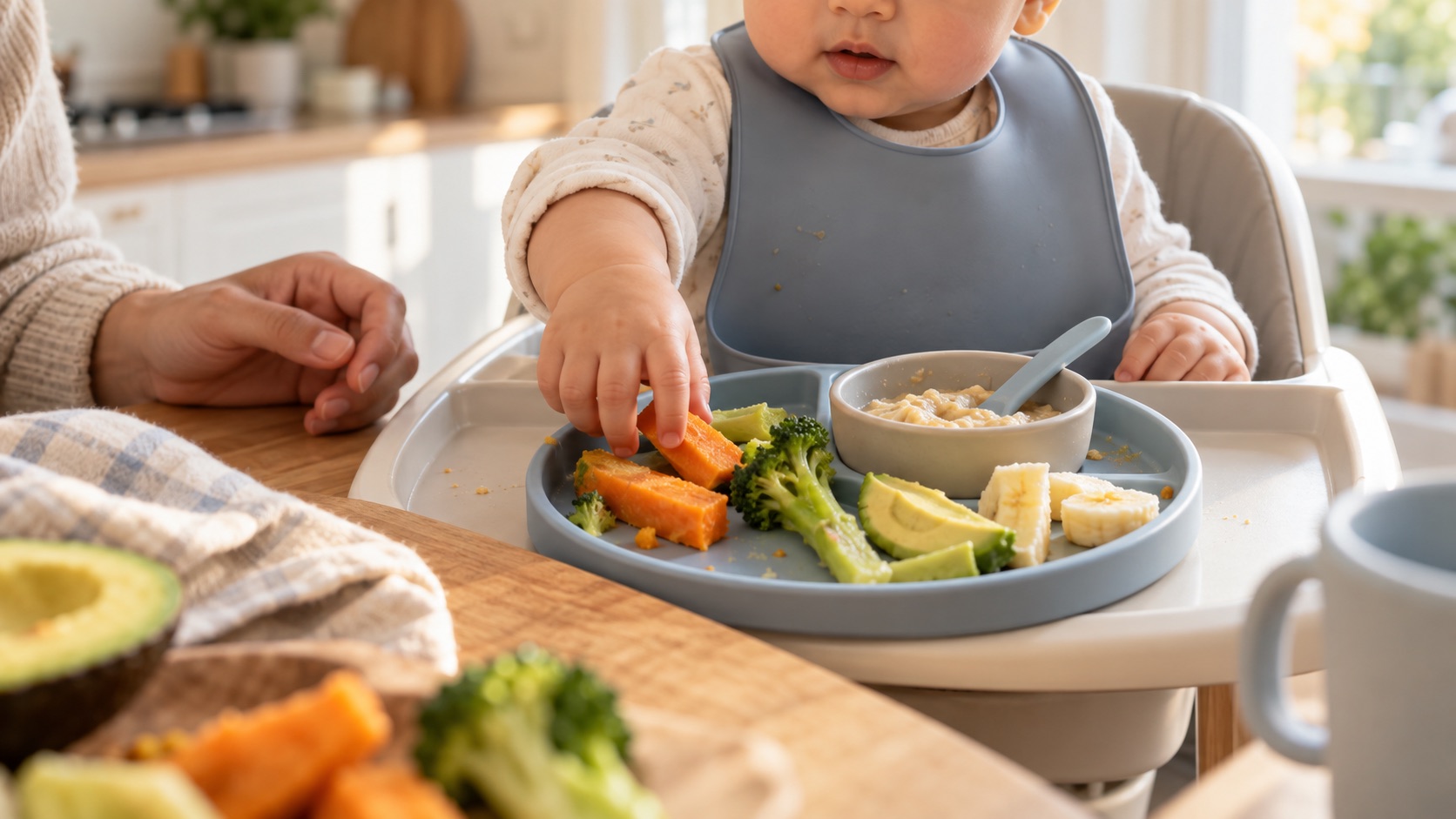
What are the best first foods for weaning?
The best first foods for weaning are simple, single foods that are soft, easy to prepare and gentle on a new tummy. At around six months, most babies begin with single vegetables and fruits, then quickly build up to a wider mix that includes iron-rich foods. The NHS suggests you "might want to start with single vegetables and fruits"[1], and gives a good starter list: "mashed or soft, cooked sticks of parsnip, broccoli, potato, yam, sweet potato, carrot, apple or pear"[1].
It helps to remember what these early meals are really for. In the first weeks your baby is learning, not being filled up. As the NHS puts it, the most important thing is "getting them used to new tastes and textures, and learning how to move solid foods around their mouths and how to swallow them"[1]. Milk is still doing the heavy lifting, and your baby will "still be getting most of their energy and nutrients from breast milk or infant formula"[1].
So a good plan for baby first foods has four parts: start with single vegetables (including some less sweet ones), add soft fruit, bring in iron-rich foods early, and offer a range of textures. The rest of this guide walks through each one, with rough amounts, a food-group table, and how to handle water and milk alongside.
Why start with single vegetables rather than sweeter fruit?
Babies are born liking sweet tastes, so fruit tends to be an easy sell. Vegetables, especially the more bitter ones, can take longer to win them over, which is exactly why it helps to offer them early and often. The NHS advises you "start weaning with vegetables that aren't so sweet, such as broccoli, cauliflower and spinach"[2].
The British Nutrition Foundation gives the same steer, suggesting you "offer a wide variety of vegetables and fruit, and try offering those with a savoury flavour first, such as courgette, green beans and broccoli"[7]. Offering single foods one at a time also makes it easier to learn what your baby likes and to notice if anything disagrees with them.
Do not read a screwed-up face as a firm no. New flavours often need several goes before they land. The Foundation notes it "may take 10 tries or more to get your baby used to new foods, flavours, and textures"[7], and the UK government's nutrition committee, SACN, says weaning foods "should have different textures and flavours and may need to be tried several times"[6].
Good to know: keep offering, gently
If your baby turns away from broccoli or spinach the first time, that is completely normal and not a sign they will never like it. Keep the food in the rotation and offer a small taste again another day. It can take ten or more relaxed tries before a new vegetable becomes familiar[7], so there is no need to force a single mouthful.
Which weaning first foods give your baby the iron they now need?
Iron is the one nutrient worth planning around. From about six months, milk on its own no longer covers everything a baby needs, and iron becomes especially important for healthy growth and development. That is why UK guidance singles it out. SACN advises that "a wide range of solid foods, including foods containing iron, should be introduced from around 6 months of age"[6], and the British Nutrition Foundation says plainly that "it is important to offer iron-rich foods from the beginning of complementary feeding"[7].
The NHS lists easy iron-rich options to work in from the start: "meat, fish, fortified breakfast cereals, dark green vegetables, beans and lentils"[1]. These protein foods pull double duty, as the NHS notes they "contain other useful nutrients, such as iron and zinc, which are important for babies"[2]. The Foundation's own list of good iron sources includes "red meat, such as pork, beef, or lamb; pulses, such as beans and lentils; tofu; green leafy vegetables; nuts (ground or smooth no-added sugar and salt nut butter, do not give whole); eggs"[7].
One practical point: "iron from non-meat sources is less well absorbed"[7], so if your family is vegetarian it is worth offering iron-rich plant foods often and pairing them with plenty of fruit and vegetables across the day. Fortified breakfast cereals with no added sugar, mixed with your baby's usual milk, are a simple way to add iron to the morning.
What texture should first foods be at around 6 months?
At six months you do not have to choose between purees and finger foods, and you do not have to stay on smooth food for long. Soft, mashed food and soft finger foods can both feature from the very start. The NHS suggests you "mash with a fork or blend soft ripe fruits to a suitable texture for your baby, or give them as finger foods"[2].
The aim is to move on as your baby manages more. The British Nutrition Foundation advises you "move from smooth purees and mashed foods to lumpier foods as soon as your baby is ready", adding that "soft finger foods can be given from the start of complementary feeding"[7]. The NHS agrees that, to help your baby get used to different textures and tastes quickly, you can "try moving on to mashed and finger foods"[3]. Handling lumps and soft pieces gives your baby valuable practice at chewing and moving food around the mouth, which also supports speech later on.
A soft finger food is ready when you can squash it easily between your finger and thumb. Cook harder vegetables and fruit, such as carrot or apple, until they are soft, and cut foods into pieces roughly the size of your own finger so they are easy to grab.
How much food should you offer at the start?
Very little, and there is no need to worry about clean plates. "Babies have tiny tummies", the NHS reminds parents, "so start by offering them small amounts of food (just a few pieces, or teaspoons of food)"[1]. The British Nutrition Foundation keeps it simple too, advising you "offer a small amount of solid food once a day"[7], and NHS Start for Life agrees your baby "only needs a small amount of solid food, once a day, at a time that suits you both"[2].
How much your baby actually eats matters far less than the practice of eating. "At the beginning, how much your baby eats is less important than getting them used to the idea of eating"[1], and the NHS is reassuring here: "do not worry about how much they eat"[1]. Let your baby set the pace and stop when they show they have had enough.
Timing helps. The NHS suggests you "start offering them food before their usual milk feed as they might not be interested if they're full, but do not wait until your baby is too hungry"[1]. Over the coming weeks the amount grows on its own. "From about 7 months, your baby will gradually move towards eating 3 meals a day (breakfast, lunch and tea), in addition to their usual milk feeds"[1], until eventually your baby can "eat the same foods as the rest of the family, in smaller portions"[1].
Which first foods can you offer by food group?
A balanced way to think about baby first foods is by food group. The table below gathers examples drawn from NHS and British Nutrition Foundation lists, with a note on how to prepare each at around six months.
| Food group | Good first-food examples | How to prepare at 6 months |
|---|---|---|
| Vegetables | Broccoli, cauliflower, spinach, cabbage, courgette, carrot, parsnip, butternut squash, green beans, peas | Steam or cook until soft, then blend, mash or serve as soft sticks[2] |
| Fruit | Pear, apple, banana, melon, peach, mango, avocado, plums, berries | Mash or blend soft ripe fruit; cook harder fruit such as apple without adding sugar[1][2] |
| Iron-rich proteins | Chicken, lamb, beef, boneless fish, well-cooked eggs, beans, lentils, tofu | Cook thoroughly, remove any bones, then blend, mash or offer as soft pieces[1][7] |
| Starchy foods | Potato, sweet potato, yam, cassava, pasta, rice, chapatti | Cook until soft, then mash or cut into grabbable pieces[1] |
| Fortified cereals | Fortified breakfast cereals, oats | Mix with your baby's usual milk to a smooth texture, with no added sugar[1] |
| Dairy in food | Full-fat plain yoghurt, pasteurised full-fat hard cheese | Use in cooking or on food, or as soft cheese sticks; not as a main drink under 1[1][6] |
Prepare foods so they are soft enough to squash between your finger and thumb, and always stay with your baby while they eat.
Does your baby need water when weaning?
Once solids begin, you can offer small drinks of water with meals. The NHS advises you "offer sips of water from a cup or beaker with meals"[4], and the cup itself matters: "using an open cup or a free-flow cup without a valve will help your baby learn to sip and is better for your baby's teeth"[4]. NHS Start for Life echoes this, suggesting that "during meal times, offer your baby sips of water from an open or free-flow cup"[3].
Learning to drink from an open or free-flow cup, rather than sucking from a valved beaker, helps your baby develop the muscles used for drinking and speaking, and it protects their new teeth. Water and milk are all that is needed. SACN advises that "breast milk, infant formula and water should be the only drinks offered between 6 and 12 months of age"[6], so there is no need for juice or other sweet drinks. For babies over six months, the NHS notes that "drinking water for babies over 6 months does not need to be boiled first"[4], and once your baby turns one, "feeding from a bottle should be discouraged"[4].
Do breast milk and formula still matter once solids start?
Yes, very much. Solid food is added alongside milk, not in place of it. The British Nutrition Foundation is clear that "breast milk (or formula) should be your baby's main drink until 12 months of age"[7], and the NHS says your baby's "main source of nutrition is still breast milk or first infant formula, so keep offering it to your baby on demand"[2].
Through the first year, milk keeps supplying most of your baby's energy and nutrients while solids gradually take on more of the job. The NHS advises parents to "continue to breastfeed or give your baby first infant formula until they're at least 1 year old"[4]. Cows' milk can be used in cooking or mixed with food from around six months[4], but it should not be your baby's main drink before their first birthday, since breast milk, formula and water are the only drinks recommended between six and twelve months[6].
Which foods should you leave out at first?
A short list of foods is best kept off the tray in the early months:
- Honey, until age one. "Do not give your child honey until they're over 1 year old"[5].
- Added salt. "Babies should not eat much salt, as it's not good for their kidneys. Do not add salt to your baby's food or cooking water, and do not use stock cubes or gravy, as they're often high in salt"[5].
- Added sugar. "Your baby does not need sugar"[5], so skip sugary foods and drinks to help protect their new teeth.
- Whole nuts. "Whole nuts should not be given to children under 5 years old, as they can choke on them"[5]. Nuts are still welcome ground finely or as a smooth, no-added-sugar nut butter[7].
None of this means your baby cannot share family meals. It simply means cooking without added salt, sugar or stock, and preparing foods so they are soft and safe.
How can you keep those first tastes safe?
Two habits prevent most trouble. First, never leave your baby alone with food: the NHS says to "always stay with your baby when they're eating in case they start to choke"[1]. Second, sit your baby up properly, because they "need to be sitting safely in an upright position (so they can swallow properly)"[1]. Do not offer food to a baby who is lying back, slumped, or sitting in a moving car seat or bouncer.
Prepare foods to remove the obvious choking risks: cook hard vegetables and fruit until soft, remove bones from fish and meat, and avoid whole nuts under five[5]. Gagging, where your baby noisily brings food forward, is common as they learn and is not the same as choking[10]. Because seconds matter in a real choking episode, many parents find it reassuring to learn infant first aid before weaning begins.
When to get urgent help
A baby who is coughing, crying or making any noise is only mildly choking, so give them a chance to clear it themselves: encourage them to keep coughing and do not intervene[8]. A baby who suddenly goes quiet and cannot cry, cough or breathe is severely choking, so shout for help, call 999 straight away, and start back blows followed by chest thrusts[8]. Their colour may change too, which on brown and black skin is often easiest to see on the gums, tongue, lips or the soles of the feet[11]. Call 999 as well for any severe allergic reaction, such as swelling of the lips, mouth, throat or tongue, or difficulty breathing[9]. If you are ever worried about your baby's feeding, weight or growth, speak to your health visitor or GP, or call NHS 111.
Frequently asked questions
What are the best first foods for weaning? Simple single foods: soft-cooked or mashed vegetables such as broccoli, carrot and parsnip, soft fruit such as pear and banana, and iron-rich foods such as meat, lentils and fortified cereal, offered from around six months of age[1][2].
Can I start with baby rice or fruit puree? You can, but they do not need to be the starting point, and it is worth going beyond sweet tastes. Offer plenty of vegetables, especially less sweet ones like broccoli and spinach, and bring in iron-rich foods early rather than staying on plain rice or fruit[2][6].
Do first foods have to be pureed? No. Smooth or mashed food and soft finger foods can both be offered from the start, and you move on to lumpier textures as soon as your baby is ready[2][7].
How much should a six-month-old eat? Only a small amount, once a day to begin with, and there is no need to worry about how much goes in. Milk still provides most of their energy and nutrients at this stage[1][7].
Should I give my baby water? Yes, offer sips of water from an open or free-flow cup with meals. Breast milk, formula and water are the only drinks needed between six and twelve months[4][6].
Does my baby still need milk? Yes. Breast milk or first infant formula stays their main drink through the first year, with solids added alongside[2][7].
Key takeaways
- The best first foods for weaning are simple single vegetables and soft fruit, offered from around six months[1][2].
- Offer less sweet vegetables like broccoli, cauliflower and spinach early, and expect to try new flavours several times before they are accepted[2][6][7].
- Bring in iron-rich foods from the start, such as meat, fish, beans, lentils and fortified cereal[1][6][7].
- Offer smooth or mashed food and soft finger foods, moving on through textures as your baby manages more[2][7].
- Start with small amounts once a day, offer water in an open or free-flow cup, and do not worry about how much they eat[1][4][7].
- Breast milk or formula stays the main drink through the first year; leave out salt, sugar and honey, and never give whole nuts under five[5][6][7].
How Tiny Timeline can help
Jotting down each new food as you offer it makes it easy to see what your baby has tried and to notice anything that seems to disagree with them. Tiny Timeline is a baby tracker, not a medical device, and nothing here replaces advice from your GP or health visitor.
References
- NHS – Your baby's first solid foods. https://www.nhs.uk/conditions/baby/weaning-and-feeding/babys-first-solid-foods/ (accessed Sep 2026)
- NHS Start for Life – What to feed your baby: from around 6 months. https://www.nhs.uk/start-for-life/baby/weaning/what-to-feed-your-baby/around-6-months/ (accessed Sep 2026)
- NHS Start for Life – What to feed your baby. https://www.nhs.uk/start-for-life/baby/weaning/what-to-feed-your-baby/ (accessed Sep 2026)
- NHS – Drinks and cups for babies and young children. https://www.nhs.uk/conditions/baby/weaning-and-feeding/drinks-and-cups-for-babies-and-young-children/ (accessed Sep 2026)
- NHS – Foods to avoid giving babies and young children. https://www.nhs.uk/conditions/baby/weaning-and-feeding/foods-to-avoid-giving-babies-and-young-children/ (accessed Sep 2026)
- SACN / GOV.UK – Feeding in the first year of life report. https://www.gov.uk/government/news/sacn-publishes-feeding-in-the-first-year-of-life-report (accessed Sep 2026)
- British Nutrition Foundation – Introducing solid foods to your baby. https://www.nutrition.org.uk/nutrition-for/baby/introducing-solid-foods-to-your-baby/ (accessed Sep 2026)
- NHS – How to stop a child from choking. https://www.nhs.uk/baby/first-aid-and-safety/first-aid/how-to-stop-a-child-from-choking/ (accessed September 2026)
- NHS – Food allergies in babies and young children. https://www.nhs.uk/baby/weaning-and-feeding/food-allergies-in-babies-and-young-children/ (accessed September 2026)
- NHS Best Start in Life – Choking and gagging on food. https://www.nhs.uk/best-start-in-life/baby/weaning/safe-weaning/choking-and-gagging-on-food/ (accessed September 2026)
- NHS – Blue or grey skin or lips (cyanosis). https://www.nhs.uk/symptoms/blue-skin-or-lips-cyanosis/ (accessed September 2026)