 Tiny Timeline
Gagging vs choking: safe finger foods and weaning safety
Gagging can look frightening, but it is a normal part of your baby learning to eat, and it is not the same as choking. This calm, evidence-based UK guide explains how to tell them apart, how to prepare finger foods safely, and exactly what to do in an emergency.
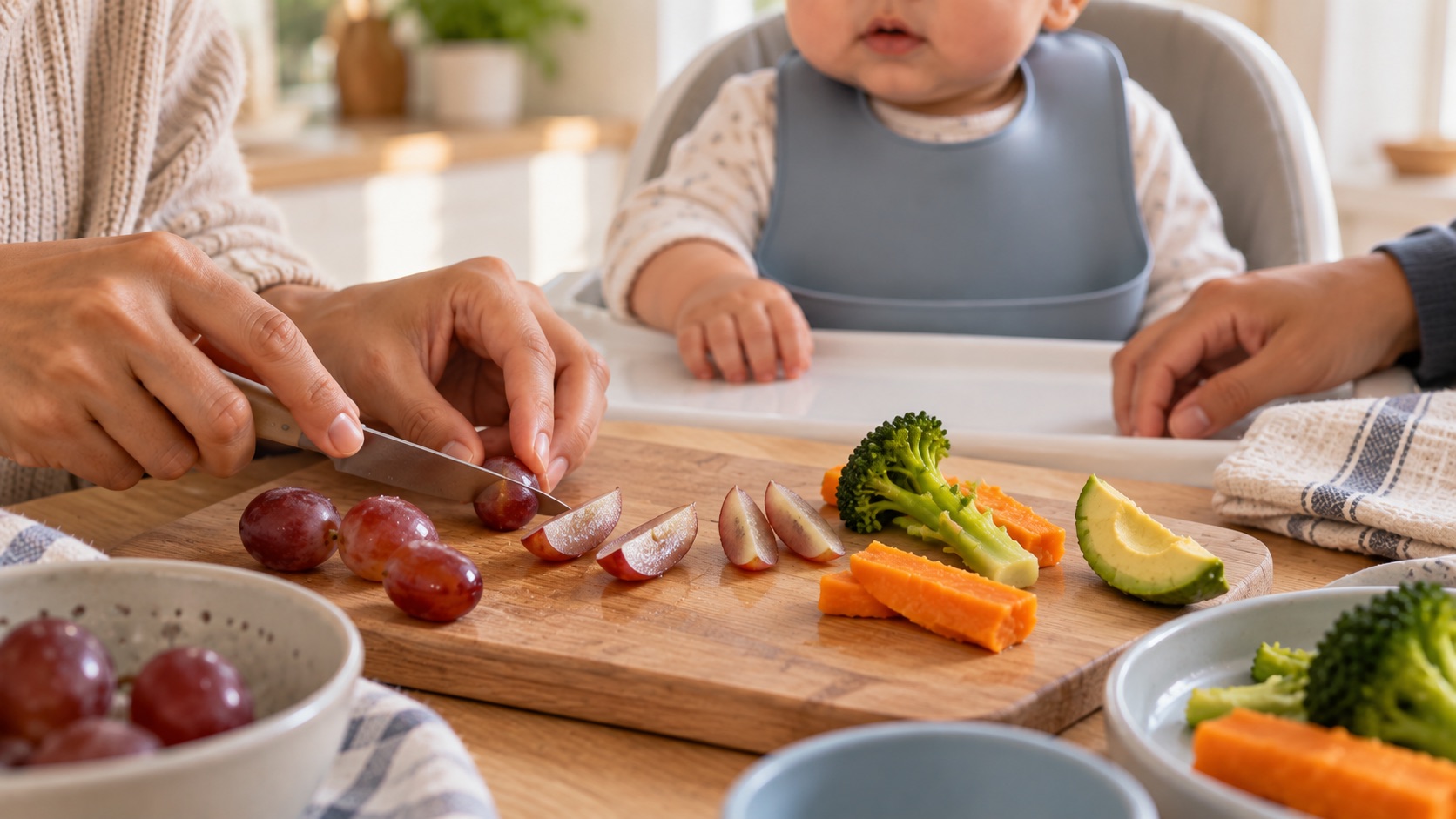
What is the difference between gagging and choking?
Learning to tell gagging vs choking apart is one of the most useful things you can do before your baby starts solid food. The two can look alike for a second, but they are very different. Gagging is a normal, protective reflex that moves food forward and away from the airway while your baby learns to chew and swallow. The NHS describes it as "a normal reflex as your baby learns to chew and swallow solid foods".[1] It is common, usually noisy, and most of the time your baby will sort the food out themselves.
Choking is different, and it is serious. It happens when food partly or fully blocks the airway so your baby cannot breathe. Unlike gagging, choking is usually quiet: the NHS puts the contrast simply, "Gagging is loud", while "Choking is quiet".[1] Knowing which you are looking at tells you whether to stay close, or to act at once.
It is general information, not a substitute for the hands-on first aid training every parent and carer is strongly encouraged to do.
Why does my baby gag, and what does it look like?
Gagging can be alarming to watch, but a lot of it is completely normal and even helpful. In babies, the gag reflex is triggered more easily than in adults, so food only has to travel a little way back before the reflex fires and pushes it forward again. It is your baby's built-in safety system while they learn to move food around their mouth and chew, and it happens more with lumps and finger foods at first, easing with practice. The NHS reassures parents that babies "will eventually learn to cope with different textures and harder foods".[1]
Gagging is loud and active. Your baby is still moving air, so you will usually hear coughing, spluttering or retching, and they may look busy rather than frightened. The NHS says that when a baby gags their "eyes may water", they "might push their tongue forward (or out of their mouth)", and they "might make a retching movement, or they may vomit", while the skin "may also look red when they're gagging".[1] Because your baby is dealing with the food themselves, the best thing you can usually do is stay close, stay calm and let them work it out. Watch for any change from this noisy, active picture to a quiet, still one, which points towards choking.
Good to know: gagging is part of learning
A baby who gags, coughs and splutters a little is usually managing the food themselves. Stay calm and let them work the food forward, rather than putting your fingers into their mouth, which can push food further back. Gagging is not a reason to avoid lumps or finger foods, because babies need that practice to learn to manage texture safely.[1]
How do I know if my baby is really choking?
Choking is quiet, and that is the single most important thing to remember. A blocked airway means your baby cannot move enough air to cough, cry or make a sound. The British Red Cross puts it plainly: "A baby who is choking won't be able to cry, make noise, cough or breathe".[6] St John Ambulance puts it the other way round: "if they can breathe, are making noises, or coughing, then they may be able to clear their own airway".[5] A weak or silent cough and no real sound are warning signs.
Skin colour can change as oxygen drops, and it helps to know where to look on every baby. The NHS advises: "If your child has white skin, it may begin to look blue (cyanosis) when they're choking. If they have brown or black skin, their gums, inside their lips, or their fingernails may begin to look blue".[1] On brown and black skin, colour change is much harder to see on the face, so check the gums, the inside of the lips, the nail beds and the inner eyelids, where a pale, grey or blue tinge often shows first. A baby may also look pale. If your baby cannot breathe, cry or cough, treat it as choking and act straight away.
| Sign | Gagging (usually normal) | Choking (emergency) |
|---|---|---|
| Sound | Loud: coughing, spluttering or retching | Quiet or silent, with little or no sound |
| Breathing | Still moving air; can usually cry | Cannot breathe, cry or cough properly |
| Face and skin | May flush red; eyes may water | May look pale or blue; on brown or black skin check gums, inside the lips, inner eyelids and nail beds |
| Movement | Tongue pushes forward, retching, may bring food back up or be sick | May look panicked and still; becomes limp if it continues |
| What it means | A protective reflex moving food away from the airway | The airway is partly or fully blocked |
| What to do | Stay close and calm; let your baby work the food forward | Act at once: back blows and chest thrusts, and call 999 |
How do I prepare safe finger foods for my baby?
Finger foods are an important part of weaning, and preparing them well is one of the best ways to lower the risk of choking. The NHS explains that "finger food is food that's cut up into pieces big enough for your baby to hold in their fist with a bit sticking out", and that "pieces about the size of your own finger work well".[2] A soft, finger-sized baton is easy to grab and gum, and long enough that a whole piece will not disappear into the mouth at once.
Aim for soft. Good early finger foods include soft cooked vegetable sticks such as carrot, broccoli or butternut squash, slices of soft fruit like banana, peach or melon, and soft, well-cooked meat, boneless fish, pasta or toast fingers.[2] A piece should squash easily between your finger and thumb. As your baby grows more confident, move on from purées to mashed, lumpy and finger foods, giving them the practice they need to learn to chew.[2]
Which foods are the biggest choking hazards, and how do I make them safer?
Some foods are risky because of their size, shape or texture. Round, hard and sticky foods are the main culprits, being just the right shape to plug a small airway or too firm to break down. Most can be made safer with preparation rather than avoided altogether.
Small round foods such as grapes and cherry tomatoes are a well-known danger. The NHS advises you "cut small, round foods, like grapes and cherry tomatoes, into quarters (4 small pieces)".[2] The Child Accident Prevention Trust explains why: "the size and shape of grapes means they can completely plug a child's airway", and the "tight seal produced by the grape's smooth surface makes them difficult to dislodge with standard first aid techniques".[7] Cut them lengthways: grapes "should be chopped in half lengthways and ideally in quarters", and keep cutting them up "for children up to five".[7]
Hard foods need softening or leaving out. The NHS says to "avoid hard foods like whole nuts, or raw carrot or apple".[2] You can still offer firm fruit and vegetables by "softening firm fruit and vegetables (like carrots, broccoli, yam and apples) by steaming or simmering until soft".[3] Whole nuts and popcorn should not be given under five: "whole nuts should not be given to children under 5 years old, as they can choke on them".[3][4] Give nuts finely ground or as smooth nut butter spread thinly on food, but do not "give nut butter on its own as your child could choke on it".[4]
Firm, tube-shaped foods such as sausages and hot dogs can plug the airway if sliced into coins. Instead, "cut sausages and hot dogs into short strips", cutting them "in half and then lengthways, or as thinly as possible", and remove the skin.[3] Take out stones, pips and bones: "remove hard pips and stones from fruits, and bones from meat or fish".[2] And watch sticky foods: "raw jelly cubes can be a choking hazard for babies and young children", with hard sweets and marshmallows best avoided too.[4][8]
| Food | Why it is a risk | How to make it safer |
|---|---|---|
| Grapes, cherry tomatoes, berries | Round, smooth and just the size to plug the airway | Cut lengthways into quarters; keep doing so for children up to five[2][7] |
| Whole nuts, popcorn | Hard and easily inhaled | None under 5; use finely ground nuts or smooth nut butter spread thinly, never on its own[3][4] |
| Raw carrot, apple and other hard fruit and veg | Too hard to chew; hard pieces can break off | Steam or simmer until soft[2][3] |
| Sausages, hot dogs | Round and firm; form a plug the shape of the airway | Remove skin; cut into short strips, halved then lengthways[3] |
| Fruit with stones or pips, meat or fish with bones | Hard bits can lodge in the airway | Remove pips, stones and bones before serving[2] |
| Raw jelly cubes, marshmallows, hard sweets | Sticky or hard; can mould to or block the throat | Avoid raw jelly cubes and hard sweets for young children[4][8] |
How should I set up mealtimes to keep my baby safe?
How and where your baby eats matters as much as what is on the tray. First, always stay with your baby. The NHS is clear: "always stay with your baby when they're eating in case they start to choke".[2] The Child Accident Prevention Trust calls staying with children while they eat "the biggest thing you can do for them".[8] Never leave a baby alone with food, even for a moment, and never prop a bottle.
Second, sit your baby fully upright and supported, because your baby "needs to be sitting safely in an upright position (so they can swallow properly)".[2] In practice that means an upright highchair with a securely fitted harness, with your baby "alert and seated safely upright in a highchair while eating".[3] A reclined or slumped baby cannot swallow safely, so do not feed your baby in a car seat, bouncer, swing or pram, or while being carried.
Third, keep mealtimes calm and still. The Child Accident Prevention Trust advises you to "get children to sit still", admitting it "can be a battle but it's much safer".[8] Meals should not happen on the move, with no eating while walking, crawling, playing or in a moving buggy, and no games or screens that pull attention away from eating. One attentive adult and an unhurried meal make choking much less likely.
What should I do if my baby is choking?
If your baby cannot cry, cough or breathe, act immediately and get help on the way. The steps below follow NHS, St John Ambulance and British Red Cross guidance for a baby under one year old. Read them now, but please also learn them hands-on, because reading is not the same as practising on a training doll, and seconds count.
If your baby is choking, act now: back blows and chest thrusts
1. Shout for help and check. Serious choking is usually silent: if your baby cannot cry, cough or breathe, they are choking. The NHS says to "shout for help" and "get them out of the high chair".[1] If someone is with you, ask them to call 999 straight away.
2. Give up to 5 back blows. Lay your baby face down along your thigh or forearm with their head lower than their bottom, supporting their head. Give up to five firm blows "between the shoulder blades" with the heel of your hand.[1][5][6] Check the mouth after each blow and remove anything obvious, but do not sweep the mouth with your finger, as this can push the object further in.
3. Give up to 5 chest thrusts. If back blows do not work, turn your baby over so they are facing upwards. Place two fingers "in the middle of their chest just below the nipples" and "push sharply downwards up to five times".[6] Never use abdominal thrusts on a baby: "using abdominal thrusts on a baby could damage their internal organs, which are fragile and still developing".[6]
4. Call 999 and keep going. If the blockage has not cleared, "call 999 or 112 for emergency help", and keep repeating cycles of five back blows and five chest thrusts until help arrives or the airway clears.[5] If your baby becomes unresponsive, start infant CPR. Any baby who has needed chest thrusts should be seen in hospital, even if they seem fine.[5]
This callout is a memory aid, not a training course, and cannot replace hands-on first aid. If in doubt, call 999 and the operator will talk you through what to do.
Should I do a baby first aid course?
Yes. If you take one thing from this guide, let it be this: book a baby or paediatric first aid course before, or soon after, your baby starts solids. Choking happens fast and quietly, and the difference between a frightening moment and a tragedy is often a carer who knows what to do. As the Child Accident Prevention Trust puts it, "knowing what to do if your child is choking means you give your child the best chance of recovery".[8]
Short courses for parents and carers are widely available in the UK, including from St John Ambulance and the British Red Cross, and both also publish free step-by-step baby first aid guidance and videos online.[5][6] A hands-on session lets you practise back blows and chest thrusts on a training doll and ask questions, which is far more useful than reading alone.
Frequently asked questions
My baby gagged, went red and their eyes watered. Is that dangerous? Usually not. Gagging is a normal, protective reflex that moves food away from the airway, and a red face, watering eyes, a pushed-out tongue, retching and being a little sick are all typical.[1] Your baby is still breathing and is managing the food. Choking is different: it is quiet, and the baby cannot cry, cough or breathe. That is an emergency.[6]
Is baby-led weaning more likely to cause choking than purées? Whichever method you use, the safety rules are the same: sit your baby upright, stay with them, and prepare foods to a safe size, shape and softness.[2][3] Gagging can happen with both. Cutting hazards like grapes lengthways and softening hard foods matters either way.
Do I still need to cut up grapes once my baby has teeth? Yes. Young children are still learning to chew and have small airways, so grapes and other small round foods should be cut lengthways into quarters, and it is best to keep doing this for children up to five.[7] Front teeth do not mean a child can safely grind food at the back yet.
Should I put my fingers in to pull food out? Do not do a blind finger sweep of the mouth, because it can push the object further down. Only remove something you can clearly see and easily reach.[5] If your baby is choking, use back blows and chest thrusts and call 999.[6]
Which foods should I never give a baby? Avoid whole nuts and popcorn under five, do not give nut butter on its own, avoid raw jelly cubes and hard sweets, and do not give honey until your baby is over one.[4][8] Other foods are fine once prepared safely, for example soft, finger-sized pieces with skins, stones and bones removed.[2]
Key takeaways
- Gagging is loud, choking is quiet. Gagging is a normal reflex that moves food forward; choking means the airway is blocked and the baby cannot cry, cough or breathe.[1][6]
- Know where to look for colour change. A choking baby may go pale or blue; on brown and black skin, check the gums, inside the lips, the nail beds and inner eyelids.[1]
- Prepare finger foods safely: soft, finger-sized pieces, with grapes and cherry tomatoes cut lengthways into quarters and hard foods softened.[2][3][7]
- Avoid the high-risk foods: no whole nuts or popcorn under five, no nut butter on its own, and no raw jelly cubes or hard sweets.[3][4][8]
- Set mealtimes up well: always supervise, sit your baby fully upright (never in a car seat or pram), and keep them still and free of distractions.[2][3][8]
- Learn the emergency steps and call 999. Back blows then chest thrusts, never abdominal thrusts on a baby, and do a hands-on baby first aid course, because this article is not a substitute for training.[5][6][8]
How Tiny Timeline can help
Tiny Timeline lets you log which foods you have offered and when, so it is easy to introduce new textures one at a time and keep track of anything that does not seem to agree with your baby. Tiny Timeline is a baby tracker, not a medical device, and nothing here replaces advice from your GP or health visitor.
References
- NHS Start for Life – Choking and gagging on food (safe weaning). https://www.nhs.uk/start-for-life/baby/weaning/safe-weaning/ (accessed Sep 2026)
- NHS – Your baby's first solid foods. https://www.nhs.uk/conditions/baby/weaning-and-feeding/babys-first-solid-foods/ (accessed Sep 2026)
- NHS Best Start in Life – Preparing food safely for babies. https://www.nhs.uk/best-start-in-life/baby/weaning/safe-weaning/preparing-food-safely/ (accessed Sep 2026)
- NHS – Foods to avoid giving babies and young children. https://www.nhs.uk/conditions/baby/weaning-and-feeding/foods-to-avoid-giving-babies-and-young-children/ (accessed Sep 2026)
- St John Ambulance – How to help a choking baby (under one year old). https://www.sja.org.uk/first-aid-advice/baby-choking/ (accessed Sep 2026)
- British Red Cross – First aid for a baby who is choking. https://www.redcross.org.uk/first-aid/learn-first-aid-for-babies-and-children/choking-baby (accessed Sep 2026)
- Child Accident Prevention Trust – Why are grapes so dangerous?. https://capt.org.uk/why-are-grapes-so-dangerous/ (accessed Sep 2026)
- Child Accident Prevention Trust – Safe from choking: how to prevent choking in children. https://capt.org.uk/choking-prevention/ (accessed Sep 2026)