 Tiny Timeline
Introducing allergens safely: peanut, egg and spotting a reaction
Introducing the common allergy-causing foods can feel daunting, but current UK advice is clear and reassuring. This is a calm, evidence-based guide to offering peanut, egg and the other main allergens from around 6 months, keeping them in the diet once tolerated, and telling a mild reaction from a serious one.
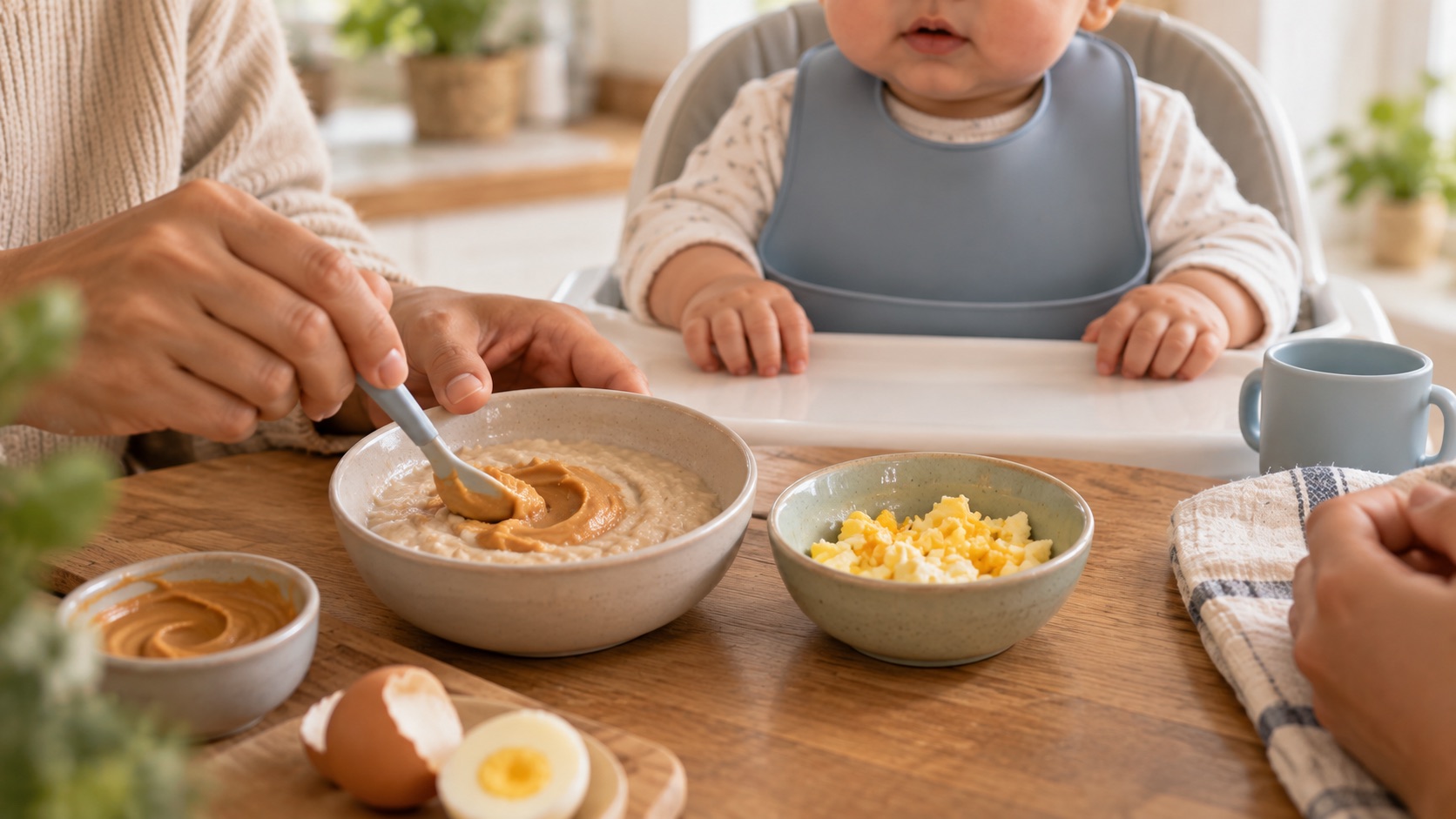
Introducing allergens to your baby is one of the parts of weaning that worries parents most, and it is also one where the advice has changed a great deal. For years the habit was to hold peanut and egg back for as long as possible. Current UK guidance is the opposite: offer the common allergy-causing foods from around 6 months, alongside your baby's other solids, and once your baby is happy with each one, keep it in their diet.[1] This guide covers when and how to do that safely, how to give peanut and egg in particular, and how to tell a mild reaction from a serious one, with exactly what to do if it happens.
When should you start introducing allergens to your baby?
Start offering the common allergen foods when you start solids, at around 6 months, and not before 4 months. There is no need to leave them until later. The NHS advises that when you start solid foods "from around 6 months old" you should "introduce the foods that can trigger allergic reactions one at a time so that you can spot any reaction".[1] Anaphylaxis UK gives the same window: "from around six months of age (but not before four months), introduce complementary foods (solids)".[5] The allergy specialists at BSACI agree: "from approximately 6 months old (not before 4 months), introduce complementary foods", including the ones known to cause allergies.[6]
Allergen foods go in alongside first tastes such as vegetables and fruit, not instead of them. BSACI notes that egg, then peanut, "should only be introduced once the baby is eating solid foods such as pureed fruits and vegetables".[6] So begin with a few simple foods, and once your baby is managing those, start working the allergens in one by one. Milk still matters too: breast milk or first infant formula stays your baby's main drink through the first year,[7] and cows' milk should not be a main drink before 1,[8] so these early allergen tastes are about learning, not about filling your baby up.
Which foods are the common allergens?
Most serious food allergies are triggered by a fairly short list of foods. The NHS names the ones to introduce carefully as "eggs, nuts and peanuts, cows' milk, foods that contain gluten, beans, lentils and peas, seeds, soya, shellfish, fish, celery, mustard, sulphur dioxide".[1] A food allergy involves the immune system, which is why introducing these foods one at a time and watching for a reaction is the whole point of the approach. Peanut and hen's egg are the two the guidance is most specific about, because introducing them in the first year is where the strongest evidence sits. The table below shows a baby-friendly way to offer each one.
| Allergen food | A safe way to offer it to a baby |
|---|---|
| Egg | Well cooked until the white and yolk are solid; mashed into puree, yoghurt or baby cereal |
| Peanut | Smooth peanut butter or fine peanut powder, thinned into your baby's usual food; never whole nuts |
| Tree nuts | Finely ground, or as a smooth nut butter mixed into food; never whole or chopped under 5 |
| Cows' milk | In cooking, or as yoghurt and full-fat cheese; not as a main drink before 1 |
| Gluten (wheat, barley, rye) | Well-cooked pasta, toast fingers, or a wheat breakfast cereal |
| Seeds (especially sesame) | Finely ground, or as smooth tahini or hummus |
| Fish and shellfish | Cooked and flaked, bones removed; shellfish never raw or lightly cooked |
| Soya, celery, mustard | As part of your normal family meals, in an age-appropriate form |
Offer foods only in a form that suits your baby's stage, to avoid choking.
Why introduce peanut and egg early rather than waiting?
This is the single biggest change in modern advice, and it matters most for introducing peanut to your baby and knowing when to introduce egg to your baby. Far from protecting your baby, leaving these foods out can backfire. The NHS warns that "delaying the introduction of peanut and hen's eggs beyond 6 to 12 months may increase the risk of developing an allergy".[1] BSACI puts it plainly: "introduction of these allergenic foods within the first year of life appears to be safe", and "early introduction of peanut and egg alongside other solids, or by one year of age, may help prevent development of food allergy".[6]
The practical message is to get peanut and egg in during the first year and then keep them going. The BSACI and British Dietetic Association guidance for parents says to "aim to introduce egg and peanut by 12 months of age, and continue to give them to your baby regularly as part of their usual diet".[7]
How do you introduce peanut to your baby safely?
The golden rule is form: never a whole nut, and never a thick lump. Whole nuts are a choking hazard, and the NHS is clear that "whole nuts should not be given to children under 5 years old, as they can choke on them".[3] You can still give peanut from the start of weaning as long as it is "crushed or ground and added to food", but you should "not give nut butter on its own as your child could choke on it".[3] On the food-allergy side, the NHS says to serve nuts and peanuts "finely ground or as nut butters".[1]
In practice, the BSACI and BDA guidance suggests you can "use smooth peanut butter, 'puffed peanut' snacks, or grind whole peanuts to a fine powder", then "mix with pureed fruits/vegetables, yoghurt, porridge, baby cereals etc. or add to baby's milk".[7] A simple starting recipe is to "mix 1 teaspoon of smooth peanut butter with 1 tablespoon of warm water (boiled) or baby's milk, or some pureed fruit/vegetable", aiming for "a total of 2 level teaspoons per week".[7]
Good to know: thin it down
Smooth peanut butter straight from the jar is thick and sticky, which is a choking risk on its own. Always loosen it into your baby's milk or a puree first, and the same goes for other nut and seed butters. As the parent guidance warns, "never give whole nuts, coarsely-chopped nuts or chunks of peanut butter to children under 5 years of age, as these are a choking risk".[7]
How do you introduce egg to your baby safely?
Egg is one of the easiest allergens to offer, as long as it is well cooked. The NHS says hens' eggs without the red lion mark "should be cooked until both the white and yolk are solid",[3] and that "eggs without a red lion stamp should not be eaten raw or lightly cooked".[1] With British Lion-stamped eggs you have a little more freedom: the parent guidance says you can "offer your baby scrambled egg, omelette, soft or hard-boiled egg", and can "mash egg into other foods e.g. pureed fruit/vegetables, yoghurt, or baby cereals".[7] A good aim is "at least 1 egg over the course of a week".[7] If you are not using Lion-stamped eggs, "only give well-cooked or hard-boiled egg".[7]
How should you introduce allergens, one at a time?
The reason for going one allergen at a time is simple: if your baby reacts, you know which food to blame. The NHS advice is to "introduce the foods that can trigger allergic reactions one at a time so that you can spot any reaction".[1] The parent guidance adds the how: "introduce each new food one at a time (don't give 2 new foods on the same day)", and "start low", about a quarter to half a teaspoon, "and then increase slowly over the next few days".[7]
A few habits make reactions easier to catch. Choose a day when your baby is well, offer the new food earlier in the day so you can watch them over the next couple of hours, and introduce it slowly. It also helps to know that some harmless things look alarming: acidic foods like citrus, tomato and strawberry "can irritate the skin and cause a red rash (especially around the mouth)", which "is not food allergy".[7]
Keep each food going once it is tolerated. This is the step families most often forget. The NHS says that "once introduced and if tolerated, these foods should become part of your baby's usual diet to minimise the risk of allergy".[1] Anaphylaxis UK suggests you "continue to offer these foods regularly (ideally at least a couple of times a week)",[5] and the parent guidance is to keep giving the food "at least once per week".[7]
Which babies are higher risk, and should you check first?
Two groups of babies are more likely to react and should get tailored advice before you begin: those with severe eczema and those who already have a diagnosed food allergy. Getting advice almost never means avoiding allergens. Usually it means introducing them in a planned, supported way, and it should not push egg and peanut past 12 months of age.[6][7]
Good to know: get advice first if your baby is higher risk
The NHS says that "if your baby already has an allergy, such as a diagnosed food allergy or eczema, or if you have a family history of food allergies, eczema, asthma or hay fever", you should "talk to your GP or health visitor first".[1] BSACI likewise recommends that carers of "infants with pre-existing food allergy and/or severe eczema speak to a healthcare professional for advice on allergen introduction".[6] Anaphylaxis UK lists the higher-risk groups as "babies with eczema (particularly severe eczema)" and "babies who already have a food allergy", and advises following the guidance "in consultation with your baby's GP, Health Visitor or Allergy Specialist".[5]
What does a mild allergic reaction look like?
Most reactions are mild, and they "usually happen quickly within a few minutes of your baby trying a new food, but it may take up to 2 hours for symptoms to appear". With cows' milk allergy, "it can take up to 3 days".[1] The NHS lists mild-to-moderate signs to watch for:[1]
- "swollen lips or face", or "red, itchy, watery eyes"
- "a red, itchy rash", or "worsening of eczema symptoms"
- "wheezing and coughing", sneezing, or a runny or blocked nose
- "feeling or being sick", "tummy pain", or a change in nappies (diarrhoea or constipation)
Skin signs look different on different skin tones. A raised, itchy rash (hives) is a classic sign, but colour is not a reliable guide on brown and black skin. The NHS notes that hives "look pink or red when affecting someone with white skin", while "the colour of the rash can be harder to see on brown and black skin".[4] On brown and black skin the rash can be the same colour as the surrounding skin, so look and feel for "raised bumps or patches" and for any swelling, rather than waiting to see redness.[4] If you notice mild signs, stop that food and get advice from your GP, health visitor or NHS 111.[7]
What does a severe reaction look like, and what should you do?
Very occasionally a food causes anaphylaxis, a severe, whole-body reaction that comes on fast and is a medical emergency. The NHS describes it as "a life-threatening allergic reaction that happens very quickly".[2] You do not need to be certain it is anaphylaxis to act. If you see any of the signs below, treat it as an emergency straight away.
Call 999 now if your baby has any of these
A severe reaction can affect breathing, the mouth and throat, and how your baby responds. Watch for:
- Swelling of the mouth or throat: the NHS lists "swelling of your throat and tongue", or lips, mouth, throat or tongue that "suddenly become swollen".[2]
- Breathing difficulty: "difficulty breathing or breathing very fast", or "wheezing, coughing or noisy breathing".[2]
- Floppiness or not responding: "a child is limp, floppy or not responding like they normally do".[2]
- Pale, blue or grey colour: "blue, grey or pale skin, lips or tongue"; on brown or black skin this "may be easier to see on the palms of your hands or soles of your feet", so also check the gums and inside the lips.[2]
The parent guidance is blunt: "if your baby has any severe symptoms (anaphylaxis), immediately dial 999 for help".[7] The NHS says the same: "call 999 if you think you or someone else is having an anaphylactic reaction".[2] Do not wait to see if it passes, and do not drive to hospital yourself. Tell the 999 operator it may be a food allergy, and if your baby becomes unresponsive be ready to start infant CPR.
How do you keep allergen introduction safe from choking too?
Allergy is not the only feeding risk, and the two overlap: several allergens are exactly the foods that need care with texture. Always give allergens in a smooth or soft, age-appropriate form, and "always stay with your baby when feeding them, to reduce the risk of choking".[7] Stick to no whole nuts under 5, no thick lump of peanut or nut butter, and no honey, which the NHS says you should "not give your child ... until they're over 1 year old".[3] Cows' milk can be used in cooking from around 6 months but should not be your baby's main drink before they are 1.[8]
Frequently asked questions
When should I introduce peanut and egg to my baby? From around 6 months, alongside other solids, and not before 4 months. Do not leave peanut and hen's egg out, because delaying them beyond 6 to 12 months may raise the risk of an allergy.[1][6] Introduce them one at a time so you can spot any reaction.[1]
How do I give peanut butter to a baby safely? Use smooth peanut butter or fine peanut powder, and thin it into your baby's milk or a puree rather than giving a spoonful on its own.[7] Never give whole nuts or chunks of peanut butter to a child under 5, as they are a choking hazard.[3]
Do I really have to introduce allergens one at a time? Yes. Giving one new allergen at a time, starting with a small amount, means that if your baby reacts you know which food caused it.[1][7]
My baby has eczema. Is it still safe to introduce allergens? Babies with severe eczema or an existing food allergy are higher risk and should have advice from a GP or health visitor first.[1][5][6] This usually means a planned introduction rather than avoiding the foods, and it should not delay egg and peanut beyond 12 months.[6][7]
How soon after a food would a reaction show? Usually within minutes, though it can take up to 2 hours, and for cows' milk sometimes up to 3 days.[1]
What if I see swelling or trouble breathing? Treat it as anaphylaxis and call 999 straight away.[2] Signs include swelling of the mouth or throat, difficulty breathing, and your baby becoming floppy or unresponsive.[2][7]
Key takeaways
- Start introducing allergens to your baby from around 6 months, alongside other solids, and never before 4 months.[1][6]
- Do not delay peanut and egg; once your baby tolerates a food, keep it in the diet regularly.[1][5]
- Give peanut as smooth peanut butter or fine powder thinned into food, and egg well cooked; never whole nuts under 5.[3][7]
- Introduce allergens one at a time, starting small, so any reaction is easy to trace.[1][7]
- Babies with severe eczema or an existing food allergy should get GP or health-visitor advice first.[1][5][6]
- A mild reaction means stop the food and get advice; a severe reaction (swelling of the mouth or throat, breathing difficulty, floppiness) means call 999.[2][7]
How Tiny Timeline can help
When you introduce allergens one at a time, a quick note of each new food and any reaction in Tiny Timeline gives you a clear record to look back on, and to show your GP or health visitor if you ever need to. Tiny Timeline is a baby tracker, not a medical device, and nothing here replaces advice from your GP or health visitor.
References
- NHS – Food allergies in babies and young children. https://www.nhs.uk/baby/weaning-and-feeding/food-allergies-in-babies-and-young-children/ (accessed Sep 2026)
- NHS – Anaphylaxis. https://www.nhs.uk/conditions/anaphylaxis/ (accessed Sep 2026)
- NHS – Foods to avoid giving babies and young children. https://www.nhs.uk/conditions/baby/weaning-and-feeding/foods-to-avoid-giving-babies-and-young-children/ (accessed Sep 2026)
- NHS – Hives. https://www.nhs.uk/conditions/hives/ (accessed Sep 2026)
- Anaphylaxis UK – Infant Weaning Guide. https://www.anaphylaxis.org.uk/living-with-serious-allergies/infant-weaning/ (accessed Sep 2026)
- BSACI (British Society for Allergy & Clinical Immunology) – Early introduction of food allergens. https://www.bsaci.org/resources/allergy-management/food-allergy/allergy-prevention/early-introduction-of-food-allergens/ (accessed Sep 2026)
- BSACI / British Dietetic Association – Preventing food allergy in your baby: a summary for parents. https://www.bsaci.org/wp-content/uploads/2020/02/pdf_Infant-feeding-and-allergy-prevention-PARENTS-FINAL-booklet.pdf (accessed Sep 2026)
- NHS – Drinks and cups for babies and young children. https://www.nhs.uk/conditions/baby/weaning-and-feeding/drinks-and-cups-for-babies-and-young-children/ (accessed September 2026)