 Tiny Timeline
Toddler Screen Time: How Much Is Okay? (2026)
If your toddler loves the tablet and you feel a flicker of guilt, please set that down for a moment. Screen time is one of the most common worries for parents of little ones, and the honest answer is kinder than the headlines suggest. This gentle, up-to-date guide sets out what the latest advice from the UK Government, the World Health Organization and the American Academy of Pediatrics really says. We cover how much is okay by age, why quality matters more than the clock, the video call exception, and how to handle screen time battles calmly, with no shame and no lectures.
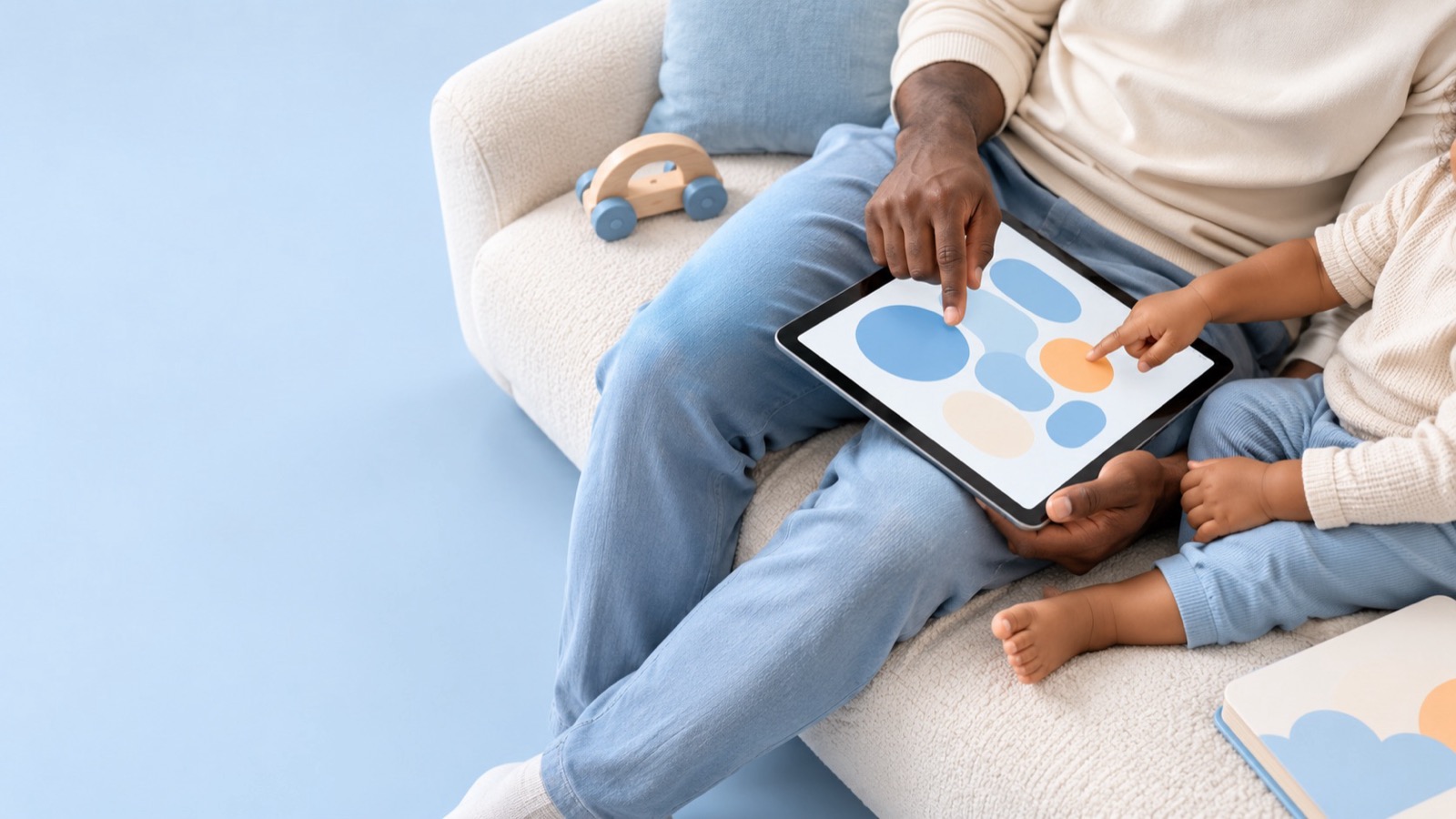
How much screen time is okay for a toddler?
The right amount of screen time depends on your toddler's age. Under 1, screens are not recommended.[2] For 1-year-olds, still avoid them where you can.[1][2] From age 2 to 5, aim for no more than 1 hour a day, and less is better.[1][2] Quality, and watching together, matter more than the exact minutes.[1][5]
That is the shared message from the World Health Organization (WHO) in 2019, the UK Government in 2026, and the American Academy of Pediatrics (AAP).[1][2][4] But the newest advice has shifted its focus. It now cares less about counting minutes, and more about what your child watches, and whether you are there beside them.[1][5] And video calls with family, like a chat with Granny, do not count.[1][6]
If that already feels like a relief, good. Below, we walk through the guidance by age, explain why quality beats quantity, and share calm ways to handle the day-to-day, including that moment you say "screen off" and the storm begins.
Is screen time bad for toddlers? Why quality beats quantity
For years, screen time advice was mostly about a number. Watch the clock, count the minutes, feel bad. The newest guidance takes a warmer and more useful view.
In January 2026, the American Academy of Pediatrics set out a major new policy statement, "Digital Ecosystems, Children, and Adolescents".[5] It looks at a child's whole media world, not just the timer. It offers a simple checklist some call the 5 Cs: Child, Content, Calm, Crowding out, and Communication.[5] In plain words: who your child is, and what they watch. Whether a screen is your only way to settle them, and what it pushes out, like sleep, play and talk. And whether you talk together about it all.
The UK Government's 2026 guidance takes the same line. It asks parents to think about quality, not only quantity. As it puts it, "slow-paced, predictable content is better for young brains".[1] And it stresses watching together, suggesting you "try watching and discussing content together with your child as it supports their development".[1]
So why the caution with very young children at all? Because under-2s learn best from the real, hands-on world. The AAP explains that "children younger than 2 learn best from exploring the world around them and playing with other children and adults".[7] A screen is flat. A cuddle, a song, a game of peekaboo and a trip to the shops all do far more for a growing brain.
There is also the simple matter of what a screen replaces. UK health advice is clear that little ones need to move. The NHS says "children under 5 should not be inactive for long periods, except when they're asleep".[3] It adds that toddlers "should be physically active every day for at least 180 minutes (3 hours)".[3] Long stretches at a screen, like long stretches strapped in a buggy, crowd out the play, sleep and chatter toddlers thrive on.[3]
It helps to know the experts are careful here too. The guidance focuses on protecting what toddlers need, like sleep, movement, play and time with you. It does not claim a screen will harm every child. That is a kinder, and more honest, place to start.
Toddler screen time guidelines by age
Here is how the main guidance lines up by age. Treat the numbers as broad aims, not pass-or-fail targets. Every family, and every day, is different.
| Age | What current guidance suggests | The idea behind it |
|---|---|---|
| Under 1 | No screen time. The WHO says for infants "screen time is not recommended"[2] | Babies learn through faces, touch, sound and movement, not screens[7] |
| 1 year | Still no screens, ideally. The WHO says for 1-year-olds screen time "is not recommended"[2] | Play, books and chatter do far more at this age[1][2] |
| 2 years | No more than 1 hour a day, and less is better.[2] UK advice for ages 2 to 5: "try to keep it to 1 hour a day. Less if possible"[1] | Quality and watching together matter more than the minutes[1][5] |
| 3 to 5 years | Still no more than 1 hour a day of good content, less is better[1][2] | Choose slow, calm programmes, and watch with them[1] |
Babies under 1: no screens, and that is okay
The World Health Organization's 2019 guidance is clear. For babies, "screen time is not recommended".[2] Instead, it suggests that "when sedentary, engaging in reading and storytelling with a caregiver is encouraged".[2] A picture book on your lap beats any app. And if a screen does creep in on a hard day, you have not ruined anything. Just aim to keep it rare.
Screen time for a 1-year-old: play comes first
The advice barely changes at 1. The WHO still says screen time "is not recommended" for 1-year-olds.[2] The UK Government suggests that under-2s "avoid screen time other than for shared activities with family that encourage bonding, interaction and conversation".[1] So if you do use a screen, make it something you share, like looking through family photos together.[1]
Ages 2 to 5: an hour a day at most, watched together
From age 2, a little screen time is fine. The WHO advises "no more than 1 hour; less is better".[2] The UK Government agrees, asking families to "try to keep it to 1 hour a day. Less if possible".[1] The AAP lands in the same place.[4] For this age it suggests no more than about an hour a day of high-quality programmes, watched together.[4] The theme across all three is the same. What they watch, and whether you are near, matters more than a strict count.[1][5]
The video call exception: call Granny any time
One lovely exception runs through all the guidance. Video calls are not counted like other screen time. The UK Government notes that shared activities "could include video calling with friends and family".[1] The AAP puts it beautifully, saying a video chat "shouldn't be considered 'screen time'", because "it's relationship time".[6] So a giggly call with grandparents is a good thing, not a guilty one.
Do the experts all agree?
Mostly, yes, and that is reassuring. The WHO set out its numbers in 2019.[2] The UK Government refreshed its under-5s guidance in 2026.[1] The AAP updated its position in January 2026.[5] The one clear change over time is tone. Newer guidance leans away from a rigid hour count, and towards quality, company, and protecting sleep and play. In the UK, the Royal College of Paediatrics and Child Health welcomed the 2026 guidance,[8] calling it "a much welcome resource to help parents protect those short, but developmentally crucial early years".[8]
How to reduce and improve your toddler's screen time
If your child is aged 2 to 5 and watches a little, here is how to make it count, and gently trim it, drawn straight from the current guidance.
- Choose slow, calm content. UK guidance says "slow-paced, predictable content is better for young brains".[1] Look for simple stories, few characters and unhurried pacing. Skip fast, flashy, endless-scroll videos.[1]
- Watch together where you can. Co-viewing turns a screen into a shared moment. The guidance suggests you "try watching and discussing content together with your child".[1] Chat about what you see, name things, ask little questions. This is how toddlers learn best.[7]
- Keep screens out of bedrooms and mealtimes. UK advice is to "keep bedrooms and mealtimes free from screens".[1] At the table, you could swap the screen "for background music, simple conversation, table games, colouring or even 'I Spy'".[1]
- Switch off an hour before bed. Screens close to bedtime can affect sleep. The guidance is to "avoid screens for the hour before bed".[1] The AAP likewise suggests no screens in the hour before sleep.[4] Try a bath, a story and a cuddle instead.[1]
- Be the model. Little ones copy us. As the UK guidance puts it, children "copy your screen use habits".[1] So it helps to "be mindful of how often you use your phone around your child".[1]
- Say yes to video calls. A call with a grandparent or a faraway friend is connection, not screen time to fret about.[1][6]
- Do not lean on the screen to calm. A screen now and then to get through a haircut is fine. But the AAP suggests avoiding using media as the only way to calm your child, so they also learn other ways to settle.[4]
How to turn off the screen without a meltdown
Ending screen time can trigger a meltdown. That is normal, not naughty. A toddler brain is not yet built for smooth switches or big feelings. Here is how to keep it kind.
- Give a warning. A heads-up softens the landing. Try "two more minutes, then we turn it off", and then follow through.
- Offer a small choice. Toddlers love a little control. "Shall we read the bear book or the tractor book next?" moves them on without a fight.
- Have the next thing ready. It is easier to leave a screen for something, not nothing. Line up a snack, a bath, or a job to "help" with.
- Stay calm and warm. If a tantrum comes, the NHS reminds us that "losing your temper or shouting back will not end the tantrum".[9] Stay close, keep your voice low, and wait for it to pass.[9]
- Hold the limit kindly. Gently keeping to your word teaches more than giving in. The NHS notes that if "you've said no, do not change your mind and say yes just to end the tantrum".[9]
- Expect a wobble at first. When you bring in a new limit, it can get a little harder before it gets easier, as your toddler tests it. This usually settles with calm, consistent repetition.
One more thing worth knowing. Tantrums often spike when a child is tired or hungry, not just over screens. The NHS points out that a tantrum may happen "because they're tired or hungry, in which case the solution could be simple".[9] A snack and an early night can work small wonders.
When to mention screen time to your health visitor
Screen time is rarely a medical worry on its own. But your health visitor is there for the bigger picture, and it is always fine to ask. Trust your instincts. You know your child best.
Worth a gentle chat with your health visitor or GP
There is no alarm here, and no rush. But do raise it at a routine check, or book a chat, if you notice any of the following. These are about your child's development and wellbeing, not the screen itself.
- You have any worry about their talking, their understanding, or how they play and connect with you.
- Sleep is a real struggle most nights, even after keeping screens away for the hour before bed.[1]
- A screen seems to be the only thing that settles them, and days without one feel impossible.[4]
- You are concerned about their eyes, their weight, or how little they move.[3]
- Your own gut says something is not quite right. That is reason enough.
Your health visitor can check your child's development, talk through routines, and put your mind at rest. Asking early is a strength, never a failure.
Remember too that toddlers are all different. Some talk early, some late. A single tricky day is not a pattern. If something quietly niggles at you over weeks, though, a friendly professional is only a phone call away.
Frequently asked questions
How much screen time is okay for a 2-year-old? Aim for no more than 1 hour a day, and less if you can. That is the advice from both the WHO and the UK Government.[1][2] More important than the exact minutes is what they watch, and whether you can see some of it with them.[1] Slow, calm content that you enjoy together is the goal.[1]
Is screen time bad for toddlers? Not in small, good-quality doses. The current guidance is careful here. It focuses on protecting sleep, play, movement and time with you, rather than saying screens harm every child.[1][3] Too much can crowd those things out, so balance is the aim, not zero, and not guilt.[5]
Does screen time cause speech delay? A screen cannot replace the back-and-forth talking that builds language. That is why under-2s are advised to learn from real play and people, who "learn best from exploring the world around them".[7] If you do use a screen, talking about it together helps.[1] If you are worried about your child's talking, your health visitor can check.
Are video calls with grandparents okay? Yes, very much so. Video calls are treated differently from other screens. The AAP calls a video chat "relationship time", not screen time.[6] The UK Government lists video calling family as a good shared activity.[1] So call away, guilt free.
What is the best kind of screen time for a toddler? Slow, simple, good-quality content, watched together. UK guidance says "slow-paced, predictable content is better for young brains".[1] Look for simple stories and calm pacing, and chat about what you see.[1] Fast, flashy videos and social media are best avoided.[1]
How do I turn off the screen without a meltdown? Give a warning, offer a small choice, and have the next thing ready. If a tantrum comes anyway, stay calm. The NHS says shouting "will not end the tantrum", so wait it out kindly and keep to your limit.[9] It gets easier with kind, consistent practice.
Does screen time before bed affect sleep? It can. Both UK guidance and the AAP suggest avoiding screens for about the hour before bed.[1][4] Swap the screen for a bath, a bedtime story and a cuddle. A calm wind-down helps little bodies settle.[1]
How Tiny Timeline can help
When your days blur into each other, it is hard to see the patterns behind the tricky moments. Tiny Timeline quietly keeps the record for you, so you do not have to hold it all in your head.
Logging naps, meals and screen time with a couple of taps can show what is really going on. Often the biggest meltdowns are not about the screen at all. They cluster before lunch, or when a nap ran short. Seeing that on a simple timeline lets you head off the storm with a snack or an earlier bedtime, rather than a battle.
A steady routine helps screens feel calmer too. If screen time sits in the same slot each day, and always ends with the same next thing, your toddler learns what to expect. Logging it helps you keep that rhythm, without watching the clock.
And because the family view is shared in real time, everyone caring for your child can stay on the same page. When a parent, a grandparent or a childminder can all see the day so far, it is easier to keep limits and routines consistent. And consistency is exactly what makes them work. The aim is simply to lift a little of the mental load, so you can enjoy the cuddles on the sofa.
Key takeaways
- Under 1, skip screens. The WHO says screen time "is not recommended" for babies, and for 1-year-olds too.[2]
- From 2 to 5, aim for an hour a day at most, and less is better. WHO, UK and US guidance all agree.[1][2][4]
- Quality beats quantity. Slow, simple content, watched together, is the heart of the 2026 message.[1][5]
- Video calls are a yes. A chat with Granny is "relationship time", not screen time.[6]
- Protect sleep. Keep screens out of the hour before bed, and out of the bedroom.[1][4]
- Handle battles calmly. Warn, offer a choice, stay calm, and keep to the limit. Shouting will not end a tantrum.[9]
- No guilt. A screen on a hard day has not ruined anything. Balance and warmth matter most.[1]
- Ask if unsure. Any worry about development, sleep or behaviour is worth a quiet word with your health visitor.
How Tiny Timeline can help
Logging naps, meals and screen time in Tiny Timeline helps you see what is really behind the tricky moments, keep a calm daily rhythm, and share it with everyone caring for your child. The shared family view keeps screen limits consistent, wherever your toddler is. Tiny Timeline is a baby tracker, not a medical device, and nothing here replaces advice from your GP or health visitor.
References
- UK Government (Best Start in Life) - Baby and toddler screen time guidance. https://beststartinlife.gov.uk/screen-time-under-5s/
- WHO - Guidelines for under-5s: to grow up healthy, children need to sit less and play more (2019). https://www.who.int/news/item/24-04-2019-to-grow-up-healthy-children-need-to-sit-less-and-play-more
- NHS - Physical activity guidelines for children (under 5 years). https://www.nhs.uk/live-well/exercise/physical-activity-guidelines-children-under-five-years/
- American Academy of Pediatrics (HealthyChildren.org) - Beyond Screen Time: healthy digital media use habits for babies, toddlers and preschoolers. https://www.healthychildren.org/English/family-life/Media/Pages/healthy-digital-media-use-habits-for-babies-toddlers-preschoolers.aspx
- American Academy of Pediatrics - Digital Ecosystems, Children, and Adolescents (policy statement, Pediatrics, Feb 2026). https://publications.aap.org/pediatrics/article/157/2/e2025075320/206129/Digital-Ecosystems-Children-and-Adolescents-Policy
- American Academy of Pediatrics - Tips for Video Chatting with Infants and Toddlers. https://www.aap.org/en/patient-care/media-and-children/center-of-excellence-on-social-media-and-youth-mental-health/qa-portal/qa-portal-library/qa-portal-library-questions/tips-for-video-chatting-with-infants-and-toddlers/
- American Academy of Pediatrics - Screen Time for Infants. https://www.aap.org/en/patient-care/media-and-children/center-of-excellence-on-social-media-and-youth-mental-health/qa-portal/qa-portal-library/qa-portal-library-questions/screen-time-for-infants/
- RCPCH - RCPCH welcomes screen time guidance for under-5s. https://www.rcpch.ac.uk/news-events/news/2026-03/rcpch-welcomes-screen-time-guidance-under-5s
- NHS - Temper tantrums. https://www.nhs.uk/conditions/baby/babys-development/behaviour/temper-tantrums/