 Tiny Timeline
Toddler Speech Delay & Late Talking: When to Worry
If your toddler is not talking as much as other children their age, it is one of the most common worries in early parenthood, and usually not a sign that anything is wrong. This warm, evidence-based guide explains what talking typically looks like, from your baby's first babble to little sentences at three. It covers the signs worth a chat with your health visitor and a hearing test, plus simple everyday ways to help your child find their words. Being bilingual, by the way, does not cause a speech delay.
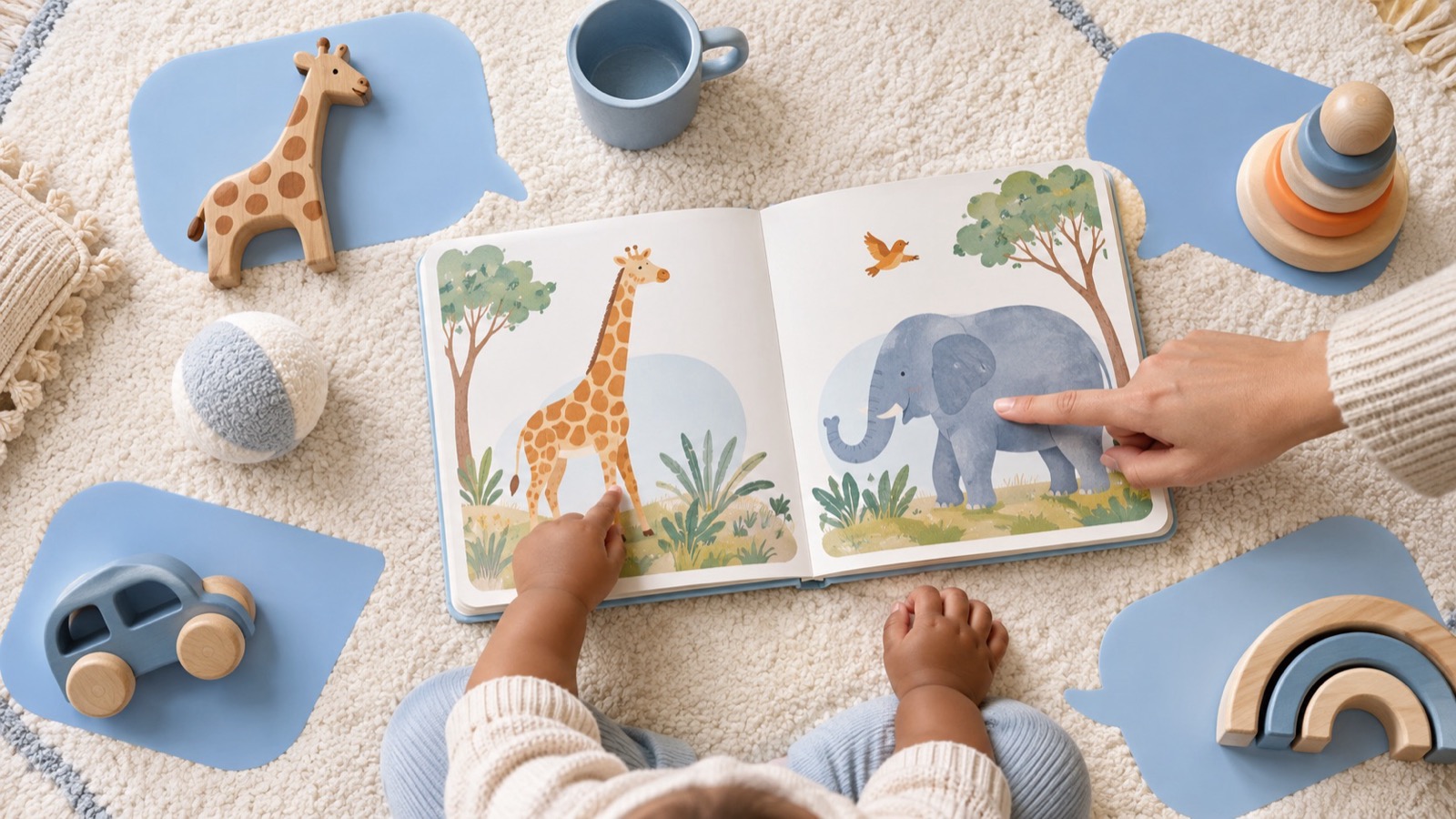
When do toddlers start talking, and what is a speech delay?
Most children say their first words around their first birthday, and put two words together by about age two.[5][6][7] The normal range is wide, though, and late talking is common. A "late talker" understands well and is developing normally, but is slow to speak.[12][13] Many catch up on their own, and some need extra help.
You cannot diagnose this at home, and you do not need to. If your toddler is behind the guide below, or you are worried for any reason, speak to your health visitor or GP. They can arrange speech and language therapy and a hearing test.[1][10] This guide explains what talking looks like at each age, the signs worth checking, and simple things that genuinely help. One thing to say straight away: being bilingual does not cause a speech delay.[11]
When to speak to your health visitor or GP (and ask about a hearing test)
Children learn to talk at different speeds, so try not to measure your child against others.[1][9] Even so, it is always fine to get things checked. Speak to your health visitor or GP if your toddler:
- does not turn towards sounds, everyday noises or their name, or you have any worry about their hearing[5][10]
- is not babbling with tuneful strings of sounds by around 12 to 15 months[6]
- has not said their first words by 18 months[6]
- is not putting two words together by about 2 years, or is saying fewer than around 25 clear words at 2[7]
- does not seem to understand simple words or instructions for their age[6][9]
- loses words or skills they used to have, at any age[9][13]
- is very hard to understand, or you are worried for any other reason[1][9]
These signs do not mean something is definitely wrong. Many late talkers catch up.[12] But getting checked early is one of the kindest things you can do. Your GP or health visitor can refer your child for speech and language therapy, and in most areas you can refer your child yourself too.[1] Ask about a hearing test as well, because even mild or come-and-go hearing loss can make it harder for a child to pick up talking.[10][12]
How do toddlers learn to talk?
Talking is not a single skill that switches on one day. It is a stack of skills that build quietly for months before the first word arrives. Knowing the order can take a lot of the worry away.
First comes listening and understanding. Long before your toddler can say "teddy", they can turn to find one when you ask "where's teddy?"[6] This hidden understanding, what specialists call receptive language, almost always runs ahead of talking. So a quiet toddler who clearly follows what you say is often doing better than they seem.
Next come sounds and gestures. Babbling in tuneful strings, like "ba-ba" and "na-na", is early practice for speech.[5] Pointing matters just as much. When a baby points at a dog to share it with you, that is language in action, even without a word attached.[5] Waving, reaching and pointing are all good signs that talking is on its way.
Then the first words appear, usually around the first birthday, often names for the people and things a child loves most.[5] Words come slowly at first, then gather pace. Two-word phrases like "more juice" tend to arrive around the second birthday, once a child has roughly 50 words to draw on.[7]
Through all of this, the range of normal is huge. If late talking is your worry, you are far from alone. Speech and Language UK estimates that around two million children in the UK are struggling with talking and understanding words.[14] Most late talkers are simply taking the scenic route to the same place.
Does being bilingual cause a speech delay?
No. This is one of the most common worries, and it is a myth. As NHS speech and language services put it plainly, "There is no evidence that bilingual children have delayed speech or find it harder to communicate."[11] Growing up with more than one language is an advantage, and it helps rather than harms your child's English.[1]
Here is the part that reassures most parents. A bilingual child's vocabulary in each single language may look a little smaller. But their total vocabulary across both languages is at least the same as a child with one language.[11] They are learning more, not less.
So keep speaking the language that feels natural to you. The important thing is simply to chat with your child in whatever language feels comfortable, at home and out and about.[1] If a bilingual child does turn out to be a late talker, it is not because of the two languages. They need the same checks and support as any other child.[11]
What are typical talking milestones by age?
Use this as a gentle guide, never a scoreboard. Children develop these skills at different rates, and most who start slowly still catch up.[5][7] The "worth a chat" column lists signs that make it sensible to speak to your health visitor, not proof that anything is wrong.
| Age | What many children are doing | Worth a chat with your health visitor if |
|---|---|---|
| By around 12 months | Turns when you speak or their name is called; babbles strings of sounds like "na-na"; understands a few familiar words such as "bye-bye"; points to get your attention; may say one or two unclear first words like "mama"[5] | They do not respond to sounds or noises by 9 months, or are not pointing to things they want by their first birthday[5] |
| By 18 months | Understands far more than they can say, including names of everyday things; follows simple instructions like "kiss Mummy"; says up to about 20 single words, even if unclear; points to ask and to show you things[6] | They are not babbling by 12 to 15 months, have not said their first words by 18 months, or do not seem to understand some of what you say[6] |
| By 2 years | Understands at least 200 words; says 50 or more single words; starts joining two words together such as "more juice"; you can usually understand them about half the time[7] | They are saying fewer than around 25 clear words, or are not yet putting two words together[7] |
| By 3 years | Understands hundreds of words; uses short sentences of three to five words; asks lots of questions; is understood by family most of the time[8][9] | They mostly use single words rather than joining them, are very hard to understand, or struggle to follow simple instructions[8] |
Around the first year. Most one-year-olds are keen listeners. They turn to a voice across the room, look at you when their name is called, and babble long runs of sounds.[5] First words often land near the first birthday, and they will not be crisp at first. That is exactly right.
The second year. This is when many children look like "late talkers", and it is the most common time to worry. By 18 months a lot of toddlers say only a handful of words but understand plenty.[6] By two, words usually multiply and start pairing up, like "daddy gone".[3][7] Being understood only about half the time at this age is normal, not a problem.[7]
The third year. Between two and three, talking often takes off. Sentences stretch to three, four or five words, questions arrive in a flood, and strangers start to understand more of what your child says.[8][9] If your child is still mainly using single words at three, or is hard to follow, it is worth a chat.[8]
How can I help my toddler talk?
You do not need flashcards, apps or special toys. The best thing for talking is warm, everyday chat. Here are simple, evidence-based ways to help, straight from NHS guidance.
- Get face to face and narrate the day. Hold your child close, get down to their level, and talk about what you are both doing as you feed, bath and play.[1] Name and point to things you can see, for example "Look, a cat", then add detail as they grow, like "Look, a black cat".[1]
- Follow their lead, and comment more than you question. Watch what your child is interested in, then put words to it. Speech and language therapists suggest following your child's lead, commenting on what they are doing, and adding on a word, rather than firing off questions.[12] If they say "car", you say "fast car".
- Repeat and gently expand, do not correct. If your toddler points and says "Ca!", reply warmly, "Yes, it is a cat."[1] When they say "sock off", you say "yes, we are taking your sock off".[1] Do not tell them off for getting words wrong. Modelling the right word is enough.
- Share books and sing every day. Look at books together, even if you just talk about the pictures rather than reading the words.[1] Shared reading is a brilliant way to build language.[12] Sing nursery rhymes with actions, like "Wind the bobbin up", because the actions help your child remember the words.[1]
- Take turns, and leave gaps. Copy the sounds your baby makes back to them, so talking feels like a game of tennis.[1] Play "peek-a-boo" and similar games, which teach turn-taking, attention and listening.[1] Pause after you speak, and give your child time to answer.
- Cut the background noise. Switch off the television and radio when you are together, because background noise makes it harder for your child to listen to you.[1] And limit screen time. Playing and listening to stories helps talking far more than a screen does.[1] The NHS suggests avoiding screens for under-twos, and no more than an hour a day for children aged two to five.[2][4]
- Rest the dummy during the day. It is hard to learn to talk with a dummy in the mouth. So the NHS advises offering it only at sleep time, and stopping dummies completely by around 12 months.[1]
Good to know: talking grows from connection, not pressure
You cannot force a first word, and you do not need to drill your child. Little and often beats any formal lesson. These ordinary moments are where language grows: a running commentary at the shops, a silly rhyme in the bath, a shared book at bedtime.[1] If some days you are too tired for any of it, that is fine too. Tomorrow is another chance.
When is it more than just late talking?
Most late talkers are healthy children who simply start speaking later, and they catch up.[12] A smaller number have a speech, language or hearing difficulty that benefits from support. You do not have to work out which is which. That is exactly what your health visitor, GP and a speech and language therapist are for.
Always get hearing checked. A child who cannot hear clearly cannot easily learn to talk. Even mild or fluctuating hearing loss can hold speech back.[12] For any child with a significant communication concern, a hearing assessment should be considered, so ask your GP or health visitor to arrange one.[10][12]
Watch for going backwards. Losing words or skills a child once had is the one sign to act on quickly, at any age.[9] A child who used to babble, point or say words and has stopped should be seen without waiting.[13]
Look at the whole picture, not just words. Talking is only one part of communicating. It is reassuring when a quiet toddler still points to share things, brings you toys, makes eye contact and joins in games.[5] If your child rarely does these things, is not responding to their name, or is losing skills, mention it early. In the UK, children can be referred to speech and language therapy from age two for concerns about talking or understanding.[10]
Getting help is straightforward. Your child is offered development reviews at around 12 months and again at about two and a half years. Both are good moments to raise any worry.[2][4] You do not have to wait for one though. Speak to your health visitor or GP whenever you feel unsure, or refer your child to speech and language therapy yourself.[1] Early help is easier help.
Frequently asked questions
What age should my toddler say their first words? Most children say a first clear word or two around their first birthday, though anywhere in the months either side is normal.[5] Early words are usually unclear, like "mama" or "dada", and that is fine. If there are no words at all by 18 months, have a chat with your health visitor.[6]
My toddler understands everything but barely talks. Is that normal? Often, yes. Understanding almost always runs ahead of talking, and a child who clearly follows what you say has the foundation in place.[6] This pattern is typical of many late talkers who go on to catch up. It is still worth mentioning at your child's review, so someone can keep an eye on it with you.[4]
Is it normal for a 2 year old to only say a few words? By two, many children say 50 or more words and begin joining two together, and you can usually understand them about half the time.[7] A two-year-old with fewer than around 25 clear words, or who is not yet pairing words, is worth a conversation with your health visitor.[7] That does not mean anything is wrong. It means a professional can help you support their talking.
Can too much screen time cause late talking? Screens are no substitute for chat, and background telly makes it harder for a child to listen and learn words.[1] The NHS suggests avoiding screens for under-twos, and capping them at about an hour a day from age two to five.[2][4] Swapping some screen time for talking, singing and books is one of the easiest wins there is.
Should I correct my toddler when they say a word wrong? No need to correct or criticise. Instead, say the word back correctly and warmly. If they point and say "Ca!", you reply "Yes, it is a cat".[1] Your child hears the right version without feeling they got it wrong, which keeps talking fun.
Do late talkers catch up, or will my child need speech therapy? Many late talkers catch up with everyday support at home.[12] Some benefit from speech and language therapy, especially if understanding is affected, hearing is a question, or skills are slipping.[10][13] Getting assessed does not commit you to anything. It simply gives you a clear picture and a plan.
How do I get my child seen by a speech and language therapist? Start with your health visitor or GP, who can refer your child. In most areas you can also refer your child to speech and language therapy yourself.[1][10] Ask for a hearing test at the same time.[10] Bringing a few notes about what your child understands and says makes that first appointment much easier.
How Tiny Timeline can help
When you are living it day to day, it is genuinely hard to tell whether talking is moving forward. A shy fortnight can feel like a standstill. Tiny Timeline lets you jot down the little wins as they happen, so you can see the slow, real progress you would otherwise miss.
Log first words and new milestones with a quick tap, and add the date a sound, a wave or a two-word phrase first appeared. Over a few weeks, you see how your toddler's words are growing. That is far more reassuring than trying to hold it all in your tired memory. It also turns a vague "they do not say much" into something concrete.
That record is quietly useful when you see your health visitor or a speech and language therapist. Instead of guessing on the spot, you can show roughly how many words your child uses and understands, and when things changed. Because the family view is shared, both parents and carers can add the words they hear too. The aim is simple: less worrying from memory, and a clearer story for the people who can help.
Key takeaways
- The range of normal is wide. First words usually come around 12 months, and two-word phrases around two years, but children vary a lot and many late talkers catch up.[5][7][12]
- Understanding comes before talking. A quiet toddler who follows what you say has the foundation in place.[6]
- Being bilingual does not cause a speech delay. Two languages are an advantage, and your child's total vocabulary is at least the same.[11]
- Know the signs worth checking. No first words by 18 months, no two-word phrases by 2 years, not responding to sounds or their name, or losing words or skills at any age.[6][7][9]
- Always ask about hearing. Even mild or fluctuating hearing loss can hold talking back, so request a hearing test alongside any speech concern.[10][12]
- Everyday chat is the therapy. Narrate, follow their lead, read, sing, rest the dummy by day and turn off background screens.[1][12]
- Getting help is easy and early help is best. Speak to your health visitor or GP, or self-refer to speech and language therapy. No one will think you are overreacting.[1][10]
How Tiny Timeline can help
Jotting down first words and new milestones in Tiny Timeline helps you see your toddler's language slowly growing, instead of second-guessing it from memory. It gives you a clear, shareable picture for your health visitor or speech and language therapist, and the shared family view lets both parents add the words they hear too. Tiny Timeline is a baby tracker, not a medical device, and nothing here replaces advice from your GP or health visitor.
References
- NHS - Help your baby learn to talk. https://www.nhs.uk/baby/babys-development/play-and-learning/help-your-baby-learn-to-talk/
- NHS Start for Life - Learning to talk: listening and learning 6 to 12 months. https://www.nhs.uk/best-start-in-life/baby/learning-to-talk/listening-and-learning-6-to-12-months/
- NHS Start for Life - Learning to talk: first words and little sentences 1 to 2 years. https://www.nhs.uk/best-start-in-life/toddler/learning-to-talk/first-words-and-little-sentences-1-to-2-years/
- NHS Start for Life - Learning to talk: chatting and building sentences 2 to 3 years. https://www.nhs.uk/best-start-in-life/toddler/learning-to-talk/chatting-and-building-sentences-2-to-3-years/
- Speech and Language UK - Ages and stages: 6 to 12 months. https://speechandlanguage.org.uk/help-for-families/ages-and-stages/6-12-months/
- Speech and Language UK - Ages and stages: 12 to 18 months. https://speechandlanguage.org.uk/help-for-families/ages-and-stages/12-18-months/
- Speech and Language UK - Ages and stages: 18 to 24 months. https://speechandlanguage.org.uk/help-for-families/ages-and-stages/18-24-months/
- Speech and Language UK - Ages and stages: 2 to 3 years. https://speechandlanguage.org.uk/help-for-families/ages-and-stages/2-3-years/
- Healthier Together (NHS) - Communicating skills: 1 to 3 years. https://sybhealthiertogether.nhs.uk/parentscarers/your-childs-development/communicating-skills/1-3-years
- Newcastle Hospitals NHS - Children's speech and language therapy: referral guidelines. https://www.newcastle-hospitals.nhs.uk/services/speech-and-language-therapy/childrens-speech-and-language-therapy/referral-guidelines/
- Cambridgeshire and Peterborough NHS - Bilingualism. https://www.cambspborochildrenshealth.nhs.uk/speech-language-and-communication/bilingualism/
- Cambridgeshire and Peterborough NHS (CPFT) - Late talkers: how to help your child. https://www.cpft.nhs.uk/speech-and-language-therapy-late-talkers/
- Speech and language delay in children: a practical framework (Singapore Medical Journal, 2023). https://pmc.ncbi.nlm.nih.gov/articles/PMC10775292/
- Speech and Language UK - The issue (scale of speech and language challenges in the UK). https://speechandlanguage.org.uk/the-issue/