 Tiny Timeline
Baby-led weaning vs purees: which is right for your baby?
Trying to decide between baby-led weaning and purees? Neither is 'better', and plenty of UK families happily mix the two. Here is what each approach really means, what the evidence does and does not show, and how to pick what suits your baby and your family.
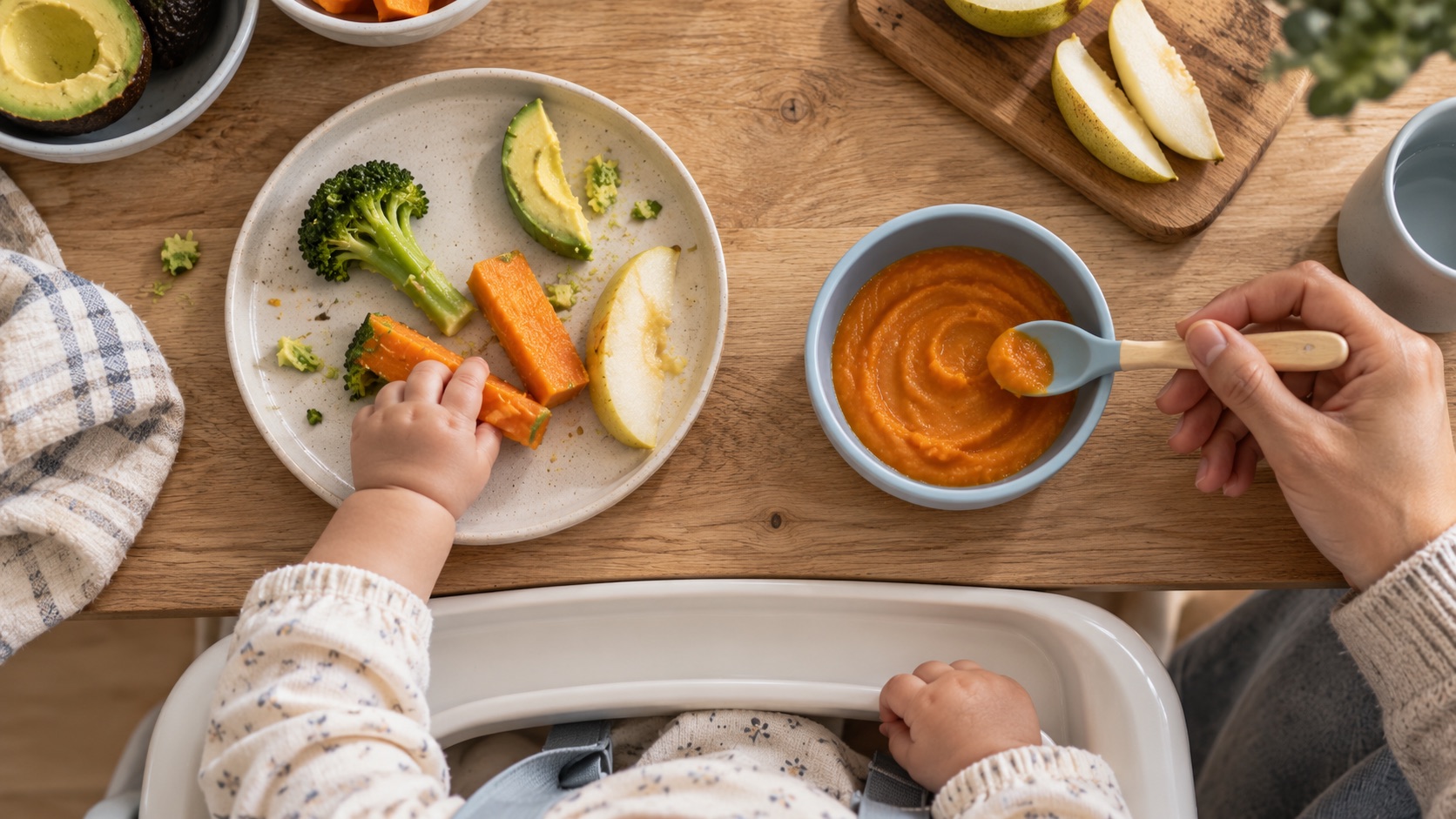
What do we mean by baby-led weaning vs purées?
When you start weaning at around 6 months, you will meet two familiar styles: purées (spoon-feeding) and baby-led weaning. The question of baby led weaning vs purées comes up in almost every parent group, and it helps to know that UK guidance does not tell you to pick one. As the NHS puts it, "some parents prefer baby-led weaning to spoon feeding, while others do a combination of both", and "there's no right or wrong way".[1] The British Nutrition Foundation agrees there is "no one way to introduce solid foods to your baby".[5]
Both share the same ground rules: start at around 6 months, offer iron-rich foods, and build up a variety of tastes and textures while keeping mealtimes safe.[1][3][6] The difference is how the food arrives, on a spoon from you or in your baby's own hand.
What does baby-led weaning involve?
Baby-led weaning (often shortened to BLW) means "giving your baby only finger foods and letting them feed themselves from the start instead of feeding them puréed or mashed food on a spoon".[1] The British Nutrition Foundation describes it as an approach where "the emphasis is on your baby feeding themselves with finger-sized pieces of family foods from the start", so "you do not need to spoon-feed them pureed or mashed foods".[5]
In its purest form, as First Steps Nutrition Trust explains, "food is not given to the baby on a spoon at all", and instead "babies are encouraged to explore for themselves all the food on offer to them and to eat whatever they can get into their mouths independently".[4] Many babies signal they are ready for this by taking an interest in holding food and moving it to their own mouth.[4]
Supporters point to a few possible benefits. First Steps summarises the thinking: that spoon-fed babies "may be given more to eat than they would choose", that "spoon-feeding purées delays the experience of chewing", that "babies fed food they dislike on a spoon may become fussy eaters", and that "allowing full independence in eating encourages the development of a range of motor skills".[4] These are common reasons people choose BLW, though the evidence behind some is mixed.
What does spoon-feeding purées involve?
Spoon-feeding, sometimes called traditional or purée weaning, means offering smooth or mashed food on a spoon and gradually building up textures. The NHS suggests starting with single vegetables and fruits, such as "mashed or soft, cooked sticks of parsnip, broccoli, potato, yam, sweet potato, carrot, apple or pear", and beginning with less sweet vegetables like "broccoli, cauliflower and spinach".[1][3]
Purées are not meant to last long. First Steps notes that offering "smooth or mashed food on a spoon may be useful to get them accustomed to new textures and tastes", especially for a baby who needs a little more encouragement to get started.[4] Good spoon-feeding is responsive rather than a race. The same guide advises that if "you are offering a baby food on a spoon, sit opposite or close by and make eye contact", so "you can follow the baby's cues on when they are ready for the next spoonful".[4]
Spoon-feeding and self-feeding are not opposites, either. Even within a purée approach, the NHS suggests you "give your baby a spoon and let them try feeding themselves", and "try moving on to mashed and finger foods (from purées or blended) as soon as they're ready".[3]
What are the pros and cons of each approach?
Each style has practical upsides and trade-offs. None makes one method "right"; they are simply things families weigh up.
Baby-led weaning lets your baby practise self-feeding, chewing and hand skills from day one, and it is easy to offer the same family foods everyone else is eating.[4][5] The trade-offs are that it can be "a messy time", it is harder to judge how much has actually gone in, and early meals may take longer while your baby's self-feeding skills are still developing.[4]
Purées make it easier to see how much your baby has eaten and to introduce "a wide range of tastes" quickly, which can be reassuring in the early weeks.[4] The trade-offs, according to those who favour BLW, are that spoon-feeding may delay chewing and self-feeding a little, and that it is possible to offer more than a baby would choose; both are easily avoided by watching your baby's cues and moving on to lumps and finger foods promptly.[3][4]
| Aspect | Baby-led weaning | Purées (spoon-feeding) |
|---|---|---|
| How food is offered | Baby picks up finger foods and feeds themselves | You offer smooth or mashed food on a spoon |
| Usual starting texture | Soft finger foods from the start | Smooth or blended, moving on to lumps |
| Self-feeding skills | Practised from the very beginning | Added as you offer a spoon and finger foods |
| Judging how much is eaten | Harder early on; more may be dropped | Easier to see the amount taken |
| Mess | Usually more | Usually less |
| Iron and nutrients | Offer iron-rich finger foods on purpose | Include iron-rich foods in the purée |
| Choking safety | Supervise; offer safe soft shapes | Supervise; gagging can still happen |
| Can you combine them? | Yes. Mixing spoon-fed purée and soft finger foods is common and encouraged[1][4][5] | |
What does the evidence show about choking, iron and fussy eating?
Three worries come up again and again in the baby led weaning vs purées debate: choking, iron, and fussy eating. Here is what UK guidance says, and where it is honest about what is not yet settled.
Choking
This is the biggest fear for many parents, and the reassuring news is that letting your baby feed themselves does not appear to raise the risk. First Steps Nutrition Trust states plainly: "The risk of choking when babies feed themselves is no different to the risk when they are fed by spoon".[4] That said, choking is possible with any method, which is why the safety steps below matter whichever way you feed. Gagging, which looks alarming but is normal, happens on both purées and finger foods, and is not the same as choking.[2]
Iron
From around 6 months, your baby's iron stores begin to run low, so iron from food becomes important on either approach. SACN, the UK government's expert nutrition committee, advises that "a wide range of solid foods, including foods containing iron, should be introduced from around 6 months of age".[6] Good sources include "meat, fish, fortified breakfast cereals, dark green vegetables, beans and lentils", and, as the British Nutrition Foundation lists, "red meat ... pulses, such as beans and lentils; tofu; green leafy vegetables".[1][5] The practical point is that iron needs a little thought in baby-led weaning, because soft, iron-rich finger foods take planning. First Steps notes that if a baby is "less independent in their eating, offering foods on a spoon at mealtimes as well can be encouraged ... to ensure that they eat well and get all the nutrients they need".[4]
Fussy eating
You may read that baby-led weaning prevents fussy eating. It is fairer to say this is a suggested benefit rather than a settled fact. First Steps lists the idea that "babies fed food they dislike on a spoon may become fussy eaters" among the things that are "suggested", not proven.[4] What is clearer is that variety and repetition help. SACN says first foods "should have different textures and flavours and may need to be tried several times before the infant accepts them".[6] Offering lots of tastes, and not giving up after one rejection, matters more than the method you choose.
Can you combine baby-led weaning and purées?
Yes, and it is one of the most reassuring things to know. You do not have to choose baby led weaning or purees and stick to it. The British Nutrition Foundation says you "can move from smooth purees and mashed foods to lumpier foods alongside soft finger foods", and the NHS explicitly lists doing "a combination of both" as a normal choice.[1][5]
First Steps describes exactly how this looks in practice: "some babies will happily eat finger foods and mashed foods", while "other babies may progress more slowly and start off on smooth foods given on a spoon alongside foods they can hold themselves", moving on to more textures "as they become more confident eaters".[4] The same guide points out that "most infants are introduced to complementary foods both by being offered small tastes of new foods on a spoon, and by being encouraged to hold foods that they can taste themselves".[4] A spoon of purée and a soft finger food on the same tray is a perfectly good meal.
Good to know
You do not have to decide today, or forever. Many families lean one way, then adjust to suit the baby in front of them, offering more finger foods on some days and a loaded spoon on others. Whatever the mix, keep including iron-rich foods and a range of tastes and textures from around 6 months.[4][6]
How do you keep mealtimes safe with either method?
The safety rules are the same for purées and baby-led weaning. First, always stay with your baby while they eat. Both the NHS and the British Nutrition Foundation are clear: "always stay with your baby when they're eating in case they start to choke".[1][5] Second, sit your baby upright. Your baby "needs to be sitting safely in an upright position (so they can swallow properly)", well supported, "such as in a highchair".[1][5] Never feed a baby who is lying back, slumped, or in a moving car seat or bouncer.
Gagging and choking are not the same
Gagging is common and normal as babies learn to move food around their mouth. It is the body's way of pushing food forward, and, crucially, "gagging is loud".[2] When a baby gags, "their eyes may water", "they might push their tongue forward (or out of their mouth)", and they "might make a retching movement, or they may vomit".[2] A gagging baby is usually sorting it out themselves, so try to stay calm and let them.
Choking is different, and it is quiet. The NHS warns that "choking is quiet", so a choking baby cannot make much noise.[2] Colour changes can be hard to spot, and the NHS spells this out for every skin tone: "if your child has white skin, it may begin to look blue (cyanosis) when they're choking. If they have brown or black skin, their gums, inside their lips, or their fingernails may begin to look blue".[2] Checking the lips, gums and fingernails is useful whatever your baby's skin colour.
If your baby is choking, act at once
Remember, serious choking is usually silent. If your baby cannot cry, cough or breathe, the NHS says to "shout for help", "get them out of the high chair", and "support their chest and chin with one hand and, with the heel of your hand, give 5 sharp blows between the shoulder blades".[2] If the blockage does not clear, call 999 straight away.[7] Because seconds count, it is well worth learning infant first aid before you start weaning.
Safe finger-food shapes for either approach
Whether your baby self-feeds or you add finger foods to a purée meal, the same shaping rules apply. Offer "a range of small, finger-sized pieces of food" that are "big enough so that when your baby grasps them, some of the food remains sticking out from their fist".[3][5] Then reduce the classic hazards:
- Cut small, round foods up. "Cut small, round foods, like grapes and cherry tomatoes, into quarters (4 small pieces)", and never offer them whole.[1][5]
- Soften hard foods. "Avoid hard foods like whole nuts, or raw carrot or apple"; cook or grate hard fruit and vegetables until they are soft.[1]
- Remove hard bits. Take out pips, stones and bones before serving.[1]
- Stay close and watch. "Always stay with babies and young children when they are eating and watch that they don't get into difficulty with any pieces of food they bite off".[4]
How do you choose what suits your family?
Because neither method is better, the best one is usually the one you can do calmly and consistently. A few things can tip the balance:
- Your baby's temperament. First Steps notes that "some babies will be ready and eager to hold food, feed themselves and enjoy a variety of foods of different textures from 6 months", while others "may need more encouragement to start on solid food", where "offering smooth or mashed food on a spoon may be useful".[4]
- Your own confidence. If self-feeding makes you anxious, starting with responsive spoon-feeding and adding finger foods is completely valid, and vice versa.
- Family routines. Baby-led weaning fits naturally with eating together at family mealtimes; purées can be handy when you want to know exactly what has gone in.
- Iron and variety. Whichever you pick, plan for iron-rich foods and a wide range of textures and flavours from around 6 months.[1][6]
If you are unsure, remember that a "combination of both" is not a compromise or a failure. It is simply how most babies end up being fed.[1][4]
When should you get advice or urgent help?
Speak to a health professional if...
Weaning is usually straightforward, but ask your health visitor or GP for advice if:
- your baby cannot move on from smooth purées to lumps and finger foods over time, or seems to gag very often;
- you are worried your baby is not getting enough to eat, is not gaining weight, or you are concerned they are not getting enough iron;
- your baby was born prematurely or has a medical condition, so the right time and approach may need to be tailored to them.
And remember: if your baby is choking and back blows do not clear it, or they cannot breathe, call 999 straight away.[7] If you are ever worried about your baby between times, contact your GP or health visitor, or call NHS 111.[7]
Frequently asked questions
Is baby-led weaning safer or more dangerous than purées? Neither. UK guidance does not rank one above the other, and First Steps Nutrition Trust says: "The risk of choking when babies feed themselves is no different to the risk when they are fed by spoon".[4] The safety steps, staying with your baby, sitting them upright and preparing foods well, matter on both approaches.[1][2][5]
Do I have to choose between baby led weaning or purees? No. The NHS lists "a combination of both" as a normal option, and the British Nutrition Foundation says there is "no one way to introduce solid foods to your baby".[1][5] Many families offer a spoon of purée and a soft finger food at the same meal.
Will my baby get enough iron with baby-led weaning? They can, but it takes planning. Offer iron-rich foods such as meat, fish, well-cooked eggs, beans, lentils and dark green vegetables from around 6 months, and add some spoon-fed foods too if your baby is eating very little.[1][4][6]
My baby gagged on a finger food, should I stop? Not necessarily. Gagging is loud and normal as babies learn, and the baby often clears the food themselves.[2] Choking, by contrast, is quiet. If your baby cannot make a noise or breathe, treat it as an emergency, give back blows, and call 999.[2][7]
Does baby-led weaning stop fussy eating? The evidence is not that strong. It is a suggested benefit rather than a proven one.[4] Offering "different textures and flavours", and trying foods "several times", helps more than the method itself.[6]
Which should I start with at 6 months? Either, or both. Let your baby's readiness and your confidence guide you: some babies grab finger foods eagerly, others take to a spoon first, and you can move between the two.[3][4]
Key takeaways
- In the baby led weaning vs purées choice, neither is better. UK guidance says there is "no right or wrong way", and "a combination of both" is normal.[1][5]
- Baby-led weaning means letting your baby feed themselves finger-sized foods; purées mean spoon-feeding smooth or mashed food and building up textures.[1][5]
- On the evidence, self-feeding carries no greater choking risk, iron needs planning either way, and BLW preventing fussy eating is suggested, not proven.[4][6]
- The safety rules are identical: stay with your baby, sit them upright, and offer safe finger-food shapes with no small round foods.[1][2][5]
- Gagging is loud and normal; choking is quiet. Check the lips, gums and fingernails for colour change on any skin tone, and call 999 for a choking emergency.[2][7]
- You can combine both and change your mind. Include iron-rich foods and plenty of variety from around 6 months whichever you choose.[4][6]
How Tiny Timeline can help
Whether you spoon-feed, go baby-led or mix both, logging what your baby tried and when makes it easier to spot favourites and notice anything that seems to disagree with them. Tiny Timeline is a baby tracker, not a medical device, and nothing here replaces advice from your GP or health visitor.
References
- NHS – Your baby's first solid foods. https://www.nhs.uk/conditions/baby/weaning-and-feeding/babys-first-solid-foods/ (accessed Sep 2026)
- NHS Start for Life – Safe weaning: choking and gagging. https://www.nhs.uk/start-for-life/baby/weaning/safe-weaning/ (accessed Sep 2026)
- NHS Start for Life – What to feed your baby: from around 6 months. https://www.nhs.uk/start-for-life/baby/weaning/what-to-feed-your-baby/from-around-6-months/ (accessed Sep 2026)
- First Steps Nutrition Trust – Eating well: the first year. https://static1.squarespace.com/static/59f75004f09ca48694070f3b/t/6399bc0f662238394803e28d/1671019543599/Eating+well+the+first+year+enlivened+for+web+14+Dec.pdf (accessed Sep 2026)
- British Nutrition Foundation – Introducing solid foods to your baby. https://www.nutrition.org.uk/nutrition-for/baby/introducing-solid-foods-to-your-baby/ (accessed Sep 2026)
- Scientific Advisory Committee on Nutrition (SACN) / GOV.UK – Feeding in the first year of life report. https://www.gov.uk/government/news/sacn-publishes-feeding-in-the-first-year-of-life-report (accessed Sep 2026)
- NHS – How to stop a child from choking. https://www.nhs.uk/baby/first-aid-and-safety/first-aid/how-to-stop-a-child-from-choking/ (accessed September 2026)