 Tiny Timeline
A simple weaning schedule: meals, milk and how much to offer
Wondering how many meals, how much milk and how much food your baby actually needs? This gentle, evidence-based guide shows how meals build from one a day to three across the first year, and how milk feeds fit alongside. It is a flexible map to follow at your baby's pace, not a rota to obey.
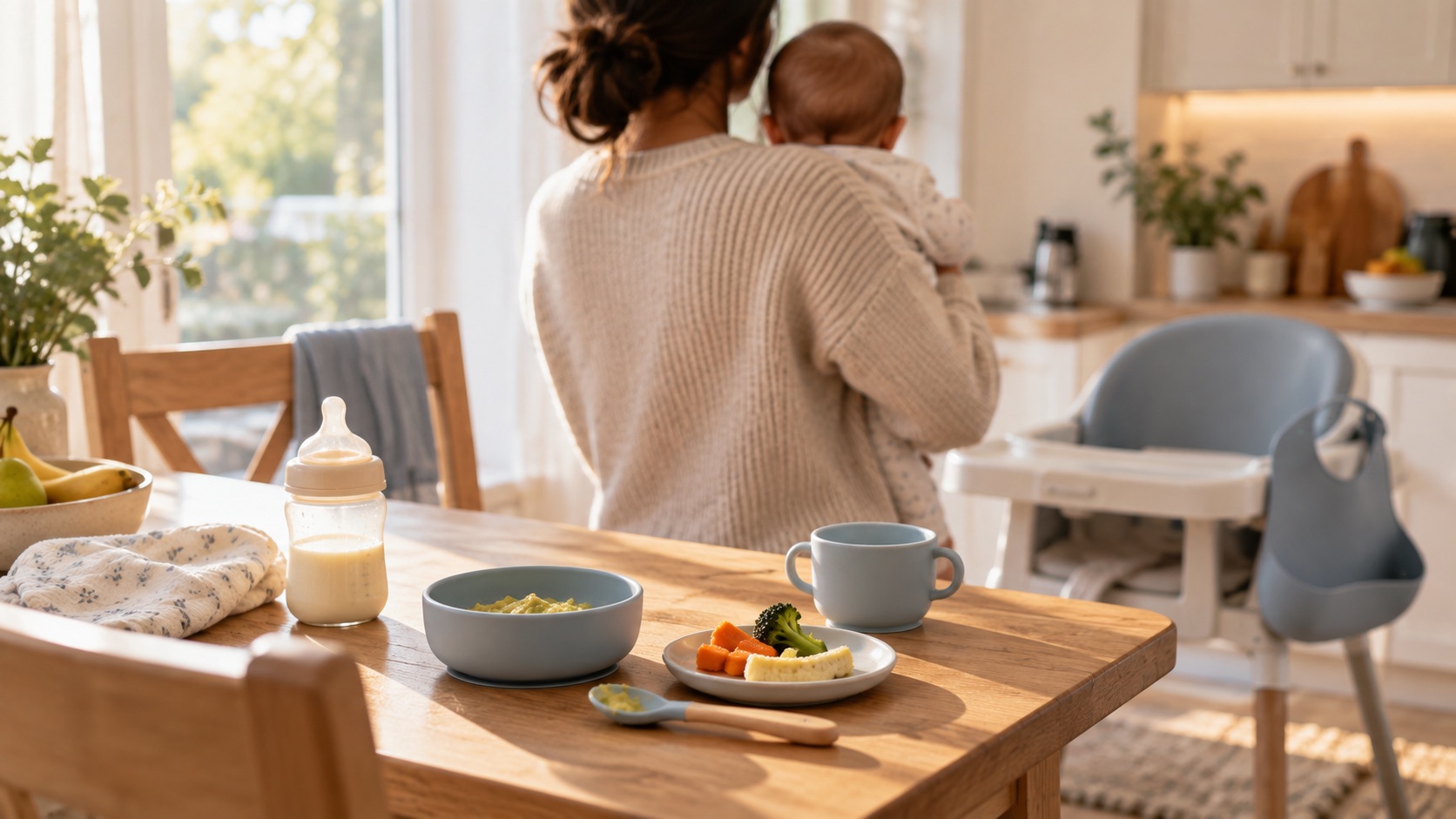
A weaning schedule is simply a rough shape for your baby's day: how many meals to offer, how milk feeds fit around them, and roughly how much food to put in front of your baby. It is a flexible guide rather than a rule, and every baby moves through it at their own pace.
Is there one right weaning schedule?
No. There is no single timetable that every baby has to follow. In the early days the NHS keeps it deliberately loose: "To start with, your baby only needs a small amount of solid food, once a day, at a time that suits you both."[2] What matters far more than the clock is that you follow your baby's cues and build up gradually.
Over the first year, two things happen slowly and steadily: meals build up from one a day towards three, and milk feeds gradually reduce as solid food fills more of the gap.[1][7] The ages below are signposts, not deadlines. A baby feeding schedule at 6 months looks very different from one at 11 months, and that is exactly how it should be.
Good to know
For the whole of the first year, milk stays the star of the show. While solids are being introduced your baby will "still be getting most of their energy and nutrients from breast milk or infant formula."[1] Solid food is added alongside milk, not swapped in for it.
How do meals build up from one a day to three?
Weaning starts small. When your baby is around 6 months old, offer one meal a day, whenever it suits you both.[2] As the NHS says, "when they first start having solid foods, babies do not need 3 meals a day."[1] The first few weeks are about getting used to tastes and textures, not filling your baby up.
From there, meals build up naturally. The NHS explains that "from about 7 months, your baby will gradually move towards eating 3 meals a day (breakfast, lunch and tea), in addition to their usual milk feeds, which may be around 4 a day."[1] Most babies pass through a stage of two meals a day on the way. The British Nutrition Foundation frames the same journey simply: "offer small amounts of food and gradually increase the amount, so by 9 to 12 months your baby is eating 3 healthy meals a day."[6]
By around 10 months, three meals is the norm. The NHS says "from about 10 months, your baby should be having 3 meals a day (breakfast, lunch and tea), in addition to their usual milk feeds."[1] At this stage "lunch and tea can include a main course and a pudding (such as fruit or unsweetened yoghurt)."[4]
What does a weaning schedule look like by age?
Here is the whole first year at a glance. Treat the milk amounts as a guide only, because appetites vary from baby to baby and from day to day.[3][7]
| Stage | Meals a day | Milk alongside | Textures |
|---|---|---|---|
| Around 6 months (first weeks) | Start with 1 meal a day | Breast milk or formula on demand, still the main source of nutrition | Smooth or mashed, moving on to soft finger foods |
| About 7 to 9 months | Building up towards 3 meals (breakfast, lunch, tea) | Milk still the main drink, roughly 4 feeds a day[1]; formula around 600ml | Mashed and lumpy foods, plus soft finger foods |
| About 10 to 12 months | 3 meals a day, with a main and a pudding at lunch and tea | Often down to about 3 milk feeds; formula around 400ml | Mashed, lumpy, chopped and finger foods |
A flexible guide based on NHS and First Steps Nutrition Trust stages, not a fixed rota.
How do milk feeds fit alongside solid food?
Milk does not stop when solids start. It stays your baby's main drink throughout the first year, and you should "continue to breastfeed or give your baby first infant formula until they're at least 1 year old."[5] First Steps Nutrition Trust puts the balance plainly: "milk will provide the majority of energy (calories) and nutrients when complementary foods are first introduced."[7]
If you are breastfeeding, simply keep feeding on demand. The NHS advises you to "keep offering it to your baby on demand,"[2] and there is no need to count feeds or measure amounts. As First Steps notes, breastfed babies "will still be fed on demand or responsively," and "as food intake increases, breastmilk intake will decline" on its own.[7]
If you are formula feeding, the amount reduces as meals grow. A rough guide is around 600ml a day at 7 to 9 months,[3] dropping to around 400ml a day at 10 to 12 months.[4] Over the same period, milk feeds tend to fall from about four a day to about three.[1][4] The NHS is clear these are guides, not targets: your baby "may need around 600ml of milk a day, but just use this as a guide."[3]
Offer milk after meals, not before. Because your baby's "tummy is tiny and fills up quickly," the NHS suggests you "offer milk feeds after solids."[2] First Steps agrees: "if babies fill up on milk before meals, they may be less interested in trying new foods, so giving milk drinks after meals is recommended."[7]
One thing to hold off on: whole cows' milk can be used in cooking from around 6 months, but it should not be given as a main drink until your baby is 12 months old.[4]
How much should my baby eat?
"How much should my baby eat?" is one of the most common weaning questions, and the honest answer is: less than you might expect at first, and then whatever their appetite tells them. The NHS reminds parents that "babies have tiny tummies, so start by offering them small amounts of food (just a few pieces, or teaspoons of food)."[1]
There is no fixed portion to hit. First Steps Nutrition Trust explains that "babies will have variable appetites and energy needs and should be encouraged to eat to appetite."[7] Some days your baby will clear the tray, other days they will take a couple of spoons and stop, and both are normal. The NHS sums it up in one line: "trust your baby to eat as much or as little as they want."[2]
Your job is to decide what to offer and when; your baby's job is to decide how much of it to eat. Judge how feeding is going over a week or so, not by any single meal.
What does responsive feeding look like?
This "you offer, your baby decides" approach has a name: responsive feeding. The British Nutrition Foundation describes the idea as one where "you look out for and respond to ... your baby's signs of hunger and fullness."[6] Fed this way, babies are helped "to eat the right amounts of food," which "supports healthy growth."[6]
In practice it means watching your baby, not the plate. The NHS advises you to "go at your baby's pace and let them show you when they're hungry or full," and to "stop when your baby shows signs that they've had enough."[1] Those signs are easy to read once you know them: your baby will let you know "by firmly closing their mouth or turning their head away."[2]
Most importantly, never push. First Steps is firm on this: "babies should never be forced to eat," and they "should be allowed to go at their own pace."[7] Pressure at mealtimes tends to backfire and makes eating stressful for everyone.
What might a day of meals and milk look like?
Every family's rhythm is different, so the examples below are illustrations, not prescriptions. First Steps Nutrition Trust notes that how milk drinks "are spaced between meals will depend on the family schedule."[7]
Around 6 months (first weeks). Keep it very simple: milk feeds on demand as usual, plus one small taste of solid food once a day at a time that suits you both.[2] There is no need for a rigid timetable yet.
About 7 to 9 months. A day might look something like this example from First Steps Nutrition Trust:[7]
| Time | What to offer |
|---|---|
| On waking | Breast milk or first infant formula |
| Breakfast | Cereal, yoghurt or an egg-based breakfast, with a finger food |
| Lunch | A savoury meal and a soft finger food, water in a cup, then a milk feed |
| Tea | A savoury meal and a soft finger food, then a milk feed |
| Before bed | Breast milk or first infant formula |
About 10 to 12 months. By now three proper meals are in place, with a pudding such as fruit or unsweetened yoghurt after lunch and tea:[4][7]
| Time | What to offer |
|---|---|
| On waking | Breast milk or first infant formula |
| Breakfast | A cereal or toast-based breakfast with some fruit |
| Lunch | A savoury main course, a savoury finger food and a pudding, with water in a cup |
| Tea | A savoury main course, a finger food and some fruit |
| Before bed | Breast milk or first infant formula |
Use these as a starting point and shuffle the timings to fit your day. The shape of the day matters more than the exact hours.
Should I offer water with meals?
Yes. Once your baby is having solid foods, water becomes a helpful part of the schedule. The NHS advises you to "introduce a cup from around 6 months and offer sips of water with meals."[1] A cup at mealtimes helps wash food down and gets your baby used to drinking from a cup.
The type of cup matters for their teeth. Using "an open cup or a free-flow cup without a valve will help your baby learn to sip and is better for their teeth."[1][5] If you are breastfeeding, there is no rush before solids start, because "fully breastfed babies do not need any water until they've started eating solid foods."[5]
Keep drinks simple. For this age, the only drinks First Steps Nutrition Trust recommends are "breastmilk or an appropriate infant formula, and water."[7] There is no need for juice or squash.
Does my baby need snacks between meals?
Under the age of one, not really. The NHS is direct: "babies under 12 months do not need snacks. If you think your baby is hungry in between meals, offer extra milk feeds instead."[3] Milk is still doing the heavy lifting, so an extra feed usually meets the need.
Towards the very end of the first year, some babies do start to have small, healthy snacks alongside their three meals. The British Nutrition Foundation notes that by 9 to 12 months a baby may be eating "3 healthy meals a day, plus 2 healthy snacks if needed."[6] If you do offer a snack, keep it simple, such as soft fruit or vegetable pieces, rather than biscuits or crisps.
When should I speak to a health visitor or GP?
Weaning is usually straightforward, and mess and the odd rejected meal are all part of it. Whatever your schedule, two habits keep mealtimes safe: always "stay with your baby when they're eating in case they start to choke,"[1] and make sure your baby is "sitting safely in an upright position (so they can swallow properly)."[1]
Get advice or urgent help
Speak to your health visitor or GP, or call NHS 111, if: your baby was born prematurely and you are unsure when to start, because "if your baby was born prematurely, ask your health visitor or GP for advice on when to start introducing solid foods";[1] your baby is not putting on weight, is having fewer wet nappies, or is refusing both food and milk; or you are simply worried about how feeding is going. Trust your instincts.
It also helps to know the difference between gagging and choking. The NHS says "gagging is loud," while "choking is quiet."[8] A choking baby cannot cry or make much noise, and a blue tinge can be harder to see on brown or black skin, so also check the lips, gums and fingernails. If your baby is choking, shout for help and give firm back blows between the shoulder blades; if it does not clear, call 999.[9] It is well worth learning infant first aid before you start weaning.
Frequently asked questions
How many meals a day should my baby have while weaning? Start with one meal a day at around 6 months, build up gradually, and aim for three meals a day (breakfast, lunch and tea) by about 10 months, always alongside their usual milk.[1][6]
Do milk feeds go down once my baby starts solids? Yes, gradually. Keep breastfeeding on demand; if you use formula, a rough guide drops from around 600ml a day at 7 to 9 months to around 400ml at 10 to 12 months, and milk feeds tend to fall from about four a day to about three.[3][4] Your baby "will automatically drink less milk as their food intake increases."[7]
Should I give food or milk first? Offer solids first and the milk feed afterwards, so your baby is not too full of milk to try new foods.[2][7]
How do I know if my baby has had enough? Let them show you. Stop when your baby closes their mouth firmly or turns their head away, and never force another spoon.[1][2][7]
Can I give water instead of juice? Yes. Offer sips of water with meals from around 6 months in an open or free-flow cup; the only drinks needed in the first year are breast milk or formula and water.[1][7]
What if my baby refuses a meal? It is normal for appetite to vary and for new foods to be turned down at first. Stay relaxed, do not push, and offer the food again another day. Speak to your health visitor if your baby is refusing both food and milk or is not gaining weight.[7]
Key takeaways
- Meals build up from 1 a day at around 6 months to 3 a day by about 10 months, with milk continuing alongside.[1]
- Breastfeed on demand; if formula feeding, amounts reduce from roughly 600ml (7 to 9 months) to 400ml (10 to 12 months), about four feeds down to three.[3][4]
- Offer solids first and milk after, so milk does not fill your baby up.[2][7]
- You choose what and when; your baby chooses how much. Trust their appetite and never force a meal.[1][2][7]
- Offer sips of water with meals from around 6 months, from an open or free-flow cup.[1][5]
- It is a flexible guide, not a rule. Ask your health visitor or GP if you are worried or your baby was born prematurely.[1]
How Tiny Timeline can help
Jotting down each meal, milk feed and new food in Tiny Timeline makes it easier to see your baby's real pattern over a week and to notice anything that unsettles them. Tiny Timeline is a baby tracker, not a medical device, and nothing here replaces advice from your GP or health visitor.
References
- NHS – Your baby's first solid foods. https://www.nhs.uk/conditions/baby/weaning-and-feeding/babys-first-solid-foods/ (accessed Sep 2026)
- NHS Best Start in Life – Feeding your baby: from around 6 months. https://www.nhs.uk/best-start-in-life/baby/weaning/what-to-feed-your-baby/from-around-6-months/ (accessed Sep 2026)
- NHS Best Start in Life – Feeding your baby: 7 to 9 months. https://www.nhs.uk/best-start-in-life/baby/weaning/what-to-feed-your-baby/7-to-9-months/ (accessed Sep 2026)
- NHS Best Start in Life – Feeding your baby: 10 to 12 months. https://www.nhs.uk/best-start-in-life/baby/weaning/what-to-feed-your-baby/10-to-12-months/ (accessed Sep 2026)
- NHS – Drinks and cups for babies and young children. https://www.nhs.uk/conditions/baby/weaning-and-feeding/drinks-and-cups-for-babies-and-young-children/ (accessed Sep 2026)
- British Nutrition Foundation – Introducing solid foods to your baby. https://www.nutrition.org.uk/nutrition-for/baby/introducing-solid-foods-to-your-baby/ (accessed Sep 2026)
- First Steps Nutrition Trust – Eating well: the first year. https://static1.squarespace.com/static/59f75004f09ca48694070f3b/t/6399bc0f662238394803e28d/1671019543599/Eating+well+the+first+year+enlivened+for+web+14+Dec.pdf (accessed Sep 2026)
- NHS Best Start in Life – Safe weaning: choking and gagging. https://www.nhs.uk/best-start-in-life/baby/weaning/safe-weaning/ (accessed Sep 2026)
- NHS – How to stop a child from choking. https://www.nhs.uk/baby/first-aid-and-safety/first-aid/how-to-stop-a-child-from-choking/ (accessed September 2026)